
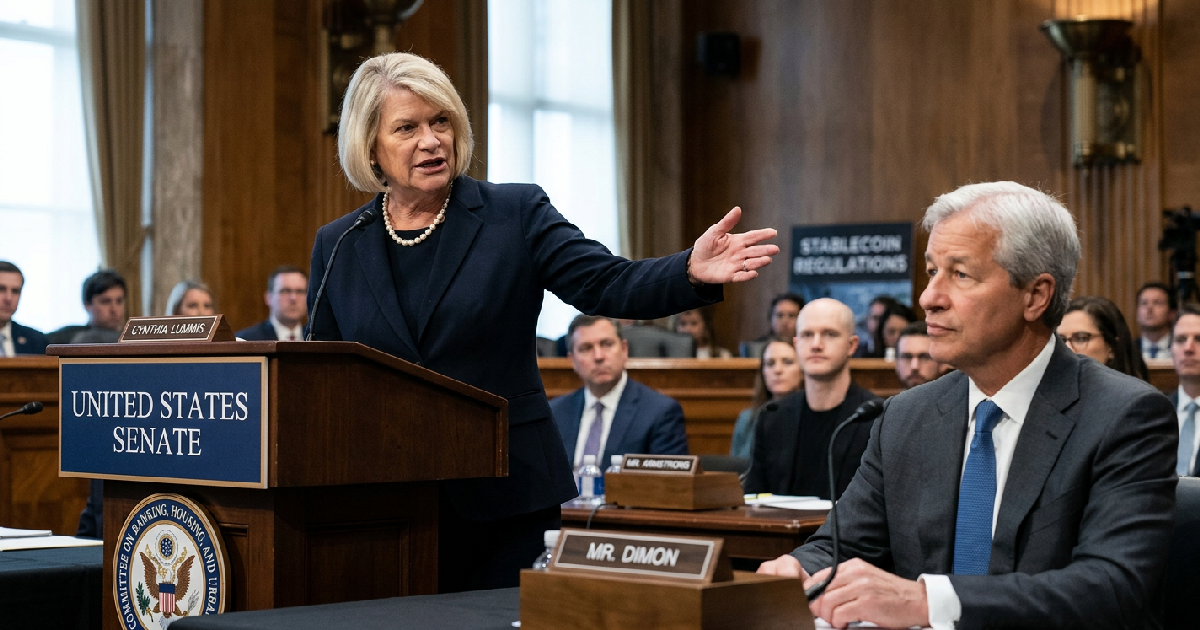

Senator Cynthia Lummis (R-WY) has delivered a blunt rebuttal to JPMorgan Chase CEO Jamie Dimon regarding his criticisms of stablecoin legislation. During a CNBC interview on Wednesday, June 3, 2026, the Wyoming senator described Dimon’s recent remarks as “distasteful” and “offensive.” Lummis, who chairs the Senate Banking Subcommittee on Digital Assets, suggested the banking executive either has not read the bill or is intentionally attempting to mislead the public about its contents.
The friction centers on the Digital Asset Market Clarity Act, also known as the Clarity for Payment Stablecoins Act. Dimon had previously used an appearance on Fox Business’ “Mornings with Maria” on May 29 to claim the bill lacks sufficient oversight. He argued the legislation offers “almost no legal protections” for consumers and fails to address Anti-Money Laundering (AML) and Bank Secrecy Act (BSA) requirements. At the time, market sentiment shifts as the CLARITY Act advances through Washington, reflecting the high stakes for both crypto firms and traditional banks.
Lummis specifically defended the bill’s regulatory framework, noting it includes up to 16 references clarifying that AML and BSA provisions apply to the crypto industry. She argued that the legislation treats permitted stablecoin issuers as financial institutions, subjecting them to the same standards as traditional banks. “He either hasn’t read the bill, or he wants to mislead people,” Lummis stated, countering Dimon’s claim that crypto firms would enjoy an unfair regulatory advantage.
Banking sector opposition to stablecoin yield products
A central point of contention in this legislative battle is the “yield” associated with digital assets. Jamie Dimon argued during his Fox Business interview that the current draft allows fintech companies to effectively pay interest on stablecoins without the consumer protections mandatory for banks. He signaled the banking lobby’s intent to resist the measure, stating, “This will be fought.”
The research indicates that a controversial bipartisan compromise on stablecoin yield remains a major friction point. While the act specifically prohibits paying interest on stablecoins, the banking sector remains wary of how crypto platforms might reward users. This debate is unfolding as Bitcoin exchange supply remains at multi-year lows, suggesting that any regulatory clarity on stablecoins could significantly impact how capital moves between traditional and digital markets.
Dimon’s rhetoric also took a personal turn last week when he targeted Coinbase Global CEO Brian Armstrong. Dimon powiedział that “no one is going to bow down” to the Coinbase executive, even using profanity to describe Armstrong’s position on the bill. Lummis called these remarks “distasteful,” especially as Armstrong has been a vocal proponent of federal oversight. The clash emphasizes the divide between legacy finance and the growing influence of leaders like David Schwartz and other crypto veterans working toward industry adoption.
National security and the future of the Clarity Act
The debate has extended into the realm of national security. Dimon flagged concerns that cross-border stablecoin payments could be used for illicit activities, such as sex trafficking. However, supporters of the bill argue that a formal U.S. framework is necessary to protect the dollar’s global leadership. A letter supporting the move was recently signed by 160 former national security, intelligence, and law enforcement professionals.
Legislative progress for the Clarity Act has been steady despite the high-profile pushback. The House version passed nearly a year ago in July 2025, and the Senate Banking Committee recently advanced the bill on May 14, 2026, with a 15-to-9 bipartisan vote. By June 1, the bill moved to the United States Senate Legislative Calendar, making it eligible for a full chamber consideraton in the coming weeks.
A full Senate vote is tentatively expected in June or July 2026. If passed, the bill would clarify jurisdictional boundaries between the SEC and CFTC while providing a concrete legal foundation for stablecoins. For now, the public exchange between Lummis and Dimon serves as a reminder that the transition toward a regulated digital asset economy remains a deeply contested political process.