
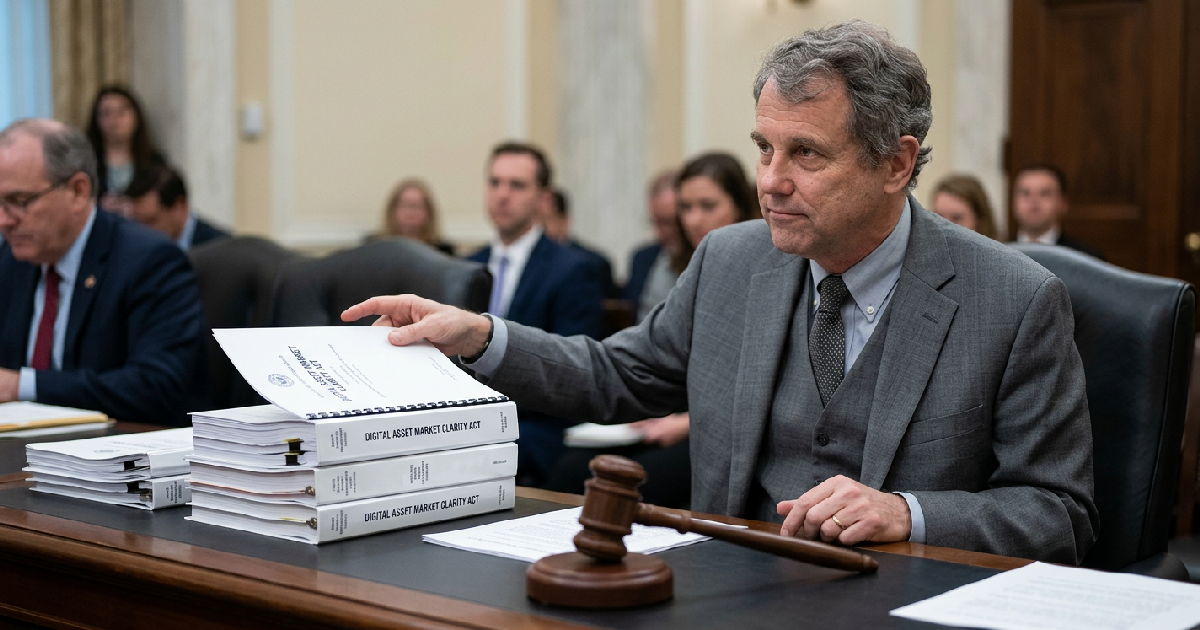

The United States Senate is making a concentrated push toward passing the Digital Asset Market Clarity Act (CLARITY Act), with lawmakers aiming for a potential signing as early as August 2026. On May 14, 2025, the Senate Banking Committee voted 15-9 to advance the bill, headlined by support from all 13 Republicans alongside Democratic Senators Ruben Gallego and Angela Alsobrooks.
The Senate Agriculture Committee has also recently cleared review of the legislation, signaling that the dual-track jurisdictional hurdles are beginning to subside as the chamber enters a high-stakes legislative window following the Memorial Day holiday.
The bill primarily seeks to establish a comprehensive regulatory framework for digital assets, finally drawing clear lines between the Securities and Exchange Commission (SEC) and the Commodity Futures Trading Commission (CFTC). It includes provisions to permanently classify Bitcoin and Ethereum as non-securities while expanding the CFTC’s supervision over spot markets. For many in the industry, this represents a crucial shift away from the “regulation by enforcement” approach that has defined recent years.
com/bitcoin-price-analysis-market-resistance-outlook-2026/”>Bitcoin market resistance has often been tied to regulatory uncertainty.
Senate Banking Committee Chairman Tim Scott has declared the legislation ready for the floor, describing it as the “rules of the road” that could make the U.S. the global crypto capital. However, the path to a full vote is narrow. With 53 Republican seats, proponents need at least seven Democratic or Independent votes to reach the 60-vote threshold required to overcome a filibuster. Senate staff are now scrambling to reconcile competing versions from the Banking and Agriculture committees into a single text that can survive a floor vote before the August recess begins.
Ethics disputes and the looming August deadline
Despite the momentum, an unresolved fight over ethics guardrails remains a significant roadblock. Senator Kirsten Gillibrand, a lead architect of the bill, has stated that ethics provisions are “non-negotiable” for broader Democratic support. These rules would restrict federal officials from certain crypto holdings to prevent conflicts of interest. Senator Ruben Gallego noted that negotiators are “close to the finish line” on these guardrails, though a specific Van Hollen amendment on the matter was previously rejected in committee by an 11 to 13 vote.
The legislative calendar is working against the bill’s sponsors. Senate aide Adam Minehardt has noted that only 34 session days remain before the August recess. While Galaxy Research head Alex Thorn estimates a 75% probability of passage this year with a signing date in the week of August 3, Senator Cynthia Lummis warned that failure to act now could push the next viable window to 2030.
Lummis described the current effort as the industry’s “last chance” before the distractions of new Congress and midterm campaign cycles take over. com/xrp-clarity-act-legislative-progress-analysis-2026/”>Market sentiment shifts often follow these legislative updates as investors weigh the likelihood of long-term stability.
Beyond the halls of the Senate, the CLARITY Act faces pressure from the banking sector. Several banks have raised objections to parts of the text, particularly regarding stablecoin deposit rules and interest payments. Furthermore, the political atmosphere has been complicated by Democratic concerns over high-profile crypto ventures linked to President Donald Trump, including World Liberty Financial. Senators such as Elizabeth Warren have used these ties to argue for stricter guardrails before allowing the bill to proceed to a final vote.
Building a future proof digital asset framework
If passed, the CLARITY Act would replace the current patchwork of guidance with a statutory regime. The bill would impose Bank Secrecy Act (BSA) obligations on digital asset firms and require strict registration and disclosure protocols. These measures are designed to protect customer funds while providing the legal certainty that institutional players have demanded.
com/david-schwartz-xrpl-foundation-clarity-act-analysis/”>XRPL Foundation and other entities navigate new compliance requirements.
The White House has remained engaged, with Treasury Secretary Scott Bessent urging the Senate to move quickly, noting that “floor time is precious.” While an original target of a July 4 signing is now considered ambitious by many, the administration continues to push for a result that “future-proofs” the digital economy. For the crypto sector, the outcome of these negotiations in the coming weeks will determine whether the U.S. successfully establishes itself as a global hub or remains mired in regulatory limbo for the remainder of the decade.