
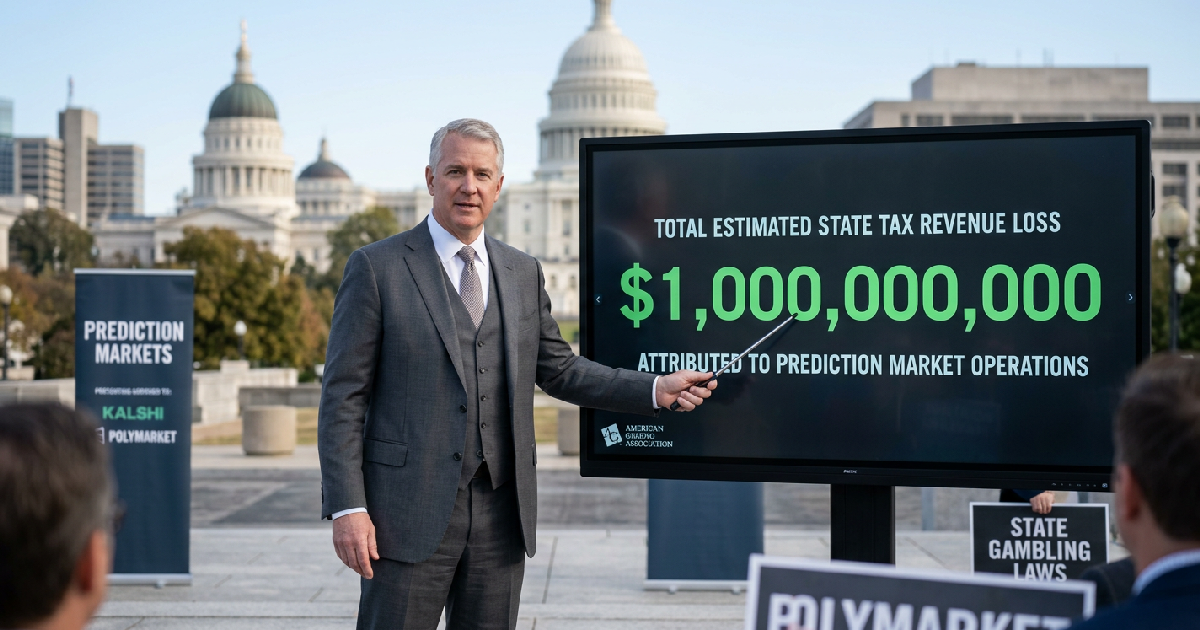

The American Gaming Association (AGA) and its CEO Bill Miller have launched a targeted campaign against prediction markets, claiming these platforms have cost states and Native American tribes over $1 billion in tax revenue. This figure, sourced from an AGA “live tracker,” has become a central tool in a regulatory battle over whether platforms like Kalshi and Polymarket should be classified as gambling or financial derivatives. The dispute reached a fever pitch on May 31, 2026, as lobbyists and state officials intensified efforts to curb the expansion of these digital contract markets.
The AGA argues that prediction markets are effectively operating as national sportsbooks without paying the state taxes and tribal fees required of traditional gaming entities. This stance is supported by a coalition of 41 Attorneys General, including New York Attorney General Letitia James. These state officials contend that the Commodity Futures Trading Commission (CFTC) is not the appropriate regulator for platforms that list contracts resembling sports bets, seeking instead to maintain state-level authority over such activities.
Defenders of the industry, such as Kalshi, have hit back at the AGA’s fiscal claims. They describe the $1 billion figure as “fake math from casinos” designed to protect established interests. While traditional sites like those featured in a ranking of top crypto casinos operate under gambling frameworks, prediction markets argue they provide hedging tools through “event contracts.” This distinction is critical to their survival as federally regulated financial instruments.
Gaming lobby uses tax revenue claims to drive state bans
The $1 billion revenue claim has already catalyzed significant legislative pushback. At least 15 states have introduced bills in 2026 to rein in prediction markets, citing the potential loss of public funds. Minnesota Governor Tim Walz has already signed legislation to ban these platforms within his state. Meanwhile, the legal environment for these operators remains volatile as the CLARITY Act advances through committees to establish more rigid definitions for digital assets.
The administrative conflict has notably expanded to include Illinois Governor JB Pritzker. In a reversal of typical state-led enforcement, the administration has actually sued the state of Illinois, though the specific grounds of the litigation reflect the deepening jurisdictional divide. This follows a broader pattern where the CFTC has sued five states since April 2026 to assert its exclusive federal authority over what it classifies as “swaps.”
State-level resistance is also mounting through the judiciary. In Kentucky, a resident named Donovan Roberts has filed a class action complaint against Kalshi. The lawsuit alleges the platform is an illegal gambling operation, mirroring the AGA’s argument that these markets gain an unfair advantage by avoiding the rules imposed on sportsbooks. Former New Jersey Governor Chris Christie, acting as an AGA adviser, remains one of the industry’s most prominent critics.
Federal lawmakers move to restrict event contracts
The legislative battle reached the U.S. Senate on March 30, 2026, when U.S. Senators Adam Schiff and John Curtis introduced a bipartisan bill. The proposed law would prohibit CFTC-registered entities from listing contracts that function like sports bets or casino games. If successful, this would prevent operators like Kalshi—which famously traded sports-event contracts for Super Bowl 59—from competing with traditional betting markets on the same terms.
The Coalition for Prediction Markets has questioned the legitimacy of the AGA’s data, stating that the underlying sources for the $1 billion tax loss claim cannot be verified. They argue the figure is an atmospheric tool used to pressure lawmakers. As the debate continues, price volatility on other speculative assets remains high, as seen with Dogecoin price predictions, which often attract similar retail interest to prediction market contracts.
For now, the industry is caught between the CFTC’s claim of federal jurisdiction and the AGA’s aggressive state-level lobbying. The outcome of this $1 billion dispute will likely determine if prediction markets can continue to function as a new class of financial derivatives or if they will be forced into the more restrictive and heavily taxed regulatory world of state-by-state gambling.