
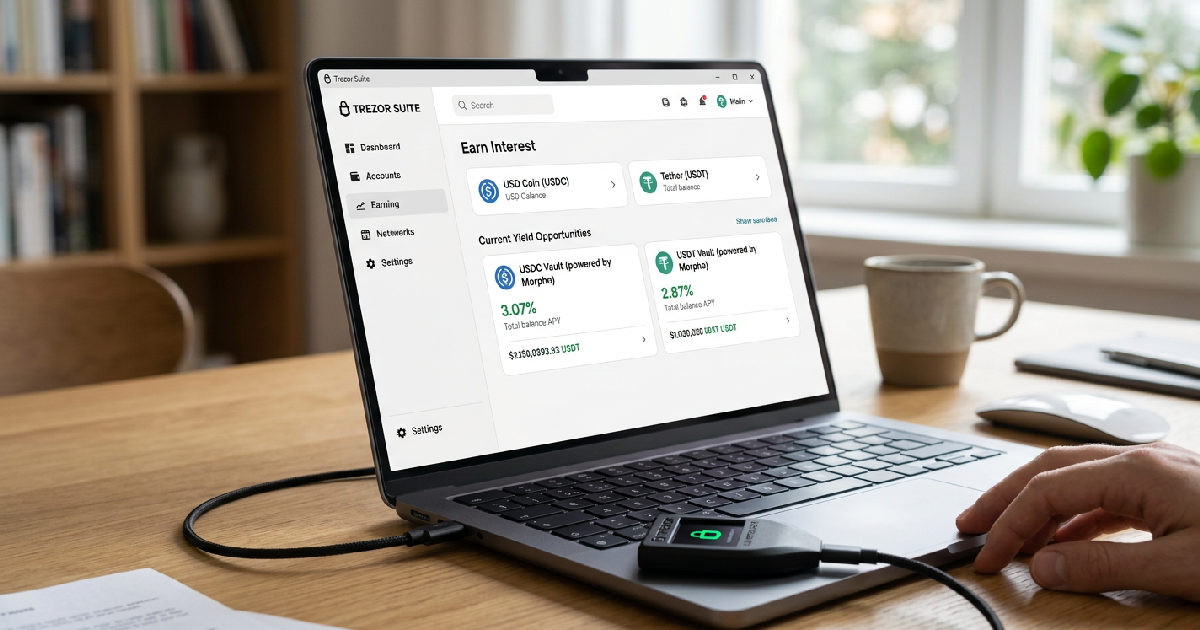

Trezor, the hardware wallet provider under the SatoshiLabs Group, has launched a native yield generation feature for USDt and USDC directly within the Trezor Suite application. This integration, powered by the Morpho lending protocol, went live on May 28, 2026, allowing more than 2 million users to earn interest on Ethereum-based stablecoins. By keeping the process internal to Trezor Suite, the company aims to eliminate the need for risky third-party browser extensions or complex decentralized finance (DeFi) workarounds.
The new functionality utilizes Steakhouse Prime Vaults, which are curated lending markets on the Ethereum blockchain optimized for conservative, low-risk returns. Users can now put their idle Tether (USDt) and USD Coin (USDC) to work while ensuring their private keys never leave the hardware device. This development follows a period where Bitcoin exchange supply maintained multi-year lows, signaling a broader market shift toward self-custody solutions that offer active financial utility.
Security remains the central premise of the update. Every action, including deposits and withdrawals, must be physically reviewed and approved in plain language on the Trezor device screen. This setup provides a safeguard against remote hacking attempts that often plague “hot” software wallets. It also addresses historical user demand for a streamlined way to access protocols like Morpho without navigating the technical hurdles of manual WalletConnect sessions.
How the native stablecoin yield integration works
The yield generation process is managed entirely through the Trezor Suite application across desktop, web, and mobile platforms. When a user deposits stablecoins, the assets are placed into a Morpho Prime Vault. These vaults function as decentralized credit infrastructure where borrowers pay interest for capital. That interest is then passed back to the Trezor user as yield, reflecting real on-chain borrowing demand rather than temporary marketing incentives.
Early 2026 data shows that annual percentage rates (APRs) for larger curated Morpho vaults—including those managed by Steakhouse, Gauntlet, and Re7—typically ranged between 5% and 7%. Because these rates are driven by organic market activity, they fluctuate based on the liquidity needs of the Ethereum ecosystem. While crypto liquidations rise alongside treasury yields in the broader macro environment, stablecoin lending often remains a focal point for investors seeking predictable on-chain returns.
Users maintain full control over their funds throughout the process. There are no mandatory lockup periods or exit delays, and withdrawals settle directly on-chain. Since participants hold standard ERC-20 vault tokens, they could theoretically withdraw their assets using any Morpho-compatible interface even if the Trezor Suite application became unreachable. This non-custodial design ensures that no middleman can freeze or restrict access to the underlying capital.
Accessing yield through the Trezor Suite application
To begin earning rewards, Trezor owners follow a simplified three-step workflow within the application. After logging into Trezor Suite and selecting the “Deposit” option, users enter the amount of USDC or USDT they wish to allocate on the Ethereum network. The final step requires following the in-Suite instructions to confirm the transaction on the physical hardware wallet. This direct path is intended to shield retail users from “sketchy” websites and fraudulent recovery schemes.
The move aligns Trezor with other major industry players like Coinbase Wallet, Rainbow, and Zerion, which also surface Morpho vaults in their user interfaces. However, the institutional backing of the Morpho protocol adds a layer of weight to the integration. Apollo Global Management recently committed to purchasing up to 90 million MORPHO tokens in a four-year deal valued at approximately $112.5 million, highlighting the protocol’s growing status as a base layer for digital credit.
Despite the streamlined experience, Trezor and Morpho have been clear that DeFi lending involves inherent risks. While the Steakhouse Prime Vaults are chosen for their conservative design and have undergone security audits, no smart contract is entirely immune to vulnerability. Trezor’s role is to provide the secure gateway, but the underlying economic risks of the lending markets remain part of the decentralized environment.
Future of decentralized credit infrastructure
Morpho has provided on-chain credit infrastructure since 2022 and currently manages billions in stablecoin assets from users worldwide. Its matching engine is designed to pair lenders and borrowers directly when possible, redirecting funds to a base lending pool to ensure continuous liquidity. This efficiency allows the protocol to offer competitive rates without relying on the inflationary token cycles that characterized earlier phases of the DeFi market.
The integration arrives at a time when stablecoin issuers are facing increased scrutiny over asset management and regional compliance. Recent reports where Tether was urged to transfer frozen assets underscore the complexities of centralized stablecoins. By moving these assets into decentralized lending vaults, users can at least ensure that the yield generation process itself is governed by immutable smart contracts rather than corporate or bank-driven intermediaries.
For the 2 million Trezor users, this update transforms the hardware wallet from a passive storage tool into a functional financial account. As the crypto industry moves toward 2027, the ability to “work” one’s capital while maintaining strict hardware-level security is likely to become a standard expectation for self-custody providers. For now, the integration solves the “zero-interest” problem of cold storage for those holding significant positions in USDt and USDC.