
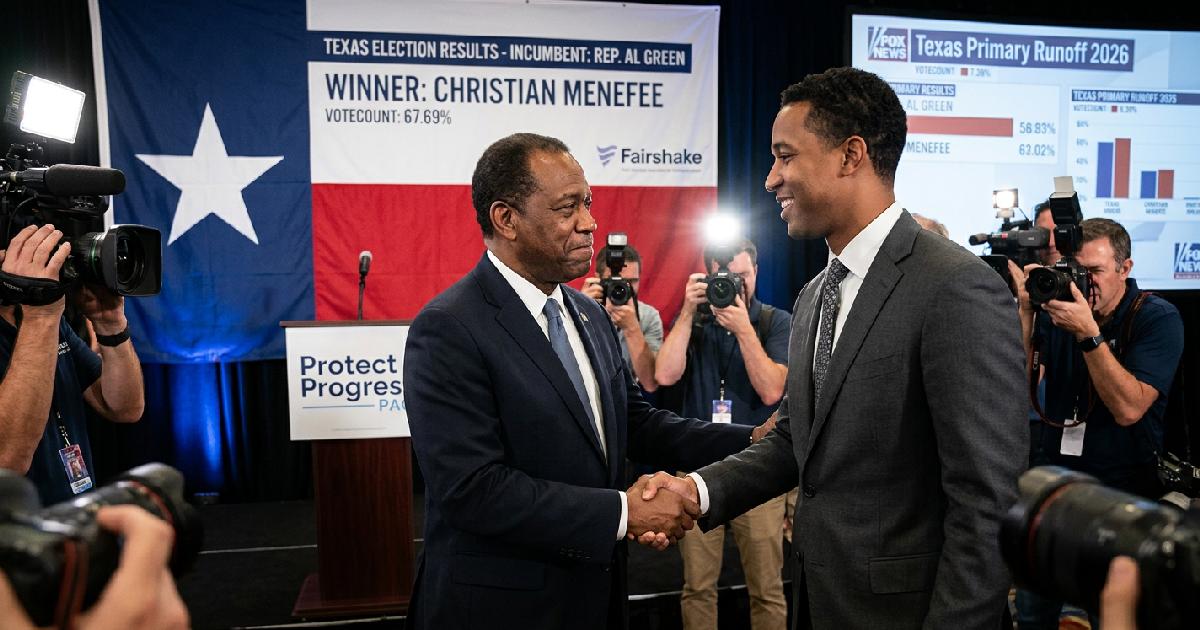

The crypto-backed political action committee Fairshake issued a public warning to lawmakers this week following a series of primary runoff victories in Texas. The group’s most high-profile win came in the Texas 18th Congressional District, where Democratic challenger Christian Menefee defeated 20-year incumbent Representative Al Green. Fairshake, which has amassed a war chest of $193 million for the 2026 cycle, declared that the result “proves that anti-crypto hostility carries real electoral consequences.”
Representative Al Green, a member of the House Financial Services Committee, was targeted for his consistent opposition to industry-favored legislation. The runoff on Tuesday, May 26, saw a massive influx of capital from digital asset interests. The PAC Protect Progress, an affiliate of Fairshake, directed $5 million to support Christian Menefee and $2.8 million specifically toward opposing Representative Al Green. Total spending from crypto-aligned groups in this single district alone reached between $6.5 million and $10.5 million, depending on various reporting estimates.
And the strategy wasn’t limited to a single Houston district. Fairshake and its network of affiliated committees, including Defend American Jobs, have now raised over $395 million across the last two election cycles. The organization’s spokesperson, Geoff Vetter, described their financial involvement as the “difference-maker” in these races. This aggressive spending reflects a broader shift as investor sentiment increasingly demands a clearer regulatory framework for digital assets in the United States.
Texas runoff results signal growing crypto influence
The defeat of Representative Al Green marks him as the first Democratic incumbent this cycle to lose his seat to a challenger backed by the heavy spending of crypto PACs. Christian Menefee, who ran on a platform open to blockchain policy, managed to overcome the veteran lawmaker’s two decades of incumbency. Similar patterns emerged in other Texas races, where industry-backed candidates such as Alex Mealer secured a GOP primary runoff victory for a Texas House seat.
In addition to the Democratic runoffs, the industry saw success in the Republican U.S. Senate runoff. Texas Attorney General Ken Paxton secured a victory with the support of the Fellowship PAC, a group funded by the stablecoin issuer Tether. These wins suggest the industry is successfully building a bipartisan “crypto caucus.” By diversifying their support across party lines, these PACs aim to ensure that CLARITY Act legislative progress continues regardless of which party controls the chamber.
But this influx of “crypto cash” has its critics. Those who previously dismissed the sector as a fringe interest are now facing a reality where millions of dollars in television ads can reshape a primary in weeks. The Blockchain Leadership Fund, backed by Anchorage Digital and Chainlink Labs, also threw its weight behind Christian Menefee, reinforcing the idea that the entire industry is now unified in its political goals.
Legislative hurdles remain despite primary victories
While the electoral results provide a morale boost for proponents, the immediate future of the CLARITY Act remains precarious. The bill, which aims to provide a market structure for digital assets, cleared a Senate committee markup in mid-May with a 15-9 vote. However, its path to a full Senate floor vote this June is complicated by growing concerns over ethics and conflict-of-interest provisions.
Jaret Seiberg, managing director at TD Cowen, warned in a recent note to clients that the political environment for the bill is deteriorating. Democratic support may waver due to these ethics fights, leading many analysts to believe the bill’s chances of passing this year have dropped below 60%. As adoption trends continue to push blockchain tech into the mainstream, the gap between electoral success and legislative reality remains the industry’s biggest challenge.
Jake Chervinsky, CEO of the Hyperliquid Policy Center, noted that there simply “isn’t much time left” in the current legislative session. Even with new allies like Christian Menefee potentially heading to Washington, the structural reforms the industry craves may be pushed into 2027. For now, Fairshake’s primary goal has been achieved: making “anti-crypto” a high-risk political stance for any incumbent.