
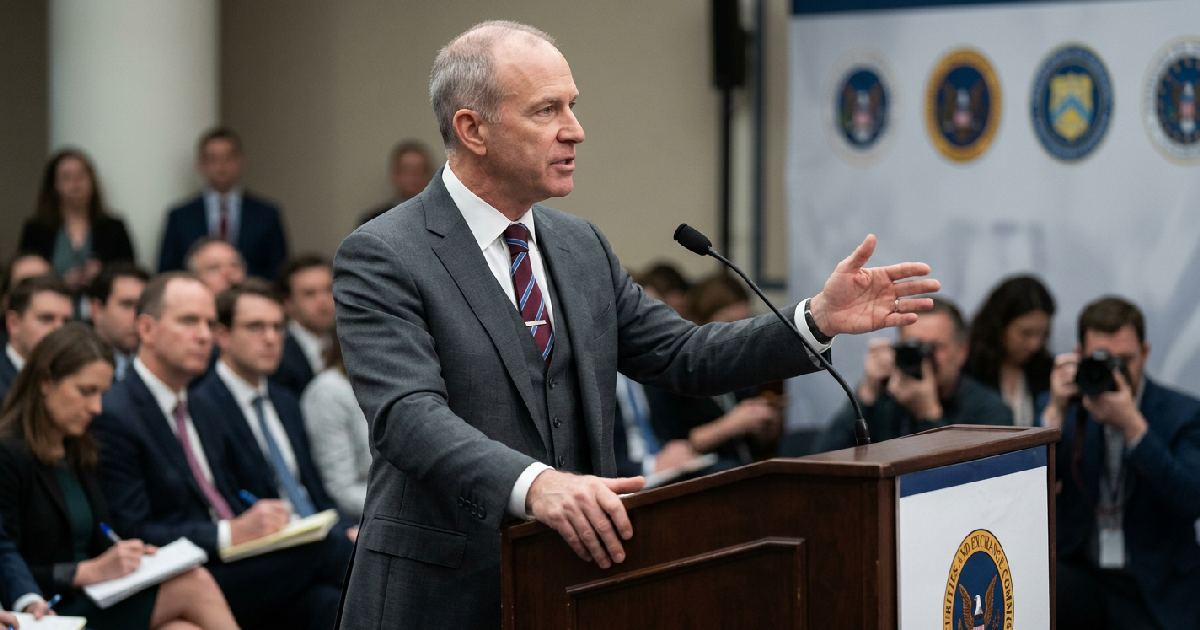

The U.S. Securities and Exchange Commission (SEC) officially rescinded its decades-old “no-admit, no-deny” policy on Monday, May 19, 2026, ending a 1972 rule that prevented defendants from publicly contesting allegations after settling enforcement actions. Following the announcement, SEC veteran Marc Fagel clarified that while the reform is a major industry shift, it does not fundamentally alter the free speech rights of Ripple leadership. Fagel noted that because the company chose to litigate its primary case rather than settle, it was never muzzled by the traditional “gag order” applied to settlement agreements.
The policy repeal has sparked a debate regarding its impact on previous legal participants. Research indicates that Ripple settled enforcement actions with the SEC in March 2026. Under the rules existing at that time, the company could not publicly contest the SEC’s framing of those specific settled events. However, for the bulk of its long-standing legal battle, Ripple executives like Brad Garlinghouse and Stuart Alderoty have been famously vocal, challenging the regulator’s stance in public forums and on social media throughout the litigation process.
The “gag rule,” formally known as Rule 202.5(e), has faced intensifying scrutiny from legal experts and high-profile figures. Critics including Elon Musk and Mark Cuban have argued for years that the policy violated First Amendment rights. The Investor Choice Advocates Network (ICAN) even filed an amicus brief on April 20, 2026, on behalf of twelve former SEC attorneys, asking the U.S. Supreme Court to review the constitutionality of the provision. Data suggests that between 2017 and 2023, approximately 2,700 SEC defendants were silenced by this rule.
Fact-checking the Ripple non-disclosure myths
Confusion regarding the impact of the repeal intensified after David Schwartz, Ripple CTO Emeritus, recently addressed rumors of a personal non-disclosure agreement. Schwartz denied claims that an NDA or gag order controls his public comments about Ripple or XRP, stating plainly that he “would never lie” and that no post-departure agreement forces him to mislead the community. His comments align with Fagel’s assessment that Ripple’s primary defense was never under a court-ordered silence.
While the repeal allows settled companies to speak out without risking the cancellation of their agreements, the XRP speculative activity in the markets remains tied to the final legal status of the token. The SEC’s decision to rescind the policy follows a plan submitted to the White House Office of Management and Budget on May 10, 2026. This technical change does not automatically resolve the underlying digital commodity status discussions or existing penalties from the March settlements but provides a new path for public discourse.
The broader crypto industry has largely celebrated the move as a victory for transparency. Under the new regime, companies can defend their reputations against the SEC’s narrative after a settlement is finalized. This is expected to change how legal teams approach negotiations with the regulator, as the permanent “neither admit nor deny” shield has been removed from the SEC’s enforcement toolkit.
Binance delists eight major trading pairs to optimize liquidity
Major crypto exchange Binance is moving to restructure its spot market by removing eight trading pairs on May 22, 2026, at 11:00 AM. The exchange cited low liquidity and declining trading volumes as the primary drivers for the decision. The removal affects several prominent assets, including Uniswap (UNI), Ethereum (ETH), and Bitcoin (BTC), though only in specific underused cross-pair configurations.
The specific pairs scheduled for removal include AVAX/ETH, CHZ/BTC, FET/BNB, and IOTA/BTC. Furthermore, UNI/ETH, UNI/FDUSD, XLM/BTC, and XLM/FDUSD will be retired from the platform. This technical cleanup follows a previous wave of delistings on May 1, 2026, which saw the removal of pairs such as NEO/BTC and ROSE/BTC. Binance has clarified that these delistings do not affect the availability of the individual cryptocurrencies, which remain tradable through more liquid instruments.
Market analysts suggest this trend reflects a shift in investor sentiment as liquidity concentrates in primary USDT pairs. By removing “dead weight” from the order books, Binance aims to maintain a high level of market quality and reduce system load. The exchange regularly reviews its listed pairs to ensure they meet evolving standards for trading volume and depth.
Web3 developers targeted by fifth wave of Shai-Hulud worm
The Web3 development community is currently grappling with a renewed threat from the “Shai-Hulud” malware worm. Security firm SlowMist has detected the fifth wave of this self-replicating NPM malware in the last eight months. The worm has grown increasingly sophisticated, now targeting modern development environments and AI assistants including Claude Code and VS Code to compromise the software supply chain.
This variant, often referred to as the “Mini Shai-Hulud,” spreads through compromised NPM packages to hijack API keys and cloud credentials from internal developer machines. The risk is particularly high for teams working on decentralized finance protocols where secure coding practices are essential. Security professionals are advising engineers to conduct thorough audits of all dependencies and monitor their development terminals for unauthorized automated commands.
As the crypto market navigates these technical and regulatory challenges, Bitcoin continues to trade within a relatively narrow range. Price action remains stabilized between $76,800 and $79,800. Traders are currently awaiting the release of the latest FOMC minutes, which are expected to provide further clarity on the Federal Reserve’s stance on inflation and future interest rate adjustments.