
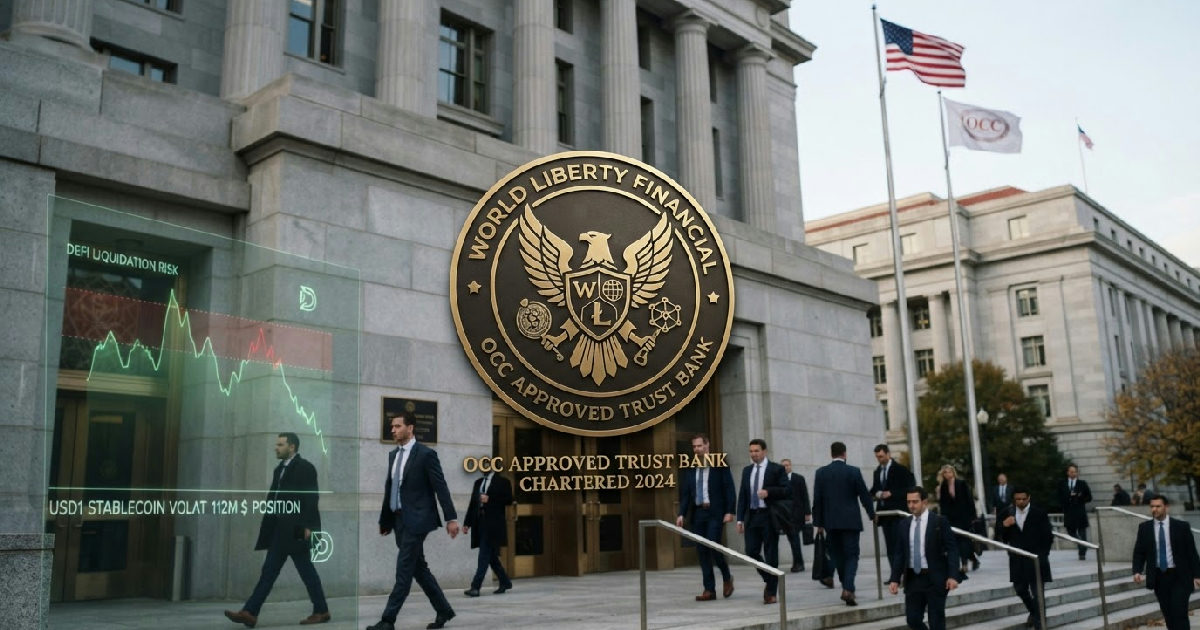

World Liberty Financial received preliminary conditional OCC approval on August 14, 2026, to charter a national trust bank as a crypto venture linked to Donald Trump.
This significant World Liberty Financial OCC approval aims to bring the firm’s $4 billion USD1 stablecoin under federal supervision. The news arrives as a substantial $112 million decentralized finance (DeFi) position, tied to the company, remains perilously close to liquidation on the Dolomite lending protocol.
World Liberty Financial receives conditional federal approval
This dual development creates a sharp contrast, showcasing World Liberty Financial’s strategic push for mainstream financial legitimacy while simultaneously navigating high-stakes leverage in the volatile DeFi landscape. The proposed World Liberty Trust Company, National Association (WLTC), if finalized, would directly handle USD1 issuance and reserve custody. This marks a notable step toward integrating a prominent stablecoin into regulated financial infrastructure.
The OCC’s preliminary conditional approval marks a pivotal step for World Liberty Trust Company, allowing it to charter a national trust bank from its proposed base in Bay Harbor Islands, Florida. This de novo institution is purpose-built for stablecoin operations, specifically managing the issuance and redemption of USD1. It will also provide digital asset custody services for institutional customers.
This move effectively places USD1’s issuance and its reserve custody directly under federal oversight, a substantial shift for the stablecoin. The conditional nature of the approval means WLTC must satisfy specific requirements before it can begin operations and receive final authorization. The OCC retains the ability to withdraw its approval should these conditions not be met.
Stringent conditions for the new bank charter
To secure final authorization, World Liberty Trust Company faces several stringent conditions outlined by the OCC. These include maintaining at least $20 million in high-quality, Tier 1 capital, alongside a minimum of $10 million in liquid assets. The company also needs to notify regulators of any major business-plan revisions.
WLTC must establish robust internal audit capabilities and hire a qualified internal audit manager. Furthermore, the OCC requires notification before the appointment of any senior executive officer. World Liberty has an 18-month window to open its bank after clearing these federal requirements, ensuring thorough preparation.
The approved structure does not permit full deposit-taking and lending, unlike a traditional bank, and would not carry FDIC insurance. World Liberty Trust Company will thus operate with a narrower scope, focusing primarily on stablecoin management and digital asset custody, avoiding the stricter oversight associated with broader banking services.
DeFi leverage position faces liquidation pressure
While World Liberty Financial pursues regulatory approval, another part of its operations faces significant market pressure: a $112 million DeFi position on the Dolomite lending protocol. This position, backed by World Liberty’s native WLFI token, highlights the complex and often intertwined risks within the crypto ecosystem.
Initial reports from April revealed World Liberty pledged 5 billion WLFI tokens, roughly 5% of its total supply at the time, as collateral.
Against this collateral, the company borrowed about $75 million in stablecoins, which drained Dolomite’s USD1 lending pool to full utilization. This situation temporarily left some depositors unable to withdraw their funds. Over $40 million of the borrowed funds subsequently moved to Coinbase Prime, indicating the liquidity didn’t remain within Dolomite itself.
WLFI price decline offsets debt repayment efforts
World Liberty made two repayments in April, totaling $25 million ($15 million on April 9 and another $10 million two days later). At WLFI’s April price of approximately $0.089, the original 5 billion-token collateral was worth around $445 million against the initial $75 million debt, implying a loan-to-value (LTV) ratio near 16.9%.
The repayment lowered the debt to $50 million, improving the LTV to about 11.2%.
However, WLFI now trades around $0.058, a decline of about 35% from its April levels. If the remaining $50 million in debt is still secured by the same 5 billion-token collateral block, the LTV ratio would effectively revert to about 17.2%.
This shows how a significant token price drop has largely nullified the benefit of a roughly 33% debt reduction, maintaining the DeFi liquidation risks.
Pledging WLFI, whose value depends heavily on confidence in World Liberty itself, introduces a circular risk. This is fundamentally different from collateralizing with independent assets like Bitcoin or Ethereum. A falling WLFI price shrinks the collateral cushion, raising the LTV ratio.
If liquidation approaches, forced selling of WLFI can further depress its price. This accelerating cycle makes the position particularly vulnerable to market downturns.
Uneven health across multiple Dolomite positions
On-chain data indicates Dolomite’s core contract still carries around 4.998 billion WLFI, valued at about $281 million at current prices, alongside 123.7 million USD1 and 27.5 million USDC. This suggests a continued large WLFI exposure within the Dolomite infrastructure. It also highlights the intricacies of crypto address misuse and tracking.
One specific wallet has supplied 3 billion WLFI against approximately $41.4 million in USD1 and USDC debt. This position maintains a healthy metric of 2.81, indicating it’s far from liquidation, showcasing a more stable structure. However, a separate DeBank-indexed Dolomite position, tied to a multisig, shows at least 112.6 million USD1 borrowed with a health rate of just 1.07.
A health rate this close to 1.0 means the collateral value only needs to fall an additional 6% to 7% before liquidation risk becomes active. Combined, the debt across these identified positions significantly exceeds the $50 million that would remain from the original borrow after the reported $25 million repayment.
This suggests World Liberty’s exposure is broader and more complex than initially framed, encompassing mixed risk levels.
Political ties and regulatory scrutiny intensify
World Liberty Financial’s operations are deeply intertwined with prominent political figures, intensifying the scrutiny around its regulatory milestones and financial health. The company was founded in 2024 by Donald Trump Jr., Eric Trump, Zachary Folkman, Chase Herro, Alex Witkoff, and Zach Witkoff. An entity affiliated with Donald J. Trump and certain family members reportedly owns a 38% stake in World Liberty Financial.
Other sources suggest a Trump business entity holds 60% ownership and is entitled to a substantial 75% of revenue from coin sales, later reduced to 40%. Both Eric Trump and Donald Trump Jr. are actively involved in the company’s management.
Donald Trump himself reported over $1.1 billion in crypto earnings in financial disclosures from 2025, including over $515 million from WLF token sales and $65 million from sales of equity in the venture’s holding company. This financial entanglement raises significant questions about potential conflicts of interest.
Senator Elizabeth Warren (D-Mass.), a vocal critic of crypto’s intersection with politics, sharply criticized the OCC’s approval. She stated that “We have never seen financial conflicts or corruption of this magnitude,” describing it as “the most brazen act of self-dealing our system has ever seen.” The OCC is led by Jonathan Gould, chosen by former President Donald Trump, further fueling concerns about impartiality.
The juxtaposition of World Liberty Financial seeking federal regulatory legitimacy while managing volatile DeFi positions and navigating political criticism creates a complex narrative. The company’s future will depend on successfully balancing these conflicting forces. The market for growing Bitcoin ETF holdings offers a stark contrast in perceived risk profiles and regulatory clarity.