
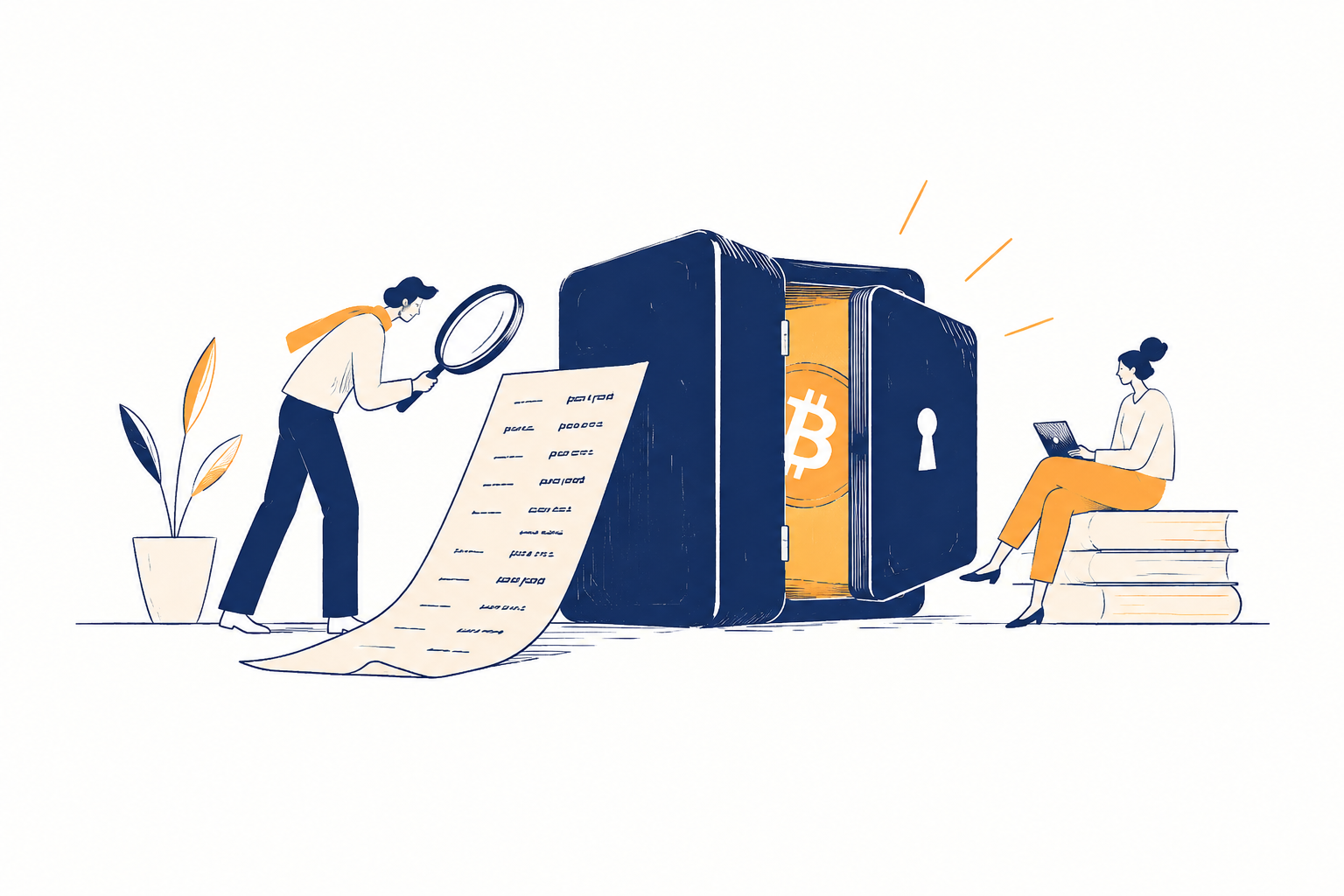

A seed phrase may be only a list of words, but its job is anything but simple. For many crypto wallets, the recovery phrase is the backup that lets a user restore access if a phone, computer or hardware wallet is lost.
That creates an unusual security problem: the phrase must be recoverable by its owner while remaining useless to everyone else. A backup hidden so well that it cannot be found is not much of a backup. A copy that is easy to reach may be easy for someone else to steal.
Learning how to protect a seed phrase therefore means thinking about more than where to put the words. It means deciding how they are generated, recorded, stored, backed up and recovered.
Why a seed phrase is more sensitive than the device holding your crypto
A seed phrase, also called a recovery phrase, is a human-readable representation of the random information from which a compatible wallet can derive its keys. In BIP-39, one standard used for mnemonic phrases, valid phrases can contain 12, 15, 18, 21 or 24 words.
The point is what the phrase represents. It is not only a password for a particular app. In a compatible wallet setup, it can be used to recreate the wallet on another device.
That is why losing a phone does not necessarily mean losing the funds, while exposing the recovery phrase can be far more serious. Someone who obtains the phrase may be able to restore the wallet elsewhere without touching the original device.
Wallet providers such as Ledger and Trezor consequently describe the recovery phrase as the backup used to restore access when the original device is lost or damaged.
The device can protect keys during normal use, but the recovery phrase remains the underlying backup.
Security starts before the seed phrase is ever stored
It is tempting to think of storage as the main security decision. In reality, the first question is whether the phrase was generated safely in the first place.
A reputable wallet should generate the recovery phrase using appropriate randomness. BIP-39 is explicit that its mnemonic format is intended to carry computer-generated randomness, rather than turn a sentence invented by the user into a secure wallet seed.
Creating your own memorable phrase, copying one from a website or using an unknown “seed generator” adds risk before the backup even exists.
The same principle applies during recovery. A legitimate recovery process may require the phrase, but an unexpected website, message or supposed support agent asking for it should be treated differently.
The phrase is the credential being protected, not information that customer support needs to collect.
How to protect a seed phrase without creating a new security risk
For most users, the biggest storage decision is whether the phrase ever becomes a digital file.
Taking a photograph feels convenient. So does saving the words in a notes app, emailing them to yourself or putting them in cloud storage. But each option creates additional ways for the phrase to be copied, synchronised or exposed.
A physical record avoids many digital attack paths. Paper is simple and cheap, although it introduces different risks: water, fire, tearing, fading, accidental disposal or simply forgetting where the backup was placed.
That is why “offline” should not be treated as the end of the conversation. The real objective is controlled access. A physical backup needs protection from both digital exposure and physical loss.
For higher-value holdings, some users choose more durable forms of storage designed to withstand environmental damage. The principle is the same: the backup should be legible enough to recover the wallet when necessary, but difficult for an unauthorised person to discover or copy.
A second backup can make your wallet safer or easier to compromise
The instinct to create several copies is understandable. One copy can disappear in a fire, during a house move or through a simple mistake.
But every additional copy also becomes another object that must be protected.
That creates the seed phrase backup paradox. More redundancy reduces the chance of permanent loss, while more copies can increase the number of places where the secret might be exposed.
There is no universal number of backups that works for every wallet holder. The right arrangement depends on the value involved, the physical environment, who else can access the storage location and how confident the owner is that the backups can be found in an emergency.
The question is not “How many copies should I have?” It is “Can I recover the wallet if one copy is lost, without creating several new opportunities for someone else to obtain the phrase?”
That shift is relevant because security is not about adding more barriers. It is about designing a system that fails safely.
A hardware wallet cannot protect a seed phrase that has already leaked
Hardware wallets can improve security by keeping signing operations isolated from internet-connected computers. But they cannot repair a compromised recovery phrase.
Suppose a hardware wallet is kept in a drawer and protected by a PIN. If its seed phrase has already been photographed, entered into a fake website or copied into an online document, the physical device is no longer the only route to the wallet.
The reverse is also true. A damaged or lost hardware wallet does not necessarily destroy access if the recovery phrase remains intact and was stored correctly. This is why hardware-wallet guidance treats the device and its backup as separate parts of the security model.
Keeping those ideas separate prevents a common misunderstanding: the device and the seed phrase solve different problems. One is used to interact with the wallet; the other is the backup that can recreate it.
For readers who use an additional BIP-39 passphrase, there is another layer to consider. It can change which wallet is derived from the same mnemonic, but it also becomes another secret that must be remembered and recovered correctly. More protection can therefore mean more responsibility, not simply more security.
The easiest way to lose a seed phrase may be trusting the wrong person
Not every seed phrase theft requires malware or a technical exploit. Social engineering can be much simpler.
A scammer may claim that a wallet needs to be “verified”, that a transaction is stuck, or that an account needs to be migrated after an update. The final request may be small: send the recovery phrase so the problem can be fixed.
The safest response is also the simplest. Do not share the phrase with a stranger, a support agent, a website or a person claiming to help recover the wallet. Both Ledger and Trezor explicitly warn users never to share their recovery phrase, including with supposed customer support representatives.
A genuine recovery procedure can require the owner to enter the phrase into the wallet or device they are deliberately restoring. That is fundamentally different from giving the secret to somebody else.
The words themselves do not become less valuable simply because the request looks urgent or official.
The safest backup is one you can recover and nobody else can
Good seed phrase security is sometimes presented as a search for the perfect hiding place. That framing misses the real problem.
The backup has to survive two different failures. First, someone must not be able to obtain it and take control of the wallet. Second, the legitimate owner must not lose the ability to recover the wallet when something goes wrong.
That is why a seed phrase should be treated as a recovery system rather than a secret note. Generate it through a trustworthy wallet. Keep it out of unnecessary digital channels. Store the physical backup somewhere it can survive realistic damage and remain accessible to the owner. Add redundancy only when that redundancy can be protected.
The strongest setup is therefore not the one with the most copies, the most expensive hardware or the most complicated hiding place. It is the one in which recovery remains possible for the owner while exposure remains difficult for everyone else.