
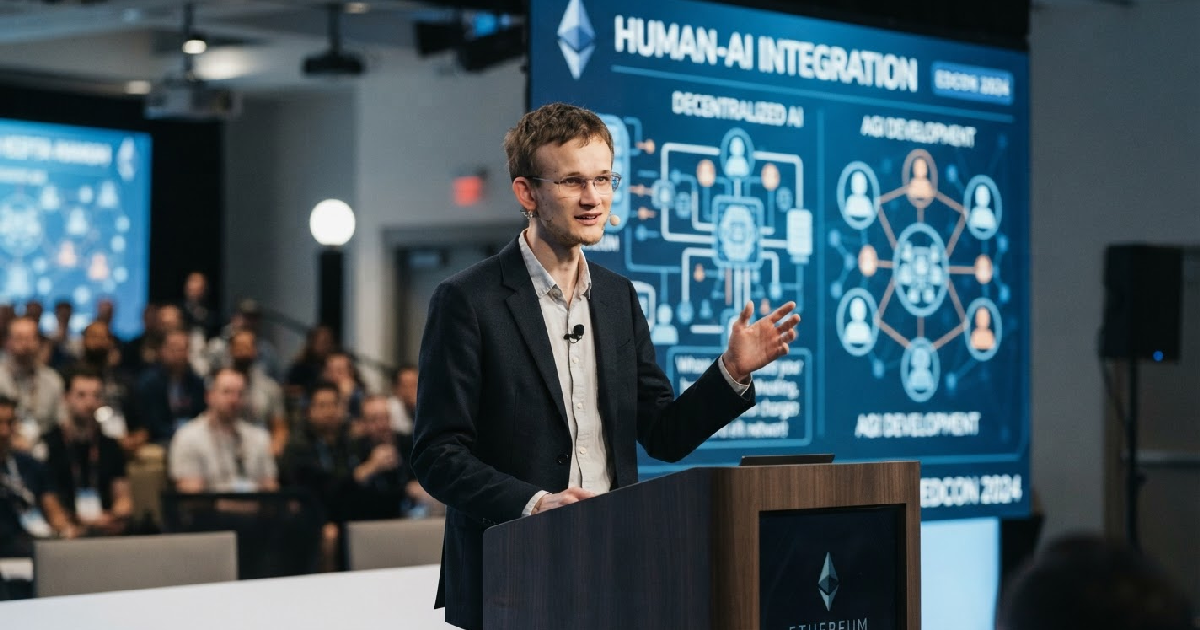

Ethereum co-founder Vitalik Buterin has again weighed in on the accelerating evolution of artificial intelligence, presenting a detailed, multi-part framework that champions deep human-AI integration. His latest analysis, shared on July 20, 2026, moves beyond earlier, more cautious warnings about AI surpassing human capabilities. He now advocates for a nuanced path forward where human and machine intelligences merge rather than compete.
This fresh perspective comes as the crypto and tech communities grapple with the rapid advancements in AI, particularly large language models. Buterin’s views offer a distinct vision for how humanity can navigate this transformative era, shifting from an “us vs. them” mentality to one of symbiotic collaboration.
Buterin’s shifting perspective on AI’s trajectory
Buterin’s current stance represents a notable evolution from his past pronouncements, which at times painted a starker picture of AI’s potential risks. In November 2023, he cautioned that super-advanced AI could become the planet’s next “apex species,” even posing an extinction-level threat to humanity. He famously warned then that “Even Mars may not be safe” from an AI gone rogue.
By May 2025, his rhetoric had softened slightly, suggesting at ETHPrague that AI should be viewed as a complementary tool. He described an “AI plus human” mode, where machines excel in specific tasks like summarizing preferences or predicting behavior based on vast datasets.
Understanding AI’s expanding capabilities
Today, Buterin emphasizes that both humans and AI possess a broad spectrum of capabilities. These range from basic physical functions to complex cognitive abilities like strategic thought and emotional intelligence.
He argues that comparing humans and AI using a single measure, such as overall intelligence or economic output, is misleading. Instead, we should assess how AI’s capacity to perform an ever-growing number of diverse tasks is expanding.
To illustrate AI’s progression, Buterin outlines three historical waves of machine advancement. The first, the Industrial Revolution, saw machines master mass manufacturing and repetitive physical actions. The second brought calculators and computers, which dominated tasks defined by precise logical rules, like coding and mathematics.
The third and current wave is driven by large language models (LLMs). These systems excel at handling tasks defined by immense datasets, extending their reach into both mental and physical domains, including areas like self-driving cars. A critical unresolved question, in Buterin’s view, is whether future LLMs will eventually encompass all human capabilities.
Navigating the artificial general intelligence threshold
Buterin defines Artificial General Intelligence (AGI) as an AI powerful enough to independently sustain and advance civilization, even if all humans were to disappear. He views the achievement of true AGI as an “irreversible turning point.” This point, he warns, could relegate humanity’s historical dominance to a mere “historical accident” rather than a testament to inherent superiority.
The implications of AGI reaching this level are profound. It challenges fundamental assumptions about human exceptionalism and control over technological progress. This perspective underscores the urgency of proactive governance and ethical considerations in AI development.
A pluralistic future with human-machine mergers
Despite these serious considerations, Buterin envisions an optimistic, pluralistic future. His ideal scenario involves preserving global political and economic diversity, allowing for a future where humans and machines genuinely merge.
This merging wouldn’t necessarily mean a forced evolution for everyone. Buterin suggests there would still be space for individuals who prefer not to alter their lifestyles or integrate deeply with advanced AI. It’s a vision of coexistence and optionality, not universal assimilation.
This concept of a human-machine merge, rather than replacement, is central to his latest framework. It suggests a future where individuals could augment their cognitive or physical abilities through AI integration, leading to new forms of human experience and productivity.
Strategies for responsible AI development
Buterin also touches upon the ongoing debate around slowing down AI development. He supports proposals to navigate this high-risk period at a more measured pace, advocating for caution as the technology advances.
Crucially, he favors a decentralized slowdown, achieved through mechanisms like open-source model weights, over coercive political measures. This approach aligns with the decentralized ethos of the cryptocurrency world, suggesting that community-driven oversight might be more effective than top-down regulation.
The promise of integrated systems
His ultimate vision points to a future where integrated human-plus-machine systems significantly outperform both pure human and pure machine efforts. He believes such synergy could lead to widespread access to strategic thinking and material abundance.
This integration aims to harness AI’s strengths while preserving human agency and control over core decisions. It implies a world where complex problems are tackled by augmented human intellect, enhancing our collective capacity for innovation and problem-solving without ceding fundamental control.
The concept suggests that AI wouldn’t just be a tool, but an extension of human capabilities, allowing for unprecedented levels of efficiency and insight across various domains. It’s about expanding what it means to be human in an increasingly AI-driven world.
Broader implications for the tech ecosystem
Vitalik Buterin’s evolving thoughts on artificial intelligence carry significant weight, not just for the blockchain community, but for the broader tech ecosystem. His position as a thought leader in decentralized technologies lends a unique perspective to the AI conversation.
His emphasis on decentralization as a pathway to managing AI risk, particularly through open-source model weights, could influence how future AI governance models are conceptualized. It aligns with the idea that transparency and distributed control are vital for powerful technologies.
Buterin’s vision of human-AI integration also provides a counter-narrative to more alarmist predictions. It suggests a proactive, collaborative future where technology serves to enhance human potential rather than undermine it. This shift in discourse from a prominent figure could encourage more constructive approaches to AI development and deployment.
For those building in the crypto space, Buterin’s remarks may also spark new ideas for how blockchain technology could intersect with AI advancements. The principles of decentralization, transparency, and user-centric control inherent in blockchain could prove crucial in implementing the kind of integrated, pluralistic AI future he describes.
It’s a call to consider not just what AI can do, but how it should be governed and integrated into society to ensure a beneficial outcome for all.