
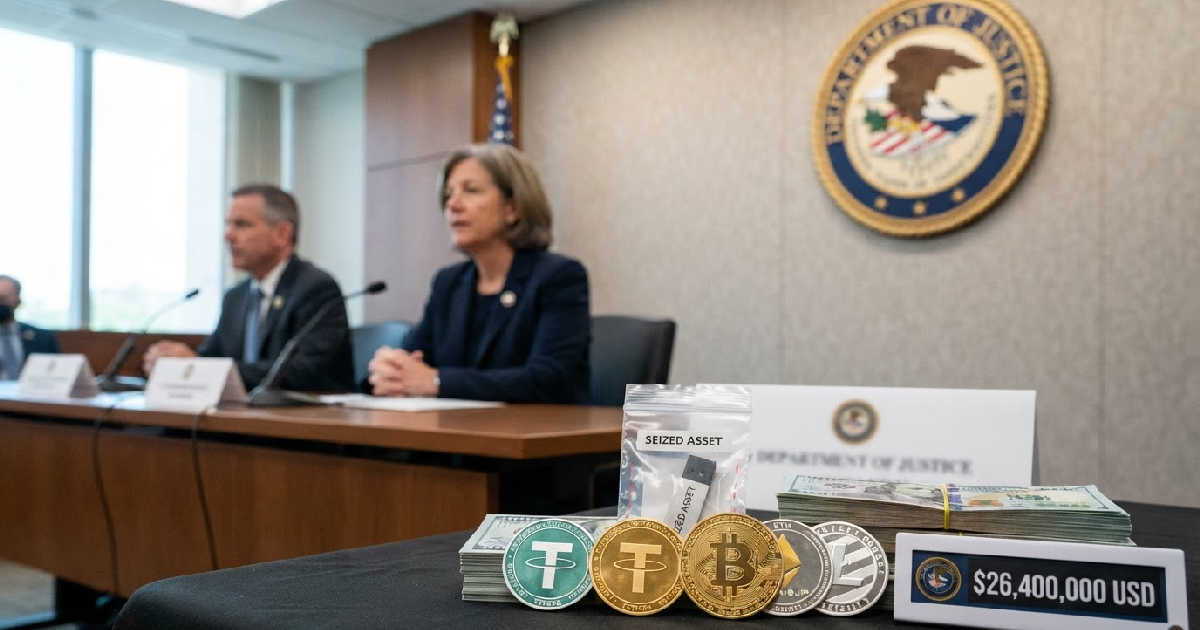

U.S. prosecutors are actively pursuing approximately $26.4 million in US crypto scam assets, filing five new civil-forfeiture complaints on July 21, 2026. S. prosecutors filed five new civil-forfeiture complaints on July 21, 2026, actively pursuing approximately $26.4 million in US crypto scam assets. These funds stem from separate international fraud investigations, marking a continued aggressive stance against digital asset crime by federal authorities. This latest action contributes to the U.S.
Department of Justice’s (DOJ) broader efforts, with its Scam Center Strike Force now reporting more than $800 million recovered from various illicit schemes.
Federal agencies intensify efforts against crypto fraud
The coordinated effort highlights an evolving strategy in tackling sophisticated, cross-border cryptocurrency fraud. Investigators are now able to freeze suspected criminal proceeds early in the process, often before identifying the specific individuals behind the schemes. This approach aims to preserve assets that can later be forfeited and potentially returned to victims, even as the search for perpetrators continues globally.
The U.S. Attorney’s Office for the District of Columbia, alongside the U.S. Secret Service Washington Field Office and its Cyber Fraud Task Force, spearheaded these recent civil-forfeiture filings. Their actions underscore a proactive shift toward disrupting the financial infrastructure of international crypto fraud networks.
One of the investigations uncovered more than 270 suspected victim transactions tied to fraudulent investment platforms, leading to the targeting of approximately $10.4 million in crypto. Another significant case involved over 200 romance-scam victims, with investigators tracing funds through hundreds of intermediary addresses used to commingle illicit gains, aiming to recover about $12.1 million.
U.S. Attorney Jeanine Ferris Pirro, who launched the Scam Center Strike Force in November 2025, emphasized the impact of these operations. “This $25 million seizure is a direct result of the Scam Center Strike Force I launched in November 2025, and it demonstrates the power of aggressively targeting these international fraud networks,” she stated.
Pirro noted that investigators “cut through complex laundering schemes, protected victims, and shut down criminal pipelines,” vowing to continue identifying and dismantling criminal operations.
Special Agent in Charge Tara McLeese of the U.S. Secret Service Washington Field Office echoed this sentiment. She highlighted that the seizure was the outcome of “months of tireless work by Washington Field Office investigators.” McLeese praised her team as “among the best in the world at tracking down cyber criminals and tracing their illicit transactions.”
Anatomy of the crypto scam operations
The recent filings provide a clearer picture of how these international crypto scams operate. The Department of Justice indicated that the money launderers predominantly reside in Southeast Asia, with associated IP addresses traced to China, Malaysia, and Cambodia.
These networks often employ intricate methods to move funds, making tracing and recovery a significant challenge. By commingling funds from various victims through numerous intermediary crypto wallets, they aim to obscure the money trail. However, law enforcement’s enhanced blockchain analysis capabilities are proving effective in unraveling these complex layers.
A particularly concerning detail emerged from one of the smaller cases, involving nearly $285,000. It showcased the issue of repeat victimization, where a person who had already suffered losses from an unrelated fraud was then targeted by scammers. These criminals falsely claimed they could recover the previously stolen funds for a fee, leading the victim to send additional transactions before investigators intervened.
This incident underscores the predatory nature of these fraud rings, which often prey on individuals already in vulnerable situations. It also highlights the constant need for vigilance and education within the crypto community.
The path from asset restraint to victim restitution
While the freezing of crypto assets marks a crucial victory for law enforcement, it doesn’t automatically translate into immediate victim compensation. A civil-forfeiture complaint is the legal mechanism authorities use to ask a court to transfer ownership of the restrained property to the government.
The Department of Justice explains that civil judicial forfeiture proceeds against the property itself and doesn’t require a criminal conviction of individuals. However, prosecutors must still demonstrate, by a preponderance of the evidence, the assets’ connection to criminal activity. So, filing a complaint does not finalize forfeiture or establish criminal guilt.
The five civil-forfeiture cases are part of the more than $800 million recovered by the Scam Center Strike Force. A program page, updated on June 18, reported $832.8 million in cryptocurrency restrained, though these figures use different terms and dates, meaning they are not a direct before-and-after comparison of a victim payout tally.
These amounts do, however, illustrate the considerable scale of assets the DOJ is successfully intercepting.
Qualifying victims may eventually receive forfeited assets through the DOJ’s remission or restoration process, or funds can be directed to courts for restitution orders. However, the July 21 announcement didn’t specify a distribution amount, a list of eligible claimants, or a timetable for payouts in these five specific cases.
The courts still need to grant forfeiture, investigators must identify suspects, and the precise amount of cryptocurrency reaching victims remains undetermined.
Broader implications for international crypto crime fighting
The strategy employed by the Scam Center Strike Force is part of a larger, coordinated international effort to combat crypto fraud. This approach focuses not just on individual scammers, but on dismantling the broader financial mechanisms that enable these illicit operations. By targeting these assets, authorities disrupt the economic incentives driving such crimes.
Global law enforcement agencies are increasingly collaborating to track down these cross-border networks. For example, Interpol’s Operation First Light 2026, conducted between January and April 2026, identified over 142,000 victims worldwide. That operation led to 5,811 arrests and blocked 31,000 bank accounts, indicating a significant uptick in international enforcement against social engineering and crypto laundering pipelines.
The ongoing challenge lies in the sheer volume and speed of cryptocurrency transactions, which can make tracing and securing funds exceptionally complex. But as these recent civil-forfeiture actions demonstrate, law enforcement is adapting quickly, leveraging advanced forensic tools to follow digital money trails across jurisdictions.
This relentless pursuit suggests that the financial infrastructure supporting crypto scams will face increasing pressure in the coming years, potentially making it harder for criminals to profit from these activities.
Ultimately, while these seizures are a positive step, the real measure of success for victims will be the timely and equitable distribution of recovered funds. The legal complexities and international nature of these cases mean that the path to full restitution often remains a long and arduous one. But for now, the U.S.
government’s focus on seizing crypto scam assets provides a beacon of hope for those affected by these increasingly prevalent crimes.