
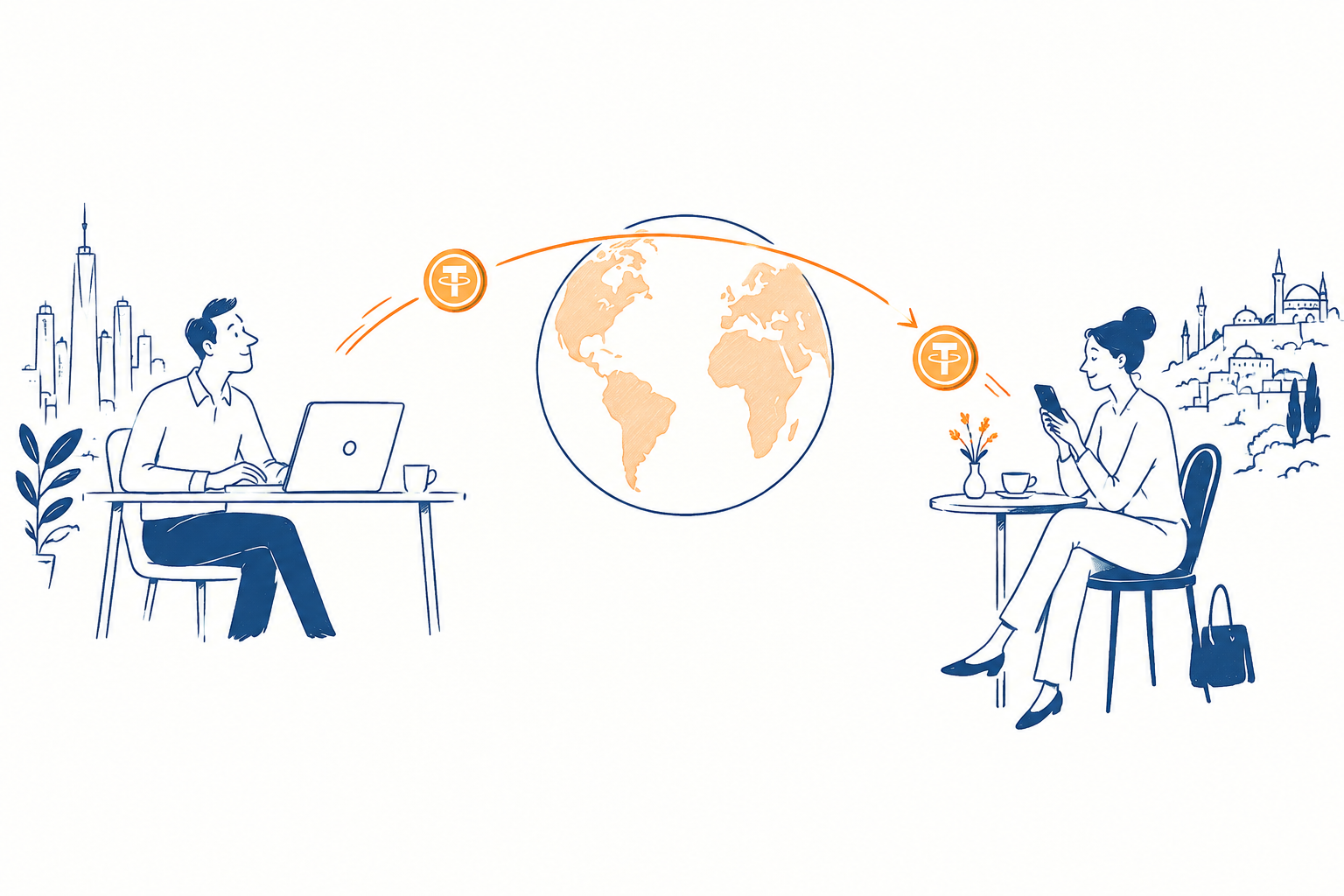

A payment can reach a blockchain address in seconds or minutes, yet the person receiving it may still have to wait before they can use the money. That distinction matters when a business needs to pay an overseas supplier, or a worker wants to send money to family in another country.
International transfers with stablecoins use digital assets designed to maintain a relatively stable value against a reference asset, usually a fiat currency such as the US dollar. They can change how value moves across borders, but they do not automatically remove currency conversion, compliance checks or the need to access local money.
To understand whether they offer a more efficient alternative to a bank transfer, it helps to follow the payment through every stage, rather than focus solely on the blockchain transaction.
What happens when you send money abroad using stablecoins?
Imagine a business in London that needs to pay a supplier in another country. Instead of arranging a conventional international bank transfer, the business uses a payment provider that supports stablecoins.
First, it transfers pounds to the provider, which converts the funds into a suitable digital asset. The stablecoin is then sent to the recipient’s wallet or to a service that handles payments on their behalf.
Once the transaction has been confirmed according to the blockchain’s rules, the recipient can hold the stablecoin, transfer it again or exchange it for another asset. If they need local currency, they must find a provider or other market participant willing and able to facilitate that conversion.
The route can vary. A business might use an intermediary that handles both the conversion and the final payout, while a recipient with a compatible wallet might receive the stablecoin directly.
These arrangements involve two distinct processes. The blockchain records the movement of the digital asset; separate services connect that asset to conventional currencies and bank accounts.
Those services are known as on-ramps and off-ramps. An on-ramp allows someone to exchange conventional money for digital assets, while an off-ramp enables the reverse.
The important detail is that neither process is guaranteed to be instantaneous simply because the blockchain transaction is fast. Availability depends on the provider, the payment route, the currencies involved and any verification requirements.
Why blockchain settlement does not tell the whole story
Traditional international payments often involve several financial institutions, particularly when the sender’s and recipient’s banks do not have a direct relationship. Banks may rely on correspondent banking arrangements to facilitate payments between countries and currencies.
SWIFT plays an important role in this infrastructure, but it is a messaging network, not a bank that independently moves or settles the funds. It transmits payment instructions between financial institutions, which then process the payment through their respective systems. SWIFT’s explanation of its role makes this distinction clear.
A blockchain transfer works differently. It records the movement of a digital asset between addresses, without requiring the same chain of payment messages between correspondent banks for that particular transfer.
However, this does not mean every conventional international transfer is slow, or every stablecoin payment is fast from end to end. Traditional payment infrastructure has become more efficient, and delays can occur at multiple stages of either process.
A stablecoin payment may be confirmed quickly on the network but still require the recipient’s platform to review a transaction, approve a withdrawal or process a conversion. The network may have finished its part while the financial service handling the payment has not.
That is why the relevant comparison is not simply how long each system takes to record a transaction. It is how long the sender waits for the payment to be completed and how quickly the recipient can access the funds.
How liquidity affects the cost of a stablecoin transfer
Moving a stablecoin between two compatible wallets does not necessarily require exchanging one token for another. Costs can become more complicated when the sender or recipient needs a different asset or currency.
Suppose a recipient receives one dollar-pegged stablecoin but needs another stablecoin to access a particular payment service. They may need to exchange the first token for the second through a centralised exchange or a decentralised exchange, where transactions take place through blockchain-based trading infrastructure.
Some decentralised exchanges use liquidity pools: reserves of tokens that allow users to swap one asset for another.
Networks such as Stellar and Solana support different ways of moving and exchanging digital assets. But the available trading pairs and conversion routes depend on the assets, applications and markets being used.
Liquidity determines how readily an asset can be exchanged without substantially affecting its price. A market with deeper liquidity can generally accommodate larger trades with less price impact than a thinly traded market, all else being equal.
When a trade moves the price away from the expected level, the difference is known as slippage. The user may also face a trading spread, which is the difference between the buying and selling prices, as well as exchange fees and blockchain network charges.
These costs can accumulate. A transfer with a low network fee may still be expensive once the initial conversion and the recipient’s cash-out are included.
There is another important distinction: the ability to exchange one digital asset for another does not guarantee that someone can redeem it for pounds, euros or local currency. On-chain liquidity and access to conventional money are related, but they are not interchangeable.
Where the real cost of an international transfer lies
The cost of a stablecoin payment is determined by the complete route, not by a single fee displayed by the blockchain.
Consider a business sending a payment in pounds to a supplier who ultimately needs another currency. The business may pay for the conversion from pounds into a stablecoin, the blockchain transaction itself, and any charges imposed by its payment provider. The supplier may then incur additional costs to convert the stablecoin into usable money.
The exchange rate matters, too. A provider can advertise a low transfer fee while offering a less favourable conversion rate. The difference may be less visible than a separate charge, but it still affects the amount delivered.
A fair comparison with a conventional bank transfer should therefore include:
- The exchange rate and any spread applied when the sender acquires the stablecoin.
- Network fees, provider charges and any additional conversion costs.
- The amount ultimately received in the required currency.
- The time required for the recipient to access and use the funds.
The World Trade Organization’s analysis of stablecoins and international trade highlights the same broader issue: any potential savings depend on the full transaction chain, including conversion, compliance and access to reliable on- and off-ramps.
This is particularly relevant when comparing providers in different countries. A route that works efficiently between two markets may be less attractive elsewhere because exchange rates, local liquidity and cash-out options vary.
A lower blockchain fee is useful, but it is not, by itself, evidence of a cheaper international payment.
What if the recipient cannot convert the stablecoin?
Receiving a stablecoin is not the same as receiving a bank deposit denominated in the currency it is designed to track.
A dollar-pegged stablecoin aims to maintain a value close to one US dollar. Its market price can nevertheless move away from that target, and the ability to redeem it depends on the particular arrangement, its reserves where applicable, and the services available to the holder.
A recipient may also encounter practical barriers. Their local provider might not support the token, withdrawals could be subject to additional checks, or the available market might not have enough liquidity to convert a large amount at a favourable price.
These issues do not necessarily indicate a failure of the blockchain. They arise because transferring a digital asset is only one part of delivering money across borders.
Compliance requirements can add another layer. Payment providers may need to verify a customer’s identity, assess transactions and meet applicable anti-money-laundering obligations. These checks can apply even when the underlying transfer between blockchain addresses takes very little time.
The result is a limitation that is easy to overlook when comparing transaction speeds: a transfer route is only as useful as the services available to the person receiving the funds.
When are international transfers with stablecoins more efficient?
Stablecoins can offer advantages where the sender and recipient have compatible infrastructure, the necessary trading markets are liquid, and both sides can access reliable conversion services. Blockchain-based transfers may reduce particular settlement steps and allow assets to move outside conventional banking hours.
But those advantages do not establish that stablecoins will be faster or cheaper in every situation. The route, the currencies involved, the providers’ charges and the availability of cash-out services all affect the outcome.
For someone comparing payment options, the practical test is straightforward: how much money will arrive, in which currency, at what total cost, and when will the recipient be able to use it?
International transfers with stablecoins can make the movement of a digital asset more efficient without making the entire payment journey more efficient. The difference lies in the points where that asset must become conventional money again. Until those conversion and payout stages work as smoothly as the blockchain transfer itself, a fast confirmation is only one part of a successful international payment.