
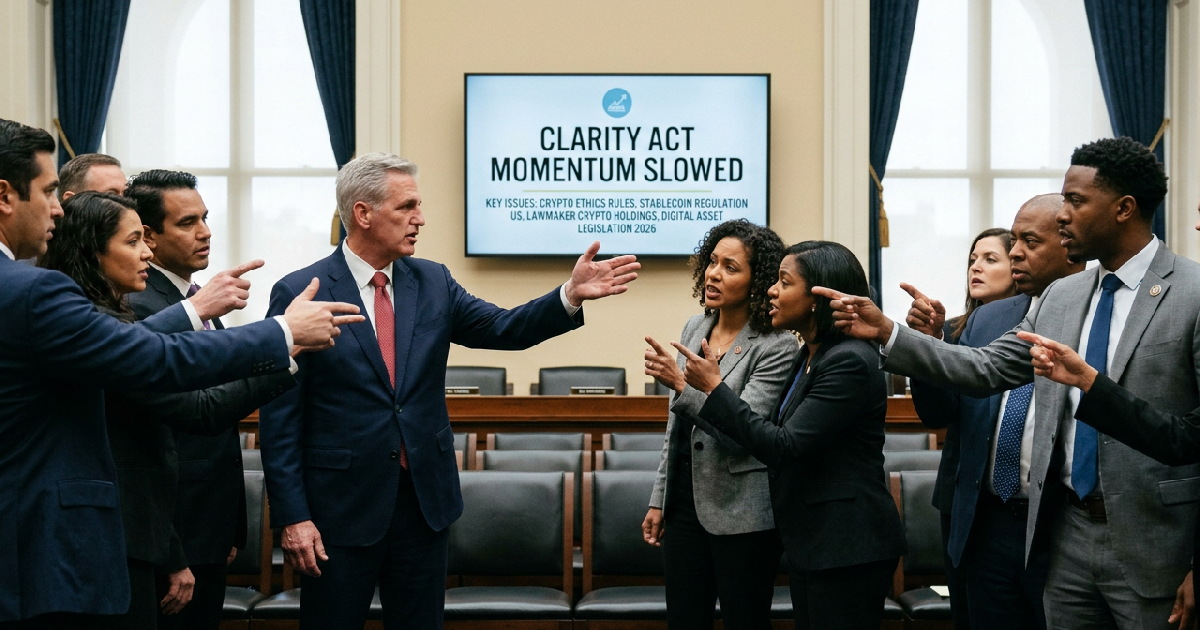

U.S. federal lawmakers have hit a significant stalemate over the CLARITY Act as debates regarding cryptocurrency ethics rules derail legislative progress. Disagreements within the House of Representatives and Senate over how to regulate the personal digital asset holdings of public officials have effectively stalled the bill.
What began as a bipartisan push to provide regulatory certainty for the stablecoin and blockchain sectors has now devolved into a partisan dispute over transparency and potential conflicts of interest.
The impasse comes at a precarious time for the industry, which has been seeking a definitive legal framework to operate within the United States. Without the passage of the CLARITY Act, businesses remain in a state of flux, governed by contradictory enforcement actions rather than clear-cut statutes.
Lawmakers are currently divided on whether to mandate the total divestment of crypto assets for officials overseeing financial policy or simply require more rigorous disclosure protocols.
Industry observers argue that this legislative friction reflects a broader discomfort with how decentralized finance integrates into traditional government ethics. While some representatives argue that holding digital assets is necessary to understand the technology, others view it as a direct threat to the integrity of the regulatory process.
This friction has pushed the timeline for the bill’s potential passage well into late 2026, leaving the market to grapple with existing volatility.
Ethical hurdles for the CLARITY Act and lawmaker holdings
The core of the disagreement centers on a specific provision that would regulate how members of Congress and their immediate families manage digital currency investments. Some legislators are pushing for a “blind trust” requirement, similar to those proposed for individual stocks, to prevent insider trading.
However, the unique nature of blockchain transactions, which are often public yet pseudonymous, complicates the drafting of these specific ethics rules.
Concerns have also been raised regarding the influence of major industry players on the legislative process. Recent reports indicate that several high-profile families involved in the sector have seen massive fluctuations in their holdings, further sensitizing the public to the intersection of political power and private wealth. For instance,
com/trump-media-bitcoin-deposit-cryptocom-transfer/”>Trump Media recently moved 2,650 Bitcoin to an exchange, highlighting the scale of assets often held by entities tied to political figures.
Critics of the current delay argue that by focusing on internal ethics, Congress is ignoring the urgent need for consumer protection. The lack of a unified stablecoin framework has left the U.S. financial system exposed to risks associated with offshore operators.
Proponents of the bill suggest that the ethics debate, while important, should be handled as a separate amendment rather than a “poison pill” for the entire piece of legislation.
Market implications of the legislative slowdown
The slowing momentum of the CLARITY Act is already starting to manifest in market sentiment and institutional planning. Companies that were preparing to launch new stablecoin products are now reconsidering their timelines or looking toward European jurisdictions where the MiCA framework provides more stability.
The uncertainty in Washington often leads to a “wait and see” approach that stifles domestic innovation and drives capital toward more welcoming markets.
Technical indicators also suggest that the market is preparing for a longer period of consolidation as these legal battles play out. Many traders are looking at long-term metrics to find footing during the policy vacuum. It is one reason why Bitcoin traders prioritize the 200-day moving average when navigating a landscape devoid of clear regulatory catalysts.
Furthermore, the delay impacts how large-scale holders manage their portfolios. If the CLARITY Act fails to move forward, the “strategic reserve” conversations that dominated early 2026 may lose steam. Without a legal definition of what constitutes a compliant digital asset, institutional custody remains a complex and expensive hurdle for most traditional American banks.
Future of stablecoin regulation and bipartisan cooperation
Despite the current friction, some members of the House Financial Services Committee remain optimistic that a compromise can be reached before the end of the year. The pressure to act is mounting as other nations move ahead with their own digital asset standards.
There is a growing realization that the United States risks losing its role as the global leader in financial technology if it cannot resolve these internal disputes.
The stablecoin market, in particular, has become too large for Congress to ignore indefinitely. As Tether reveals $141 billion Treasury holdings, the link between digital assets and the stability of U.S. government debt becomes increasingly clear. This interconnectedness may eventually force lawmakers to set aside ethics disagreements in favor of broader economic security and the preservation of the dollar’s dominance.
For now, the CLARITY Act remains in a state of legislative limbo. The coming months will likely see intense behind-the-scenes negotiations as staffers attempt to find a middle ground on ethics disclosures. Until then, the industry will have to rely on the slow and often inconsistent updates provided by the courts and individual regulatory agencies like the SEC and CFTC.