
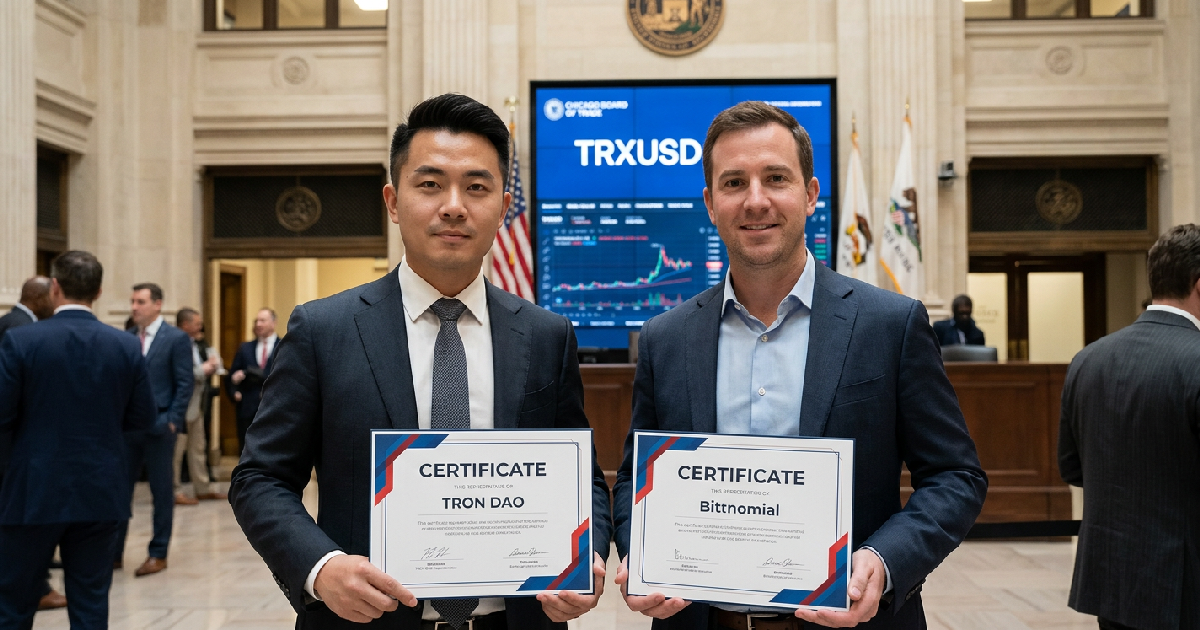

TRON DAO and Bitnomial, the Chicago-based crypto derivatives exchange, announced on June 5, 2026, the spot listing of TRX for the United States market. This move allows U.S. investors to trade the TRON network’s native utility token through a platform regulated by the Commodity Futures Trading Commission (CFTC).
The new TRXUSD contract is a physically-settled, margined spot product designed to provide institutional-grade access to one of the world’s most active blockchain ecosystems.
The listing follows a formal self-certification process Bitnomial Exchange, LLC submitted to the CFTC. Because the regulator did not object during the statutory review period, the exchange moved forward with the launch. All trades will be cleared through Bitnomial Clearinghouse, LLC, ensuring that the asset remains within a regulated financial framework.
This structure attracts institutional players who have previously avoided TRX due to a lack of compliant U.S. trading venues.
Justin Sun, the Founder of TRON, described the listing as a vital step for the network’s maturity in the American market. Sun noted that as the demand for compliant digital asset products grows, availability on regulated platforms like Bitnomial supports greater transparency. The timing is particularly relevant as Tron price prediction targets have shifted recently following various global exchange integrations and index additions.
Expanding TRX reach within CFTC regulated frameworks
Bitnomial operates as a Designated Contract Market (DCM) and a Derivatives Clearing Organization (DCO). This dual registration allows it to offer leveraged spot and futures products under strict federal oversight. By adding TRX, the exchange provides a bridge for U.S. traders who want exposure to the TRON network’s high transaction volume and stablecoin activity.
The TRON blockchain currently hosts more than $89 billion in circulating USDT. It also maintains over $27 billion in total value locked (TVL), making it a dominant force in digital asset settlement. These figures highlight why a regulated U.S. on-ramp is such a significant development for the network’s long-term liquidity and institutional adoption.
The Bitnomial listing is not an isolated event but part of a broader push for institutional infrastructure. Recently, TRX became available for custody through Anchorage Digital, the first federally chartered crypto bank in the United States. This growing foundation suggests a shift toward the “maturation” Justin Sun mentioned, moving the token beyond retail speculation into the realm of professional finance.
Institutional demand for regulated crypto spot products
Market participants are increasingly looking for “physically-settled” contracts, which mean the actual TRX tokens are delivered rather than just a cash equivalent. This transparency is a key selling point for Bitnomial, which manages clearing and brokerage via its own subsidiaries. Such a unified exchange and clearinghouse model reduces the counterparty risk often found in offshore, unregulated exchanges.
Market data from Bitnomial’s CFTC filing shows that TRX maintained a market capitalization of $34.49 billion in late May 2026. Despite broader market volatility, the token has shown resilience. While the global cryptocurrency market recently saw a double-digit decline, TRX outperformed many peers, which some analysts attribute to its massive revenue from network fees.
In the last 24 hours alone, TRON recorded over $8.28 million in project revenue. This cash flow is driven by the 385 million total user accounts on the network. As bitcoin signals suggest shifting market structures across the industry, utility-heavy networks like TRON are positioning themselves as more than just payment rails.
Key TRON network statistics as of June 2026
- Total Value Locked (TVL): Over $27 billion
- Circulating USDT on TRON: Exceeds $89 billion
- Total User Accounts: 385 million
- Daily Project Revenue: Approximately $8.28 million
- Total Transactions: Over 14 billion
The Bitnomial listing provides a regulated path for American investors to participate in this ecosystem without the legal hurdles of offshore platforms. It effectively brings TRX into the same regulatory conversation as Bitcoin and Ethereum, which have long dominated the U.S. regulated futures and spot markets.
Future outlook for TRON in the United States
The launch of TRXUSD on Bitnomial could serve as a precursor to more complex financial instruments. With a regulated spot price now established on a CFTC-governed exchange, the door opens for potential futures and options contracts. This path mirrors how other major tokens have integrated into the U.S. financial system over the last several years.
As the digital asset landscape evolves, the focus has shifted toward “tokenized real-world assets” (RWAs). TRON DAO has already begun working with top-tier asset managers to expand these products. The availability of TRX on regulated infrastructure is a prerequisite for these high-level partnerships to succeed in the U.S. market.
Reliable market infrastructure remains the biggest hurdle for institutional crypto adoption. By leveraging Bitnomial’s Chicago-based clearinghouse, TRON is effectively de-risking the asset for hedge funds and corporate treasuries. This development likely marks the end of TRX’s era as an “offshore-only” asset, cementing its place in the regulated U.S. financial ecosystem.