
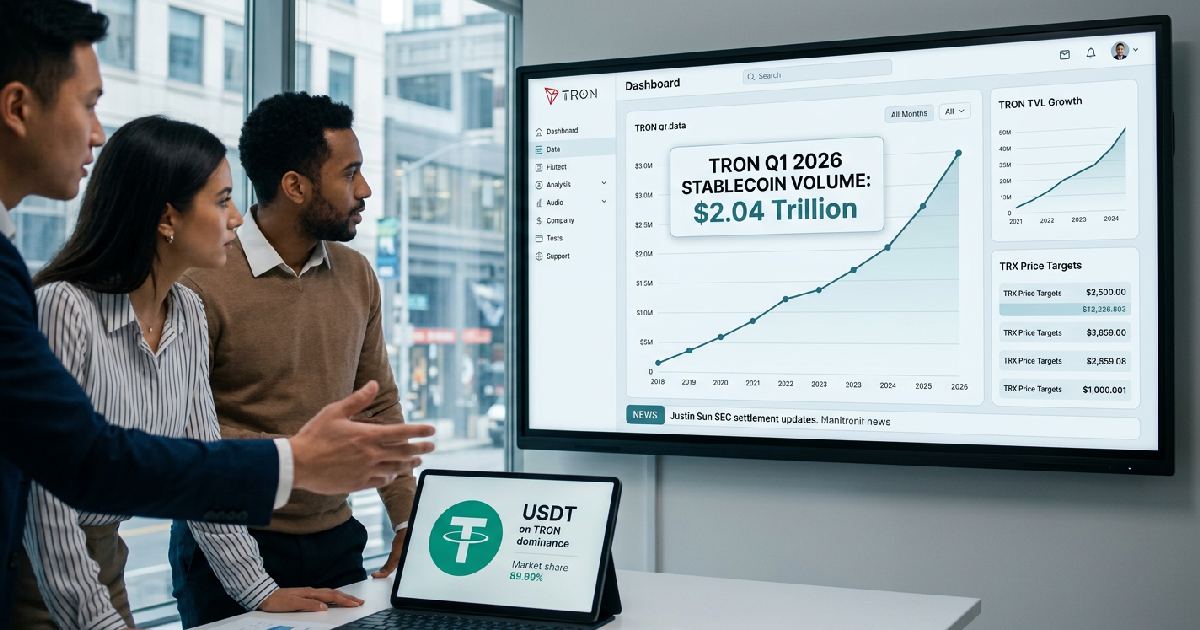

TRON (TRX) processed $2.04 trillion in stablecoin payments during the first quarter of 2026, marking a record period that has pushed analysts toward a bullish outlook for the network. Founder Justin Sun and the TRON DAO reported the volume as the asset currently sits at a price of $0.
34 with a market capitalization of $32 billion. According to research data, the network’s activity was largely underpinned by Tether (USDT), which maintains a dominant 98.6% market share of all stablecoins on the TRON blockchain.
The network\’s performance in the early months of 2026 diverged sharply from broader market trends. While Bitcoin (BTC) saw a 24% decline during Q1, the TRX token rose by 9%. This resilience is increasingly tied to TRON’s role as a settlement layer, with the network handling approximately $23 billion in daily stablecoin transfers.
Revenue remains high, with TRON posting $604 million in network revenue year-to-date as of June 5, 2026, ranking it among the industry\’s top-earning protocols.
As the Tron price prediction gains new technical targets, the network is benefiting from improved legal standing. In March 2026, the U.S. Securities and Exchange Commission (SEC) reached a settlement with the Tron Foundation and Justin Sun, dismissing all claims.
This development has provided much-needed regulatory clarity in the United States, encouraging institutional interest as the coin eyes a potential retest of its $0.43 all-time high.
Stablecoin growth and varying liquidity metrics
The total supply of stablecoins on TRON fluctuated between $85 billion and $86 billion throughout the first quarter before rising to $86.6 billion by April 7, 2026. This figure represents nearly half of the global total stablecoin supply. USDT remains the primary asset on the chain, accounting for $84.5 billion of that total.
High liquidity levels correlate with Tether treasury holdings and their broader impact on the digital asset economy.
Data regarding Total Value Locked (TVL) on the network presents a mixed picture depending on the source. Research indicates that TVL climbed 7.38% to reach $26 billion in Q1 2026. However, alternative market data suggests a much lower figure, placing TVL at $4.7 billion following a 7.1% quarter-over-quarter increase.
Despite these discrepancies in reporting, the directional trend for locked capital on the network remained positive through the first three months of the year.
Network efficiency has also improved through new technical integrations. On March 2, 2026, TRON DAO integrated Dune Analytics’ Model Context Protocol (MCP) server. This allows users to query stablecoin data using natural language prompts through AI agents like Claude. Such tools make on-chain data more accessible to retail traders who are monitoring shifting market structures to time their entries into the TRX market.
Surging active addresses and European market entry
User adoption peaked in April 2026, when the network recorded 76.09 million daily active addresses. This represented a 46% increase from March figures. Transaction volume followed suit, with 290 million monthly transactions recorded in April. During the first quarter, average daily transactions reached a record 10.9 million.
These metrics suggest that the network is being used for more than just simple transfers, reflecting a deeply engaged user base.
Geographic expansion is also providing a tailwind for the TRX price. This week, OKX Europe listed TRXUSD expiry perpetuals, opening regulated exposure for the asset across the European Economic Area for the first time. This move provides a gateway for European institutional capital.
Combined with the $2 trillion in USDT transfers processed by TRON in Q1—second only to Ethereum’s $2.2 trillion—the network’s global footprint is continuing to expand.
Forecasts and long-term price targets for 2026
Technical analysts have adjusted their TRX price predictions in light of these fundamental shifts. Changelly currently forecasts an average price of $0.40 for June 2026. Looking further into the summer, Binance projections for August 2026 suggest an average price of $0.372, with a potential maximum of $0.437.
Some analysts are more aggressive, suggesting that a move toward $0.57 is possible by the end of the year if address growth remains consistent.
Longer-term outlooks remain optimistic as the network matures. By September 2026, Binance projects an average price of $0.380, with a maximum range reaching $0.444. Looking toward 2027, analysts have set targets ranging from $0.47 to $0.89.
The combination of high network revenue, nearly $87 billion in stablecoin supply, and the resolution of legal challenges in the U.S. has created a fundamental floor for the asset’s valuation.