
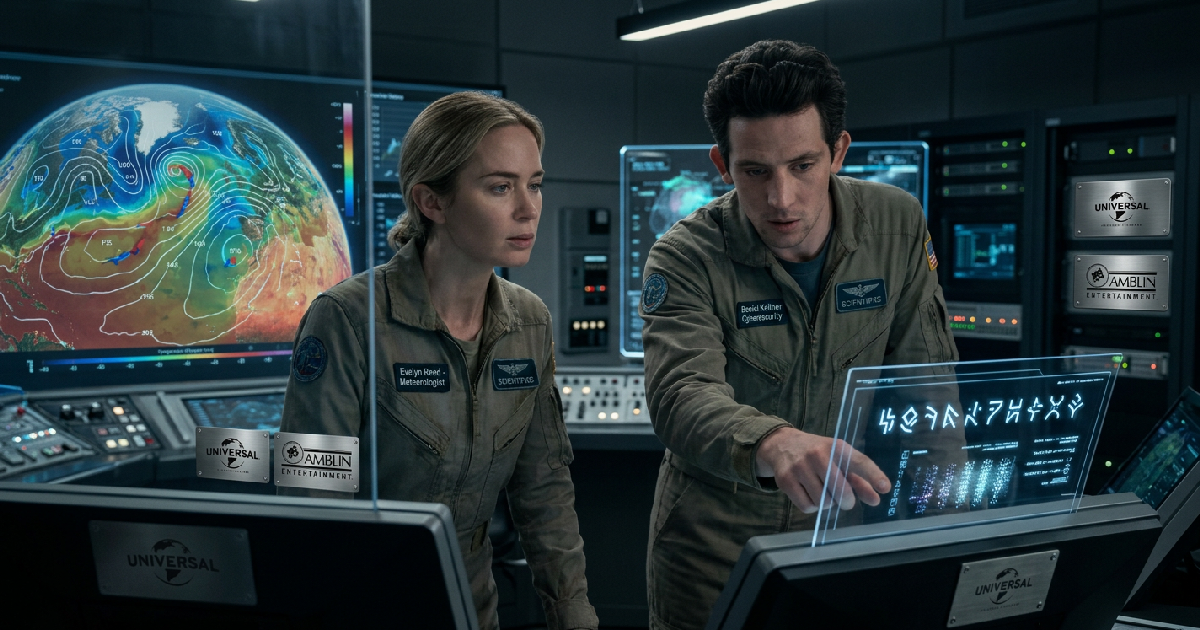

Director Steven Spielberg returned to the summer blockbuster stage this week as critics issued largely positive reviews for his latest sci-fi thriller, “Disclosure Day,” which debuted nationwide on June 12, 2026.
The film stars Emily Blunt as a mysterious meteorologist and Josh O’Connor as a cybersecurity expert caught in a high-stakes conspiracy involving proof of extraterrestrial life. Following preview screenings on Thursday, the Universal Pictures and Amblin Entertainment production has secured an 87% “fresh” rating on Rotten Tomatoes and a 74 score on Metacritic.
The 2-hour and 25-minute epic, written by David Koepp from an original story by Steven Spielberg, follows Daniel Kellner (Josh O’Connor) as he flees from his former boss, Noah Scanlon (Colin Firth). Scanlon serves as the director of WARDEX, a shadow agency desperate to contain proof of alien contact.
Along the way, Kellner intersects with Margaret Fairchild (Emily Blunt), a TV meteorologist whose eccentric behavior suggests she knows more about the impending revelation than she lets on. The PG-rated film ends an uncommonly long gap for the director since his 2022 movie, “The Fabelmans.”
Critics have highlighted the film’s blend of classic “Spielbergian” wonder with a more modern exploration of government secrecy and religious faith. While the movie echoes the DNA of “Close Encounters of the Third Kind” and “War of the Worlds,” it focuses heavily on the “ripple effect” of disclosure.
The narrative explores how the confirmed existence of “supreme beings” might dismantle established organized religion or unite a fractured global populace. This thematic depth is supported by a cast that includes Colman Domingo as a WARDEX defector named Hugo, Eve Hewson as Jane, and Wyatt Russell.
Critics praise Emily Blunt and technical mastery in Disclosure Day reviews
The consensus among top reviewers suggests that “Disclosure Day” is a masterclass in technical filmmaking, even if it occasionally lacks the raw awe of Steven Spielberg’s earlier alien encounters. Peter Bradshaw of The Guardian described the film as “grade-A fun,” specifically praising the “career-topper” performance by Emily Blunt.
He noted that the film’s exhilarating chases and “barnstorming set-pieces” make it a rare achievement in contemporary cinema, shifting market structure expectations for summer sci-fi titles.
Writing for the San Francisco Chronicle, G. Allen Johnson awarded the film a perfect 10 out of 10 stars. He pointed to a “pulse-pounding train sequence” and the expert blocking of scenes as evidence of the director’s enduring skill.
Johnson noted that even simple sequences, such as Emily Blunt walking through a crowded newsroom, were constructed with the intricate precision of a classic Hollywood musical. The visual language of the film bridges the gap between old-school craftsmanship and 21st-century digital scale.
The film’s score also reunites Steven Spielberg with long-time collaborator John Williams. The music serves as an emotional anchor for the film’s more abstract questions about humanity’s place in the universe. Critics suggest the score helps ground the high-stakes tension of the extraterrestrial tale.
This technical polish is consistent with the filmmaker’s history of delivering high-production value, much like how advances in connectivity can shift public expectations for technical infrastructure.
Analysis of the sci-fi thriller’s narrative and thematic weight
While the action sequences have garnered acclaim, some critics find the film’s philosophical inquiries to be its most compelling asset. Brian Tallerico of RogerEbert.com gave the movie 4 out of 4 stars, stating that Steven Spielberg is less interested in the immediate impact of aliens and more in the “ripple effect” on human society.
He questioned whether the truth would “unite us or divide us further,” highlighting the film’s focus on how trust and empathy function during a global crisis.
However, the reception has not been entirely without critique. Variety’s Owen Gleiberman noted that while the ride is “vigorous and diverting,” the film struggles to compete with the modern reality of real-world unidentified aerial phenomena (UAP) footage.
He argued that the “contact high of awe” found in “Close Encounters” is harder to achieve in an era where the public is already saturated with headlines about government transparency. The film attempts to address this by focusing on the legal and spiritual fallout of the revelation.
This sense of modern-day skepticism is baked into the character of Daniel Kellner. As a cybersecurity expert, his journey reflects contemporary anxieties about data leaks and institutional lies. In the film, he fights to bring transparency to a world hidden by WARDEX. This push for total clarity resembles the way com/tether-treasury-holdings-us-debt-risk/”>transparency in financial holdings is often sought to provide stability in markets clouded by institutional uncertainty.
A mature perspective on the extraterrestrial genre
Odie Henderson of the Boston Globe described “Disclosure Day” as an “old man’s movie,” but clarified that he meant the term as high praise. He suggested that the film showcases a perspective and wisdom that Steven Spielberg could not have possessed in the 1970s or 80s.
Every skill acquired over a five-decade career appears to have been utilized to shape this more reflective, perhaps more hopeful, take on first contact. The film suggests that humanity’s response to the unknown should be rooted in empathy.
The film currently playing at venues like Galaxy Cinemas Sault Ste. Marie is being positioned as a major sci-fi event of 2026. The cast is rounded out by Elizabeth Marvel, who plays a Mother Superior, further emphasizing the film’s intersection of science and spirituality.
With a screenplay by David Koepp, who previously worked with the director on “Jurassic Park,” the technical foundation is robust. The movie aims to provoke thought long after the credits roll.
As the film continues its nationwide theatrical run, the industry will be watching its box office performance closely to see if Spielberg can still command the “summer blockbuster” title. Early indicators from Rotten Tomatoes suggest that audiences are ready for a grand-scale narrative that prioritizes human curiosity over mere special effects.
The final act’s moral, centered on trust, appears to be vibrating well with viewers seeking optimism in an increasingly complex world.