
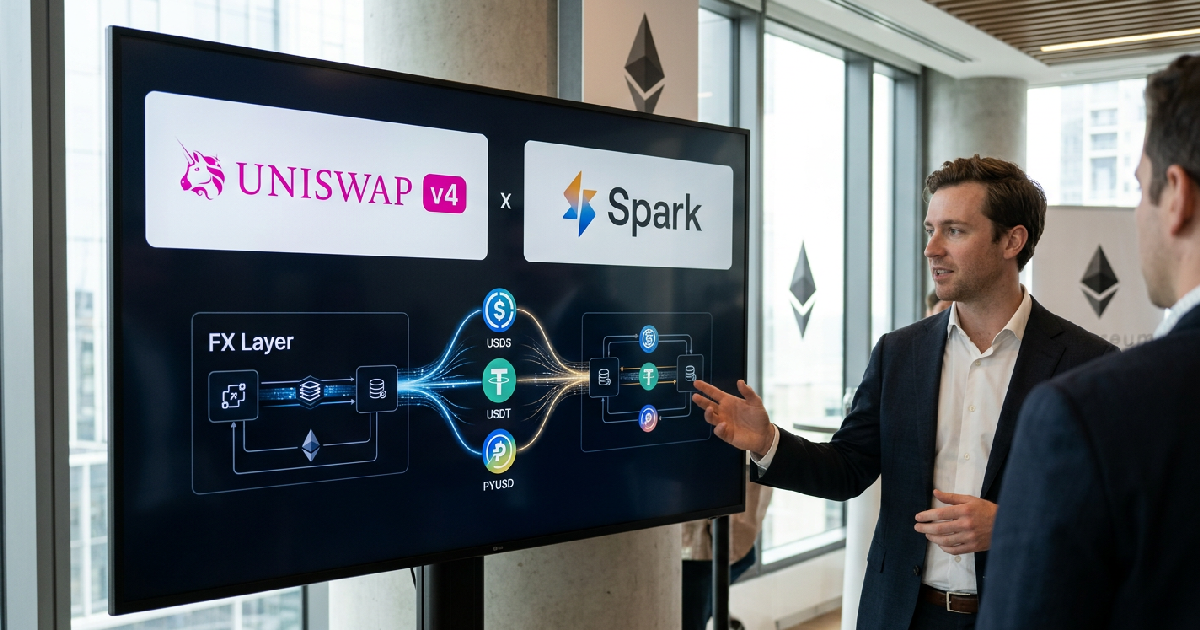

Spark and Uniswap announced a collaborative effort on Thursday, June 25, 2026, to launch a stablecoin “FX Layer” on the Uniswap v4 protocol, kickstarted by a $150 million liquidity migration. The initiative focuses on providing banks and fintech institutions with a low-slippage infrastructure for stablecoin conversions, specifically targeting the USDS, USDT, and PYUSD markets on Ethereum.
The “FX Layer” serves as a shared settlement system, allowing institutional players to access a unified liquidity pool without the need to engineer internal market-making software.
Addressing stablecoin liquidity fragmentation through Uniswap v4
By seeding this layer with $150 million from the USDS ecosystem, Spark aims to resolve the persistent issues of fragmented liquidity and idle capital that have historically burdened the decentralized finance (DeFi) sector.
While Ethereum navigates key support during broader market shifts, this deployment reinforces the network’s role as a critical backend for global financial settlement.
The core problem this partnership addresses is the inefficiency of capital sitting in isolated silos across the DeFi market. Spark CEO Sam MacPherson noted that the next generation of stablecoins will likely be defined by the infrastructure that allows hundreds of issuers to operate together at a global scale.
Key details
He emphasized that while the native stablecoin remains visible to the user, the underlying liquidity infrastructure must become “invisible.”
Currently, Spark manages approximately $6.8 billion in Total Value Locked (TVL) across the Ethereum, Gnosis, and Base networks. By concentrating $150 million of that capital into Uniswap v4, the protocol is building a foundation for trade efficiency normally found only on centralized exchanges. This development coincides with a period where DEX growth trends are increasingly driven by institutional-grade tools and improved technical architectures.
The initial deployment consists of two specific pools on Uniswap v4: one pairing USDS with PayPal’s PYUSD and another with Tether’s USDT. USDS, the successor to the DAI stablecoin issued by Sky (formerly MakerDAO), currently ranks as the third-largest dollar-pegged stablecoin in the market.
The architecture allows Spark to oversee liquidity allocation and governance while Uniswap provides the automated market maker (AMM) framework to facilitate high-volume institutional swaps.
Technical milestones and the role of the DualPool hook
The implementation of the FX Layer relies on Uniswap v4’s programmable architecture, particularly the use of “hooks.” In future phases, Spark intends to deploy its “DualPool” hook alongside the Spark Shared Liquidity Layer (SLL). These tools will allow the protocol to coordinate liquidity distribution across varied stablecoin markets dynamically, maintaining depth even during periods of high volatility.
For large-scale users, the primary benefit is the reduction of slippage. Large blocks of capital can often move prices in smaller pools, increasing costs. The $150 million migration provides sufficient depth to mitigate these issues.
This move follows a period of growth for the sector after the passage of the GENIUS Act last year, which helped expand the total stablecoin market capitalization by providing regulatory clarity.
Projected growth and the road to 2030
Market analysts are increasingly bullish on the role of DeFi in the broader financial system. Standard Chartered recently forecasted that total assets held in DeFi could reach $2.7 trillion by 2030, with a prediction of $100 for Uniswap’s UNI token. Furthermore, some reports suggest stablecoin trading volumes could reach $1.5 quadrillion by 2035, matching the scale of traditional payment giants like Visa and Mastercard.
To reach those levels, the industry requires the type of robust plumbing currently being established by the FX Layer. This infrastructure is intended to unite traditional fintech entries like PayPal USD with established crypto-native assets like USDT. As assets move toward decentralized utilities, evidenced by bitcoin exchange supply maintaining multi-year lows, the demand for stable, low-slippage conversion paths is expected to grow.
The evolution of Spark and Sky governance
The migration also highlights the ongoing evolution of the Spark Protocol, which launched in May 2023 as part of the MakerDAO Endgame plan. Originally a fork of Aave V3, Spark is now transitioning its governance from the MakerDAO MKR token to the SKY token. This transition includes the separate SPK token, which was approved in 2024 to handle Spark-specific governance decisions.
The Spark Liquidity Layer has been operating as a non-custodial capital allocator since November 2024. By integrating directly with Uniswap v4, Spark is positioning itself as an orchestration layer for dollar liquidity. This setup allows the protocol to move quickly on new institutional partnerships and technical integrations, serving as a scalable bridge between decentralized protocols and the wider financial world.