
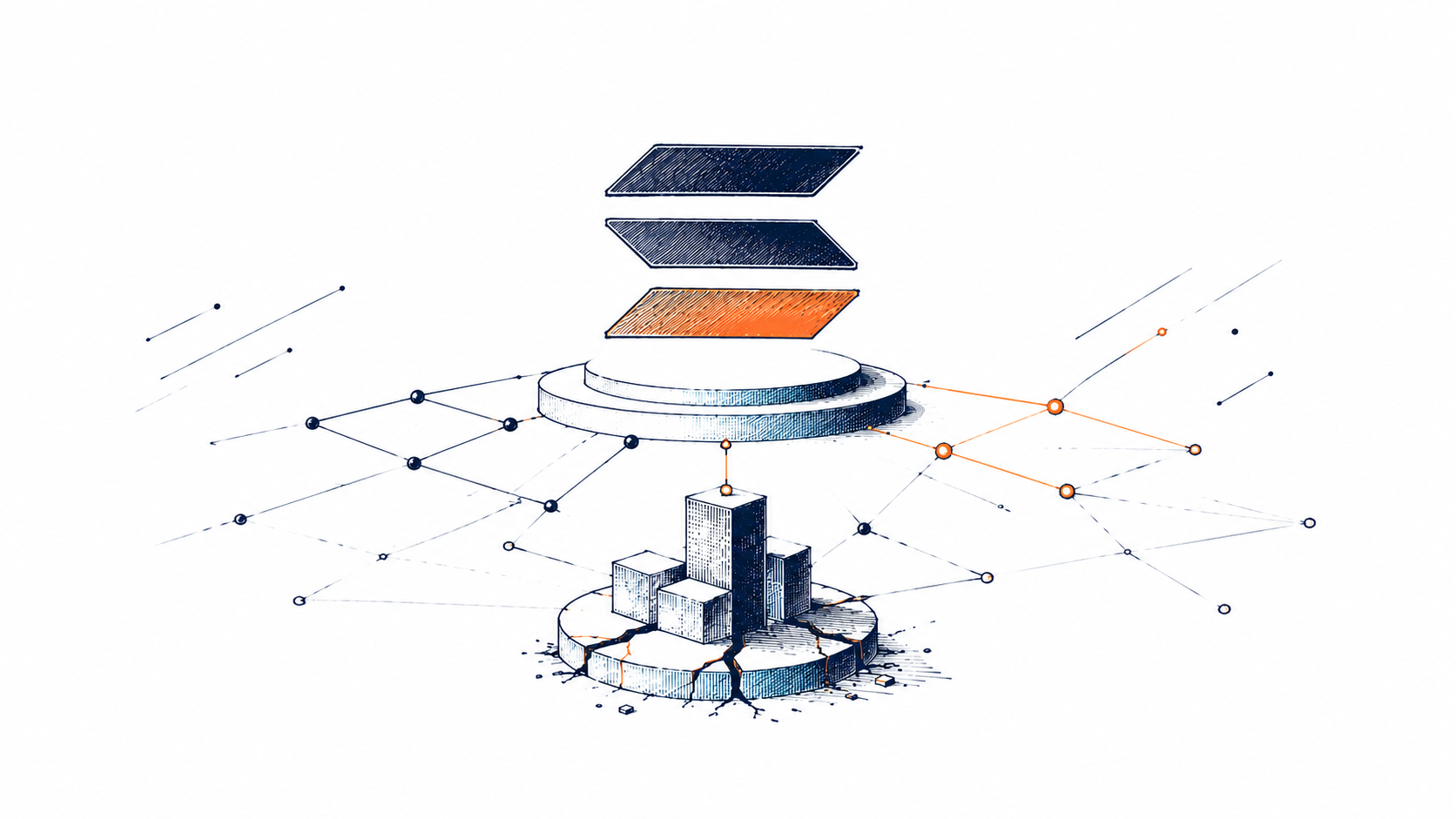

Solana went through one of the most severe tests of its recent infrastructure without the blockchain going down.
On August 12, a routing failure associated with TeraSwitch temporarily knocked offline validators responsible for 28.83% of all staked SOL. That figure matters because once more than one-third of the stake stops participating in consensus, the network loses its ability to finalize new transactions.
For a brief period, Solana came within just over four percentage points of that threshold.
Yet the blockchain kept running.
The episode could be viewed simply as a demonstration of resilience. Even with nearly 29% of the stake temporarily unavailable, enough validators remained active to preserve consensus and transaction finality.
But the source of the problem tells another story.
The failure did not occur within the Solana protocol. It was not a bug in the consensus mechanism or a software problem affecting the blockchain itself. It occurred in shared infrastructure used by dozens of validators.
That exposed a form of concentration that traditional measures of decentralization do not always capture.
Many Validators Can Share the Same Point of Failure
When evaluating how decentralized a blockchain is, the usual questions involve how many validators it has, how stake is distributed among them and how much power would be required to control consensus.
Those metrics remain important, but they do not tell the whole story.
Validators need servers, connectivity, electricity and data centers to remain online. Independent operators can therefore participate separately in consensus while relying on the same underlying infrastructure to run their validators.
That is precisely the dependency the Solana incident made visible.
The TeraSwitch routing failure affected roughly 90 validators at the same time. Data released after the incident indicated that approximately 27% of active stake was associated with the company’s infrastructure.
That does not mean TeraSwitch controlled those tokens or the validators’ votes. The problem was operational: when so many independent operators rely on the same infrastructure, a single failure can remove a significant portion of them from consensus simultaneously.
The validators may remain decentralized in terms of control.
The infrastructure keeping them online may not be decentralized to the same degree.
The Concentration Was Visible Before the Failure
The incident did not uncover an entirely unknown dependency.
In its June 2025 network health report, Solana showed active validators spread across more than 100 data center providers. At first glance, that suggested broad distribution.
Looking at the stake told a different story.
TeraSwitch hosted 108 validators responsible for 24.28% of the stake, while Latitude.sh accounted for another 21.42%. AWS was far behind at 5.98%.
More recent data indicated that the share associated with TeraSwitch infrastructure had grown to roughly 27% before the incident.
There is an economic reason for this type of concentration.
Running high-performance validators requires hardware, connectivity and maintenance. Specialized providers can deliver those resources efficiently, and as they build reputation and scale, they naturally become attractive choices for more operators.
Individually, each decision can make sense.
The risk emerges when many independent decisions create the same dependency.
This is a different form of centralization. It does not necessarily concentrate control over consensus, but it does concentrate part of the infrastructure required to participate in it.
Solana Showed Resilience at the Same Time It Exposed a Weakness
There is an important counterpoint: the incident also demonstrated that Solana’s architecture worked as intended.
An exceptionally large portion of the stake temporarily disappeared, yet enough validators remained online to preserve finality. The problem was resolved without the blockchain having to halt operations.
That distinguishes the episode from the outages that marked part of Solana’s earlier history.
Had the network stopped, the discussion would probably have returned to the stability problems that followed Solana through its early years. This time, however, the protocol absorbed a significant failure that occurred beneath it.
That is precisely what makes the incident interesting.
Solana demonstrated that its consensus can tolerate the temporary loss of a substantial portion of its validators. At the same time, the episode revealed how much of that participation could disappear because of a single problem outside the protocol.
The two conclusions are not contradictory.
The network demonstrated greater resilience.
The infrastructure revealed where concentration still exists.
The Next Decentralization Challenge May Be Outside the Blockchain
The Solana incident suggests that the way we think about decentralization may need to expand.
Two questions have traditionally dominated the discussion:
How many validators are there?
And how much stake do the largest operators control?
Both attempt to measure the distribution of power within the protocol.
This week’s incident introduces a third question:
How many of those validators can disappear at the same time when a single company, network or data center runs into trouble?
That measures something different.
Not who controls consensus, but how many shared points of failure exist beneath it.
The distinction is likely to become increasingly important as blockchains move beyond experimental networks and begin supporting payments, markets, stablecoins and financial applications that need to remain continuously available.
In that environment, decentralization cannot be only a property of code or stake distribution. Network resilience also depends on the physical infrastructure that allows the system to keep running.
Solana did not go down on August 12.
And that may be precisely what makes the episode so useful.
Rather than exposing just another failure, it revealed a dimension of decentralization that usually remains invisible while everything works: it is not enough to know how many validators a blockchain has. It also matters how many of them depend on the same things to stay online.