
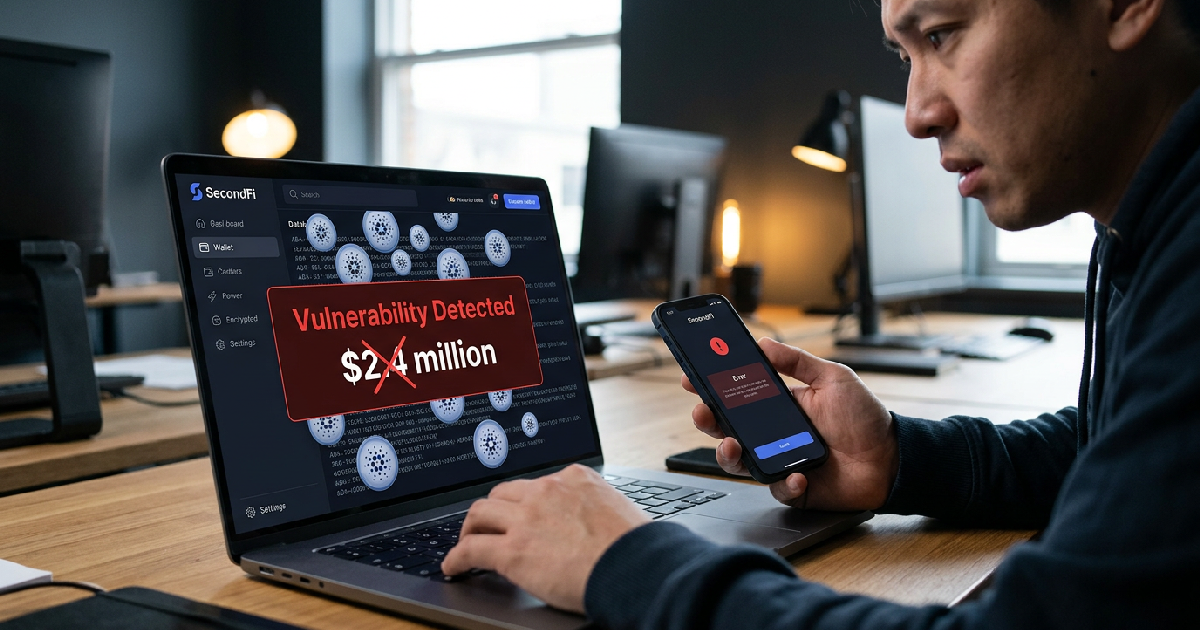

SecondFi announced a significant wallet generation vulnerability on June 23, 2026, which led to an initial loss of 16 million ADA worth approximately $2.4 million from user accounts.
The platform, which operates within the Cardano (ADA) ecosystem, revealed that a fundamental flaw in its wallet-creation process compromised private keys, effectively granting unauthorized parties a direct entry point into user funds.
Security flaws in Cardano wallet generation process
Early investigations suggest the total financial exposure could be much higher, with potential losses reaching 129 million ADA when accounting for various native tokens and non-fungible tokens (NFTs).
The security breach has forced SecondFi to temporarily suspend all services and enter an emergency maintenance mode while developers attempt to contain the fallout. On-chain data has already identified several suspicious addresses linked to the movement of these funds, but the decentralized nature of the blockchain makes recovery a complex task.
For the Cardano community, this incident marks one of the most substantial infrastructure-related security failures in recent months, raising urgent questions about the safety protocols governing third-party wallet providers.
The core of the issue lies in how SecondFi generated the cryptographic seeds for new users, a process that is supposed to ensure that private keys remain unique and inaccessible to anyone but the owner.
According to the platform’s initial report, a technical error meant these keys were not as secure as intended, allowing attackers to reconstruct or bypass the expected security barriers.
Key details
This vulnerability didn’t just affect a single point of entry; it undermined the fundamental promise of self-custody that many users rely on when moving away from centralized exchanges.
Investigators have so far identified approximately 178 individual wallets that were directly hit during the first wave of the exploit. However, the threat is not limited to those who have already lost funds.
SecondFi recently warned that the danger is persistent, as the vulnerability remains active whenever an affected user attempts to sign a transaction using a compromised address. This creates a “poisoned” environment where any further activity by the user could inadvertently trigger additional thefts or expose remaining assets to the attackers.
As the market reacts to these technical failures, crypto market liquidation analysis suggests that security scares of this magnitude often lead to immediate localized selling pressure as users rush to move assets into “cold” hardware storage.
While the Cardano network itself remains secure and operational, the failure of a layer-2 or service provider like SecondFi highlights the risks inherent in the broader infrastructure. The ability for an attacker to gain unauthorized access via a wallet-generation flaw is a nightmare scenario for any decentralized finance (DeFi) participant.
Financial impact and recovery efforts on-chain
While the $2.4 million in ADA represents the confirmed liquid loss, the secondary exposure to the Cardano ecosystem’s broader asset list is staggering. The reported 129 million ADA potential exposure includes a vast array of community tokens and high-value NFTs that were stored in the compromised wallets.
If these assets are moved or sold on decentralized exchanges, it could suppress the floor prices of several prominent NFT collections and decrease liquidity across the Cardano DeFi landscape.
To mitigate further damage, SecondFi’s security team has successfully isolated many of the affected accounts and taken a full balance snapshot. This snapshot is intended to serve as a definitive record of holdings before the exploit escalated, which is a common precursor to potential reimbursement plans or the issuance of recovery tokens.
Key details
However, the platform has not yet committed to a timeline for restoring funds, leaving many users in a state of financial limbo during a period of high market volatility.
The technical investigation has moved beyond the SecondFi servers to the blockchain itself, where analysts are tracing the flow of 16 million ADA. These funds often move through “mixing” services or multiple hop addresses to obscure their final destination.
This incident follows a broader trend of sophisticated attacks targeting wallet infrastructure rather than the blockchain’s core protocol, similar to how fraudulent recovery schemes proliferate after major exploits to prey on already vulnerable victims. Users are being urged to ignore any unofficial “support” accounts claiming they can help retrieve lost Cardano tokens.
Community backlash and the crisis of trust
The reaction from the Cardano community has been swift and largely unforgiving. SecondFi’s decision to disable comments on several of its social media announcements has exacerbated the sense of frustration among victims.
For many investors, the loss of “life savings” is not just a technical hurdle to be solved by a snapshot, but a personal catastrophe that shatters their confidence in the platform’s management.
One user noted that the lack of open communication “says more than any statement ever could,” suggesting a deep rift in the relationship between the provider and its user base.
Trust is the most valuable currency in the digital asset space, and SecondFi now faces an uphill battle to prove it can ever be a safe harbor for funds again. When a wallet-generation flaw is discovered, it suggests a lack of rigorous third-party auditing and stress testing prior to launch.
Key details
Unlike a standard smart contract bug, a wallet flaw strikes at the very beginning of the user journey, meaning users were effectively compromised from the moment they created their accounts.
This crisis of confidence comes at a time when users are already hyper-vigilant about where they store their digital wealth.
While some may look toward new opportunities, such as how the ApeMars presale gains momentum by attracting those looking for the next big altcoin opportunity, others are retreating to the established safety of Bitcoin or Ethereum hardware wallets.
The lasting legacy of the SecondFi exploit will likely be a renewed demand for “open-source” wallet generation tools that allow for public verification of how private keys are handled.
What the Cardano ecosystem faces next
In the coming weeks, SecondFi is expected to release a detailed “post-mortem” report outlining exactly how the wallet-generation flaw occurred and what measures are being taken to prevent a recurrence.
The Cardano community will be watching closely to see if the platform can secure enough capital to cover user losses or if this exploit marks the end of the project’s viability. If the 129 million ADA exposure is fully realized, it would rank among the largest losses in the history of the ADA ecosystem.
Meanwhile, other wallet providers within the space are likely to conduct their own internal audits to reassure users. This event serves as a stark reminder that even on a highly peer-reviewed blockchain like Cardano, the applications built on top are only as strong as their weakest link.
For now, users with wallets generated through SecondFi are advised to remain in “read-only” mode and wait for official instructions on how to safely migrate their remaining assets to new, uncompromised addresses.
The broader crypto industry is shifting toward more transparent security standards, but as this exploit shows, the race between developers and attackers remains tight. Whether through insurance funds or improved cryptographic standards, the “maintenance” period SecondFi has entered will need to produce more than just a patch; it will need to produce a new blueprint for user safety that the industry can actually trust.