
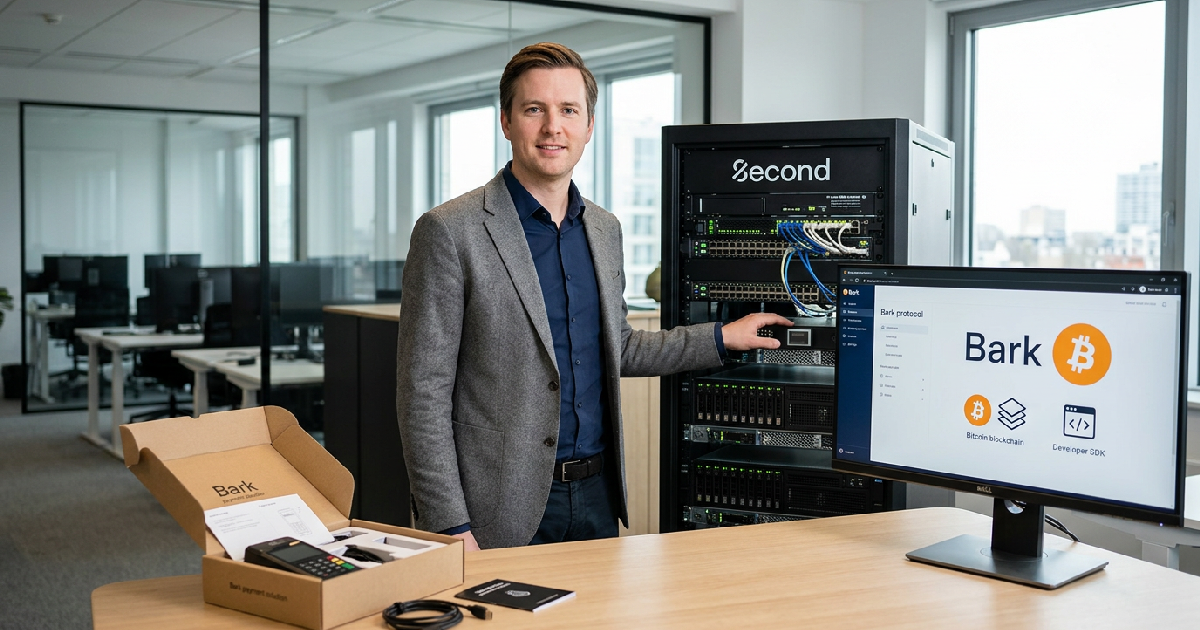

Second, a Bitcoin development lab, officially launched Bark on the Bitcoin mainnet today, June 9, 2026. CEO Steven Roose announced the rollout of Bark, a custom implementation of the Ark protocol designed to bridge the gap between user experience and self-custody in Bitcoin payments. This layer-2 solution allows users to conduct fast, low-cost transactions without the technical overhead of the Lightning Network.
The launch addresses common friction points for Bitcoin users, particularly those who rely on custodial services to avoid managing payment channels or liquidity. Bark utilizes trees of pre-signed, off-chain transactions to share on-chain UTXOs (Unspent Transaction Outputs) across many participants. This architecture spreads transaction fee costs while ensuring that individual users maintain full control of their private keys.
The debut of Bark comes as Bitcoin signals market structure shifts that favor layer-2 scaling. Unlike the Lightning Network, Bark requires no channel opening or pre-allocation of liquidity. Users can send and receive payments immediately, making it a viable tool for those who found the previous self-custodial options too complex for daily use.
Simplifying Bitcoin self-custody through the Ark protocol
Bark operates on a client-server model where users interact with an Ark server to facilitate off-chain payments. A key feature of this system is the unilateral exit guarantee. Users can withdraw their bitcoin from the protocol at any time, either through a cooperative process with the server or independently on-chain by broadcasting specific transactions.
The protocol is built entirely in Rust, providing a performant foundation for high-throughput financial transactions. Theoretically, the Ark protocol has no practical upper bound on throughput and could support millions of transactions per second. This is a sharp contrast to the Bitcoin main chain, which handles approximately 3 to 7 transactions per second with 10-minute block times.
CEO Steven Roose stated in a blog post that the company’s objective was to make it “ridiculously easy for users to get started” with self-custody. By eliminating surprise fees and the need for liquidity providers, Bark aims to attract users who would otherwise keep their assets on centralized exchanges.
This focus on accessibility is a direct response to the rising Bitcoin supply on exchanges hitting multi-year lows as more investors seek sovereign storage solutions.
Developer tools and mainnet-ready mobile wallets
Second has paired the mainnet launch with the release of the Bark SDK, a comprehensive developer toolkit. The SDK includes language bindings for Rust, Kotlin, Swift, React Native, Flutter, Go, Python, and WebAssembly. For server-side integration, the company is shipping “Barkd,” a standalone wallet daemon that features a REST interface and an OpenAPI specification.
Several hardware and software partners have enabled Ark functionality at launch. The Noah mobile wallet utilizes a React Native frontend and a Rust backend to provide a full-stack Ark experience. Meanwhile, Arke offers a native iOS wallet designed around open-source UX principles from the bitcoin.design community. Other compatible apps include Satsigner for multisig workflows and a Bark Wallet app for the Umbrel platform.
Lightning Network interoperability and merchant integration
Bark includes a built-in Ark-to-Lightning bridge, allowing users to pay standard Lightning invoices directly from an Ark balance. This atomic swap occurs without the user needing to open a channel or manage liquidity. It bridges two distinct layer-2 ecosystems, providing users with the flexibility to interact with the broader Lightning network without its inherent management hurdles.
A new BTCPay Server plugin, also developed by Second, allows merchants to accept self-custodial payments via these bridges. This setup enables small businesses to process payments without “renting” inbound capacity or managing Lightning Service Providers (LSPs). Such developments are likely to influence the why Bitcoin traders care about fundamental utility upgrades that drive adoption beyond mere speculation.
Funding and the covenant-less implementation strategy
The development of Bark was supported by a $5.1 million funding round from a private investor. Second consists of an 11-person team, which includes notable talent such as former Blockstream engineer “Grubles.” The team’s technical strategy centered on “covenant-less Ark” (clArk), a method that uses MuSig2 and pre-signed transactions to function on the current Bitcoin mainnet.
This implementation choice allows Second to deploy its technology today without waiting for a Bitcoin soft fork. Bark remains forward-compatible with future “covenant-based” Ark upgrades. This approach positions Second as a primary competitor in a landscape that includes Ark Labs’ Arkade and various statechain solutions, all vying to solve the user experience gap in the Bitcoin industry.
To provide further technical details to the community, Second will host a live AMA on Stacker News today, June 9, at 10:00 AM EST. The session is expected to cover topics ranging from unilateral exit fee structures to the long-term roadmap for the Bark SDK.
As the race for layer-2 dominance continues, the success of these implementations will depend on their ability to maintain security while matching the convenience of custodial apps.