
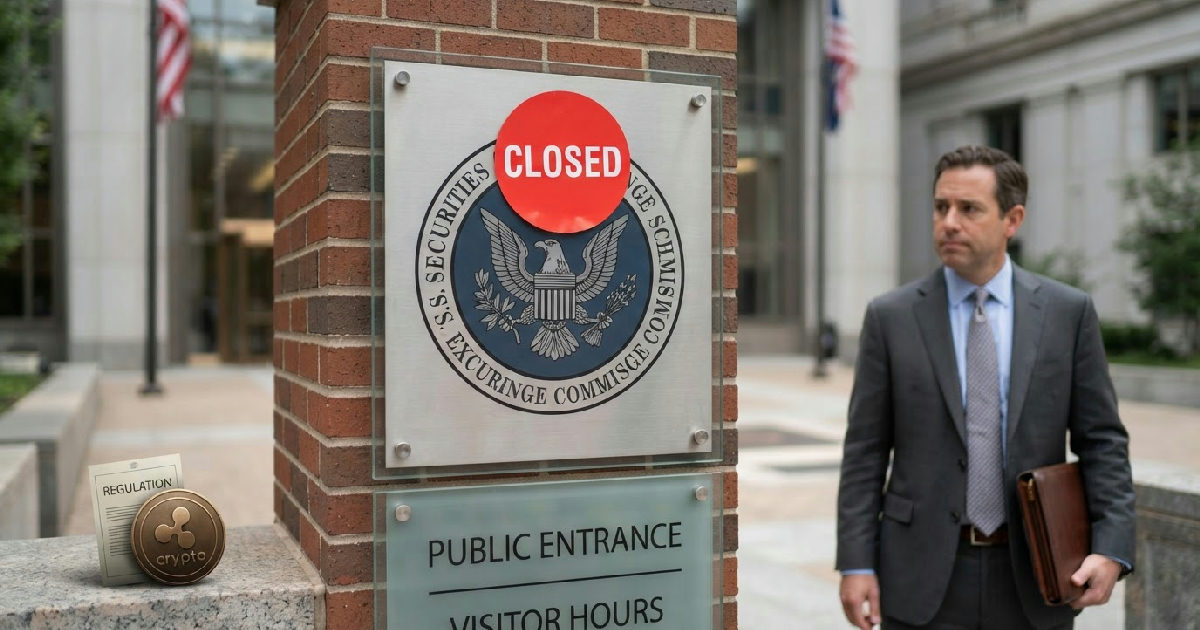

The SEC shelves crypto regulations by abruptly cancelling a public meeting scheduled for Friday, August 14, 2026, at 10:00 a.m. ET. S. Securities and Exchange Commission (SEC) abruptly cancelled an open meeting scheduled for Friday, August 14, 2026, at 10:00 a.m. ET.
This sudden move postponed the public’s first look at a potential new regime for crypto fundraising, a development that leaves digital asset issuers still seeking clearer paths to secure capital.
The agency cited an “unforeseen scheduling issue” as the reason for the cancellation, announcing it late Thursday, August 13, 2026, at 5:13 p.m. ET. But reports suggest the decision stems from concerns among Wall Street and White House officials. They worried that unilateral SEC action might clash with ongoing Senate discussions surrounding the Digital Asset Market Clarity Act (CLARITY Act).
Regulatory vacuum persists for token issuers
The cancelled meeting was set to consider a proposal known colloquially as “Regulation Crypto.” This framework would have introduced tailored offering regimes for certain investment contracts involving crypto assets. Specifically, it proposed a startup exemption capped at $5 million, requiring simpler, whitepaper-style disclosures.
Additionally, the proposal included a larger fundraising track, allowing up to $75 million to be raised within a twelve-month period. A critical component was also a safe harbor provision. This would have permitted tokens to exit securities status once a founding team disengaged from active management.
An affirmative vote by the commissioners would have only initiated a rulemaking process. Subsequent steps, such as adoption, establishing an effective date, and enabling issuers to rely on any final exemption, would have been necessary. The cancellation, however, means a delay in revealing crucial details like eligibility standards, disclosure obligations, and resale conditions.
This situation prolongs the regulatory uncertainty for founders and traders in the crypto sector. It also risks encouraging startups to continue utilizing offshore structures for capital formation. For now, token issuers must navigate the existing, often complex, registration and exemption framework.
March interpretation offered clarity, not new routes
In March 2026, the SEC, in coordination with the Commodity Futures Trading Commission (CFTC), released a 68-page legal interpretation. This guidance aimed to clarify how existing securities laws apply to crypto assets. It distinguished between a crypto asset itself and the transaction through which it’s sold.
Under this interpretation, a crypto asset not inherently a security can still be part of an investment contract. This occurs when buyers expect profits from an issuer’s managerial efforts within a common enterprise. The interpretation also provided a framework for how tokens might eventually separate from investment contracts.
This would allow them to trade on secondary markets without triggering securities registration requirements. While this resolved some classification questions, it did not create new crypto fundraising routes. Instead, it solidified that capital formation still operates under the existing Securities Act framework.
The guidance did encourage clear public disclosure of issuer promises and milestones relevant to investment-contract analysis. But it fell short of establishing a new fundraising exemption or a standardized disclosure document specifically for token launches. SEC Chair Paul Atkins had separately outlined personal ideas for safe harbors in March, including a $75 million fundraising limit, but these were presented as his own thinking.
Congressional efforts and political backdrop
The cancellation comes amidst significant legislative efforts to establish a clearer regulatory framework for digital assets. The Digital Asset Market Clarity Act (H.R. 3633) has seen considerable progress on Capitol Hill. It passed the House of Representatives in July 2025 with a 294-134 margin.
More recently, the Senate Banking Committee advanced the measure in May 2026 through a 15-9 vote. A combined text from the Banking and Agriculture committees was released in late July. However, the Senate departed for its August recess without holding a vote on the bill, leaving its fate uncertain for now.
Sources indicate the postponement of the SEC meeting may be a strategic move to avoid pre-empting or conflicting with Congress’s ongoing work. SEC Chair Paul Atkins, who has reversed parts of the agency’s previous crypto policy and dismissed certain lawsuits, had expressed readiness for the SEC to act.
He stated in a July 27 CNBC interview that if the Senate failed to pass the CLARITY Act, the SEC was “prepared, willing, and able” to issue rules for digital assets.
This suggests a delicate balance between executive and legislative action in shaping crypto regulation. The CLARITY Act now faces a crucial procedural vote on September 15, 2026, when lawmakers return. Advancing this step will require 60 votes in the Senate, where Republicans currently hold approximately 53 seats.
Existing pathways remain for crypto capital formation
Despite the lack of new, tailored crypto fundraising rules, token issuers still have avenues for capital formation under existing law. These pathways, however, each come with specific requirements that dictate who can invest, how much can be raised, and what disclosures are necessary. These include registered offerings, which have no offering-size cap but require extensive registration statements and public-company obligations.
Private offerings under Rule 506(b) also have no cap but prohibit general solicitation. Rule 506(c) permits general solicitation, provided all purchasers are accredited investors, with verification steps required. For smaller raises, Rule 504 allows up to $10 million in 12 months, subject to state-law requirements.
Regulation Crowdfunding permits up to $5 million over 12 months, necessitating a registered broker-dealer or funding portal. Regulation A provides for Tier 1 offerings up to $20 million and Tier 2 up to $75 million in 12 months, both requiring SEC qualification and disclosure. Finally, Regulation S covers offers and sales made outside the United States.
These existing routes mean that while fundraising is possible, it often involves significant compliance costs and navigating rules not designed specifically for digital assets. For projects financing unfinished work through promises of future managerial effort, the launch transaction requires a registered or exempt offering. This holds true even if the token might later evolve to separate from its investment contract status.
What’s next for SEC crypto rules
The cancellation of Friday’s meeting introduces further uncertainty into the landscape of crypto regulation. There’s no new date specified for the proposed “Regulation Crypto” meeting, leaving token issuers in a holding pattern. The immediate focus now shifts to Congress and the fate of the CLARITY Act.
Should the CLARITY Act pass, it could mandate the SEC to create a specific regulatory framework for digital assets. Senator Cynthia Lummis, for instance, released updated text in July for the CLARITY Act.
Her draft proposes an exemption of up to $50 million per year for four years, or 10% of outstanding ancillary-asset value, with a $200 million aggregate cap for qualifying investment-contract transactions. This would involve initial disclosures and a notice of reliance 30 days before the first offer.
Until either the SEC reschedules its meeting with a new proposal or Congress enacts new legislation, the current regulatory status quo prevails. This means investor eligibility, intermediary requirements, disclosure burdens, and resale conditions will continue to dictate how token launches can proceed.
The crypto industry will be closely watching for any new signals from the SEC, whether it’s a rescheduled meeting or a published proposal on its official channels.