
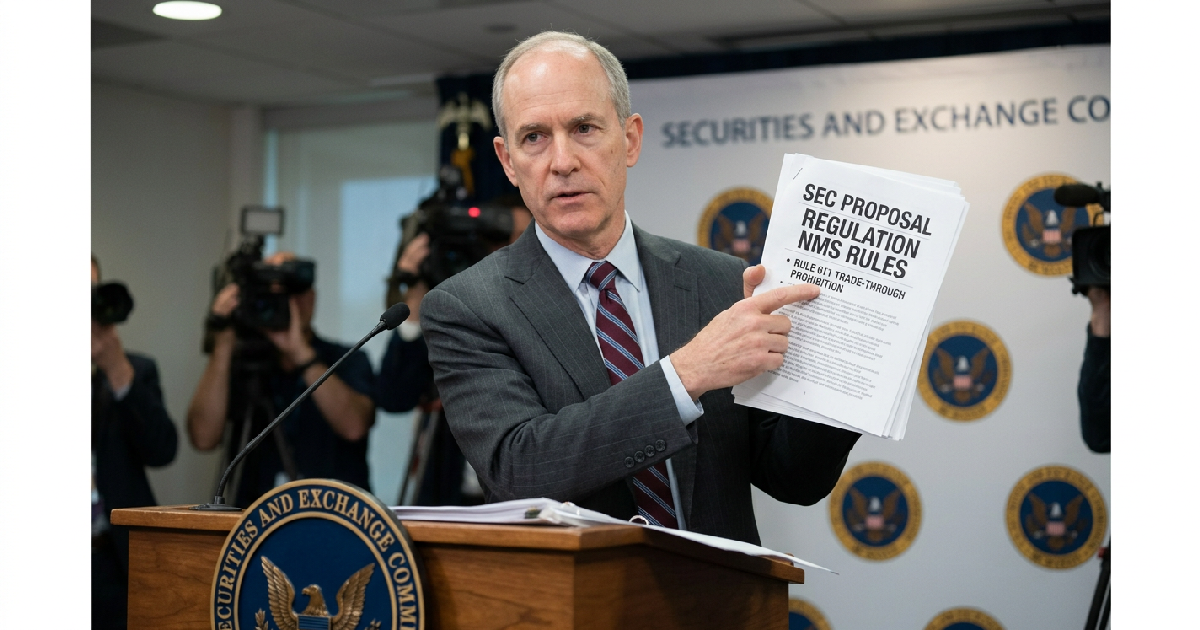

The U.S. Securities and Exchange Commission (SEC) proposed a major overhaul of market regulations on June 11, 2026, by moving to rescind two cornerstone rules under Regulation National Market System (NMS). SEC Chairman Paul S.
Atkins announced the proposal to scrap Rules 611 and 610(e), a move that analysts signal could finally allow tokenized U.S. stocks to trade at scale within Decentralized Finance (DeFi) environments. By removing these 2005-era protections, the agency aims to simplify market structures and lower costs for participants while fostering technological innovation.
The proposed changes target the “trade-through” prohibition and restrictions on “locked or crossed” quotations. Under the current Rule 611, trading venues are barred from executing a stock trade at a price inferior to the best-protected quote available on another exchange.
While intended to protect investors in traditional markets, this requirement has acted as a legal wall for Automated Market Makers (AMMs) in the crypto sector. These protocols operate on bonding curves and block-time granularity, making it impossible for them to guarantee they aren’t “trading through” a better price on a venue like Nasdaq in real-time.
Alex Thorn, Head of Firmwide Research at Galaxy Digital, described the proposal as one of the most significant “unlocks” for the tokenization of U.S. equities to date.
He noted that AMMs, by their very construction, cannot comply with Rule 611 because they cannot route intermarket sweep orders or ingest consolidated tape data with the necessary latency triggers.
Under the current regime, any liquidity pool hosting a tokenized NMS stock would effectively be operating as an illegal trading center due to constant trade-through violations. This shift indicates that Bitcoin signals and market structure shifts are now being mirrored in the way regulators view traditional equity integration on-chain.
How the SEC proposal removes barriers for DeFi market makers
The elimination of Rule 610(e) is equally vital for the future of on-chain trading. This rule currently prevents trading centers from displaying quotes that equal or cross the National Best Bid and Offer (NBBO).
In the world of DeFi, AMM prices drift continuously based on capital flow, frequently creating “crossed” markets where the pool price differs from the national benchmark. Scrapping this rule allows these decentralized protocols to function without being held to a standard of price discovery that was designed for high-frequency centralized exchanges.
Instead of the rigid, trade-by-trade compliance required by Regulation NMS, the SEC plans to lean on FINRA Rule 5310. This is a principles-based “best execution” duty that applies at the broker level rather than the venue level.
This framework is far more flexible for blockchain-based trading, as it focuses on whether a broker-dealer exercised reasonable diligence to obtain the best price for a customer over time, rather than requiring every individual swap to match a legacy exchange quote in microseconds.
Industry leaders believe this is a calculated step in a broader regulatory strategy. Alex Thorn suggested the SEC is executing a “Project Crypto” playbook, which involve clearing the most difficult market structure obstacles through rescission before handling specific venue registration issues via “innovation exemptions.”
This mirrors other recent efforts to modernize the financial system, such as when Scott Bessent rejected central bank digital currency in favor of private-sector ledger innovations.
Implementation timeline and the 2027 outlook for tokenized stocks
The SEC has now opened a 60-day public comment period, inviting feedback from market participants and the Securities Industry and Financial Markets Association (SIFMA). Kenneth E. Bentsen, Jr., President and CEO of SIFMA, has already acknowledged the significance of these amendments.
While the proposal is still in its early stages, Jaret Seiberg, Managing Director at TD Cowen’s Washington Research Group, anticipates the agency will finalize the rule in the first quarter of 2027.
However, the industry may not have to wait until 2027 to see the first results of this policy shift. TD Cowen analysts suggest the SEC might grant “exemptive relief” to specific tokenization pilots in the coming months, allowing them to bypass Rule 611 before the formal repeal is complete.
This would provide a sandbox environment for firms looking to bring blue-chip U.S. equities onto public blockchains. Even with these changes, Hyperliquid and other decentralised platforms will still need to navigate remaining hurdles like Alternative Trading System (ATS) registration and clearing requirements.
Commissioner Hester Peirce has also weighed in, providing a cautious note on the scope of these changes. She indicated that any eventual exemptions would likely apply to digital versions of existing public equities that carry full shareholder rights.
This suggests the SEC is not yet ready to embrace synthetic stock tokens or derivatives that lack the legal backing of the underlying company. The next year will be critical as the SEC determines how to bridge the gap between 20th-century investor protections and 21st-century settlement technology.