
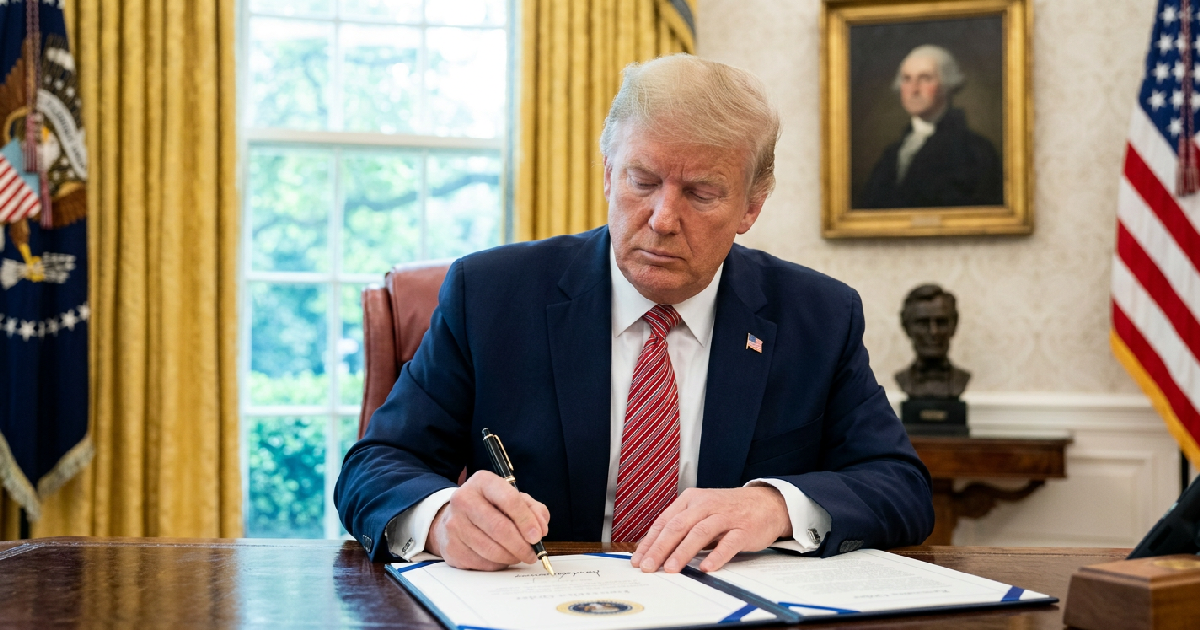

President Donald Trump has signed two sweeping executive orders to accelerate the United States\’ transition to post-quantum cryptography (PQC), a move that has reignited urgent concerns over the long-term security of blockchain networks.
Signed on Monday, June 22, 2026, Executive Order 14409 and Executive Order 14411 mandate aggressive new deadlines for federal agencies to secure high-value assets against future quantum computer attacks. These computers could theoretically break the encryption currently protecting everything from national secrets to Bitcoin private keys.
Setting aggressive deadlines for post-quantum cryptography migration
The White House initiative specifically addresses the “harvest now, decrypt later” threat, where adversaries collect encrypted data today to unlock it once practical quantum hardware arrives. By pushing the federal migration deadline forward by four years, the administration is signaling that the era of traditional digital signatures is nearing its end.
This shift forces a reckoning for decentralized ledgers, which must now consider whether they can adapt their underlying math before the Department of Energy delivers its first science-enabling quantum computer, currently targeted for 2028.
The centerpiece of the federal strategy, Executive Order 14409 (“Securing the Nation Against Advanced Cryptographic Attacks”), establishes a strict timeline for upgrading government infrastructure. High-value assets and high-impact systems must complete their transition to post-quantum cryptography for key establishment by December 31, 2030.
Digital signatures, critical for verifying transactions and identities, must follow with a final deadline of December 31, 2031. These targets significantly accelerate the previous federal benchmark of 2035.
Key details
Implementation of this nationwide policy falls to the Office of Management and Budget (OMB) and the National Cyber Director. Within 30 days, every agency head is required to appoint a PQC migration lead to coordinate these efforts.
Unlike earlier security initiatives, the Bitcoin price analysis and broader crypto market discussions are now closely monitoring these federal standards, as they often dictate the path for private sector security protocols.
The private sector will feel the impact through the Federal Acquisition Regulation (FAR) Council, which has 180 days to propose rules requiring government contractors to meet NIST standards for PQC-compliant algorithms by the 2030 deadline. Notably, the OMB has been tasked with identifying cost-saving opportunities during this expensive transition.
While some had previously speculated on other agency involvements, the research confirms that the OMB remains the primary lead for identifying these efficiencies.
Quantum innovation and the threat to blockchain ledgers
Under Executive Order 14411 (“Ushering in the Next Frontier of Quantum Innovation”), the administration is also forcing the pace of hardware development. The Department of Energy (DOE) is directed to deliver a powerful quantum computer to one of its facilities by 2028. For the blockchain industry, this creates a tangible “countdown” for current encryption methods.
Most existing networks use elliptic curve cryptography, which is highly vulnerable to Shor’s algorithm—a mathematical process a quantum computer could use to derive private keys from public data.
The “harvest now, decrypt later” phenomenon carries heavy weight for institutional holders. If public ledger data is recorded today, it remains vulnerable to retrospective decryption in the future. We are already seeing an Ethereum price outlook that increasingly weighs the security of the network\’s “road to 2030.”
Key details
Developers are now faced with the choice of maintaining current performance or implementing bulkier, quantum-resistant signature schemes that may be required for regulated financial integration.
Role of federal agencies in the cryptographic transition
The migration involves a coordinated effort across several key technical and administrative bodies. The National Institute of Standards and Technology (NIST) will oversee technical guidance and launch a PQC pilot project on its own systems within 180 days, aiming for completion by the end of 2027.
This pilot will help verify the real-world performance of the new algorithms before they are rolled out across the entire federal government.
Other agencies are also taking on specific roles to secure the nation\’s digital foundation:
- National Security Agency (NSA): Collaborating with other departments to develop technical guidance for PQC adoption.
- Department of Commerce: Oversecing NIST’s pilot projects and expanding federal investment in private quantum technology firms.
- Office of Management and Budget (OMB): Leading the implementation and identifying national cost-saving opportunities.
- Department of Energy: Developing deployment plans for quantum sensors and aiming for hardware delivery by 2028.
Implications for the future of digital asset security
The speed of these executive orders has caught much of the digital asset space off guard. While the Bitcoin exchange supply remains at multi-year lows, the long-term storage of these assets now requires a roadmap for quantum resistance.
Moving a network as large as Bitcoin or Ethereum to a new cryptographic standard would likely require a significant hard fork, compelling millions of users to migrate their funds to new, secure address types.
By mandating an update to the National Quantum Strategy within 180 days, the Trump administration is ensuring that cryptographic security remains a top-tier policy priority. The Departments of Commerce, Energy, and Defense have also been directed to develop five-year deployment plans for quantum networking technologies.
This could eventually lead to a quantum-secured internet, potentially rendering legacy, non-resistant blockchain architectures obsolete if they do not adopt NIST-compliant standards.
Ultimately, the orders issued this week have transformed a long-term academic debate into a near-term compliance requirement. Federal agencies are now on a clear path toward 2031, and the blockchain industry has been effectively warned that the “harvest now” window is wide open. The race to achieve quantum-safe status is no longer a theoretical exercise but a matter of technical and financial survival.