
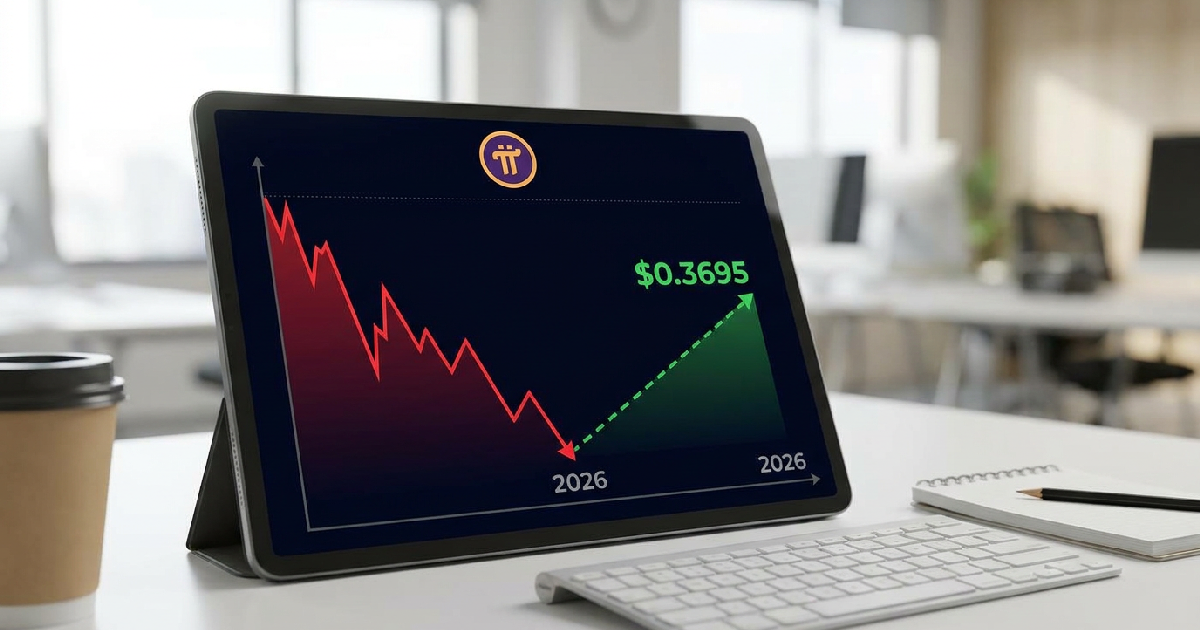

The Pi Network (PI) token has seen a considerable drop, currently trading around $0.0824 on July 13, 2026, after hitting an all-time low of $0.08025 earlier today. This sharp decline follows its all-time high of $2.98 in February 2025, impacting Pi Network price prediction outlooks.
Despite the current bearish sentiment, market analysis suggests a potential for long-term recovery, with forecasts projecting PI could reach up to $0.3695 by 2026 and potentially $1.71 by 2032.
Pi Network’s current market performance
This mobile-first cryptocurrency, designed to make digital assets accessible, is grappling with intense selling pressure. The current downturn reflects investors reacting to the impending unlock of over 127 million PI tokens, which adds to wider market weaknesses and pushes the token into deeply oversold territory.
As of July 13, 2026, Pi Network’s PI token is under significant downward pressure, having lost approximately 14.77% of its value over the past 24 hours. Its price hovers around $0.0824, a stark contrast to its all-time high. The token’s market capitalization currently sits between $864.22 million and $1.1 billion, reflecting varying reports.
Trading volume has surged to $23.79 million in the last 24 hours, indicating increased activity even amid the sell-off. This heightened trading suggests that while sellers presently dominate, there’s also considerable interest and volatility in the market. The token’s year-long performance shows an 81.21% drop from its value of $0.467428 a year ago, reflecting sustained bearish sentiment.
Technical signals reflect strong bearish pressure
Technical analysis paints a clear picture of a market under duress for Pi. The token consistently trades below key moving averages, including its 20-day, 50-day, 100-day, and 200-day Exponential Moving Averages (EMAs). For instance, the 20-day EMA stands at $0.1228, significantly above the current price, reinforcing the bearish outlook.
The Relative Strength Index (RSI) registers at 28.91, signaling oversold conditions. While this could historically precede a short-term bounce, buyers haven’t yet shown convincing signs of stepping back into the market. Immediate support levels are eyed at $0.081 and then $0.075, with resistance located at $0.09 and $0.10. Until PI reclaims $0.09, bearish pressure looks set to continue.
Ecosystem growth and new tools
Despite the recent price downturn, the Pi Network team continues to prioritize ecosystem development and infrastructure enhancements. They’ve recently focused on improving the network’s utility through various upgrades, including Protocol v24 and Pi Nodes update expansion. These efforts are crucial for the project’s long-term viability, especially given the current market conditions.
During its annual Pi2Day celebration on June 28, Pi Network unveiled three new products: SoloHost, Pi Sign-in, and PiVerify. SoloHost is a framework for locally run AI applications, Pi Sign-in offers a decentralized login system, and PiVerify provides a Know Your Customer (KYC) verification service for external clients. This push aims to extend Pi resources outside its immediate ecosystem, potentially boosting ecosystem growth.
AI-powered app development and exchange support
The network’s Pi App Studio also saw advancements, introducing a new AI App Planning Phase feature in July 2026. This tool guides creators in refining their app ideas before generation, prompting them for details on the app’s main idea, goal, design, and user experience. Such features aim to foster developer activity and practical utility.
In March 2026, Kraken, a prominent cryptocurrency exchange, listed PI for trading, marking a significant step towards broader accessibility. This move, alongside ongoing protocol upgrades like the recent v23.0 rollout in May 2026, indicates the project’s continued efforts to strengthen its underlying technology and market presence.
Long-term outlook and challenges for Pi Network
The long-term forecast for Pi Network presents a complex picture of potential growth tempered by significant risks. Analysts anticipate PI could trade between $0.07845 and $0.3695 in 2026, with an average price of $0.2239. Looking further ahead, the token’s maximum price is projected to reach $1.71 by 2032.
One of Pi Network’s most pressing challenges is its token supply. The total supply stands at 100 billion PI, with ongoing unlocks contributing to significant selling pressure. Token inflation runs at approximately 20% monthly, which naturally suppresses price growth unless absorbed by robust demand.
The project’s ability to convert its claimed base of over 60 million total users into active ecosystem participants is paramount. While 11 million users are KYC-verified, according to the project, or 18.1 million per some reports, the actual engagement in building real utility through Decentralized Applications (DApps) and merchant integrations will dictate its long-term success.
On-chain analysis from PIScan revealed a high concentration of PI tokens, with 21 wallets holding over 10 million PI each, and the Pi Foundation reportedly controlling more than 52 billion PI.
Investment considerations and ambitious price targets
For cautious investors, PI remains a high-risk, speculative asset. Its price volatility is heavily influenced by overall market conditions, and its long-term value hinges on factors like developer activity, exchange accessibility, and regulatory developments. While there’s potential if adoption expands, investors must consider the substantial upside and downside risks. Current macroeconomic warning signs also play a significant role in broader market sentiment.
Reaching a price target of $5 or $10, while often discussed in speculative forecasts, appears unlikely in the near term. Such levels would require a massive increase in market capitalization and sustained demand not currently present. Most optimistic forecasts place a $10 milestone more than a decade away, if it occurs at all.
Without widespread real-world use cases, the PI token will struggle to attract the sustained demand needed for significant price appreciation, making it a highly speculative altcoin.