
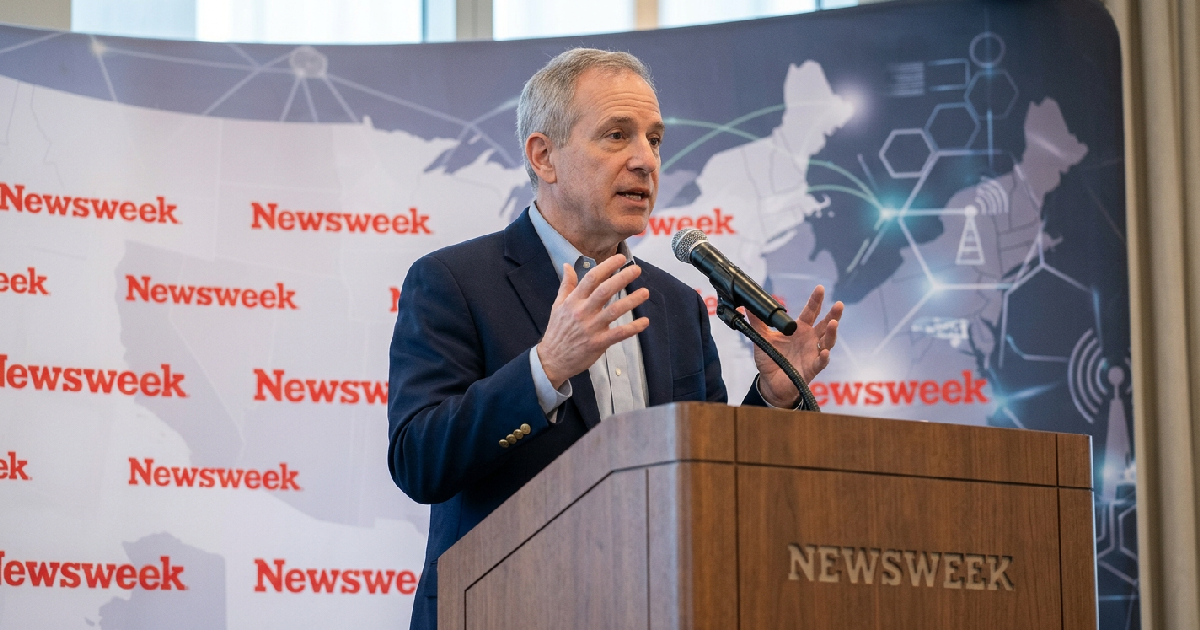

Paul Rosenzweig warns that the United States must win the competition for next-generation wireless technology to protect its economic competitiveness and national security against China, according to a Newsweek opinion piece published on June 27, 2026.
Author Paul Rosenzweig argues that securing leadership in 6G and mobile artificial intelligence (AI) is critical, as dominance in these fields will dictate global standards, patent control, and the future of international supply chains. While the U.S. currently leads in 5G availability, the race for what comes next is intensifying.
The critical role of mid-band spectrum in the 6G race
This technological contest focuses heavily on advancements beyond current 5G infrastructure. Next-generation 6G networks, expected to be commercially available around 2030, aim to unlock faster and more sustainable communication by connecting devices at higher speeds and lower latency. Such infrastructure will enable precision robotics, smart cities, and autonomous vehicles.
In a military context, 6G is expected to facilitate the rapid transmission of data between fast-moving platforms, including ballistic-missile early warning systems in outer space.
The stakes for the American economy are substantial. A study from Boston Consulting Group suggests the 5G economy alone will support a $1.5 trillion economic impact and 4.5 million new U.S. jobs this decade. However, these gains rely on robust digital foundations. As macro warning signs emerge regarding global market stability, the link between reliable connectivity and economic resilience has never been clearer.
Mid-band spectrum, specifically the 3 to 8.5 GHz range, is essential for future wireless technologies because it offers a necessary balance of capacity and geographic coverage. The United States currently faces a significant deficit in this area compared to its primary rival.
Key details
China has already assigned nearly twice the amount of mid-band spectrum to its wireless operators, a gap that could soon quadruple under current trajectories.
To bridge this divide, The Brattle Group estimates that the U.S. will require almost 1,500 MHz of additional mid-band spectrum over the next 10 years. Accenture has identified the Lower 3 GHz, 4 GHz, and 7-8 GHz bands as the most viable opportunities to put U.S. operators on par with Chinese counterparts.
Despite these challenges, the U.S. wireless industry continues to invest aggressively, spending approximately 4.5 times more per capita than China on network upgrades.
Efficiency in deployment remains a key differentiator. The U.S. was the first to deploy nationwide 5G, achieving this milestone 13 months before China. Furthermore, American providers were the first to establish three nationwide 5G networks, whereas Chinese providers are currently pursuing two. Last year, 90% of new home broadband subscribers in the U.S.
opted for 5G fixed wireless, underscoring the immediate domestic demand for high-performance networks.
Federal Communications Commission strategies for wireless leadership
The Federal Communications Commission (FCC) is currently executing a spectrum pipeline intended to deliver 800 megahertz of spectrum by 2034. This long-term plan was set out in President Donald Trump’s Working Families Tax Cut Act, which also restored the FCC’s essential auction authority.
The commission is also moving to auction up to 180 megahertz of prime mid-band spectrum in the Upper C-band by July 2027, surpassing the minimum requirements established by Congress.
In addition to auctions, the commission is looking toward private sector solutions to maximize existing resources. The FCC recently approved two transactions with a combined deal value exceeding $40 billion, allowing the private sector to utilize roughly 115 megahertz of underused mid-band spectrum.
These movements align with broader efforts by the National Telecommunications and Information Administration (NTIA) to promote open, secure, and reliable 6G standards that prevent international fragmentation.
Collaborative research is also receiving a significant boost through the National Science Foundation (NSF). On June 3, 2025, the NSF announced the Verticals-enabling Intelligent NEtwork Systems (NSF VINES) program, a $100 million investment into next-generation intelligent network systems. This initiative includes major industry partners such as Intel, Qualcomm, and Ericsson, alongside the Department of Defense, to accelerate both basic research and functional prototyping.
Global standards and the path to 2030
International cooperation has become a cornerstone of the U.S. strategy to counter China’s influence. In February 2024, the United States and nine other governments issued a joint statement to outline a global vision for 6G that is resilient and secure by design.
This is viewed as a necessary response to China’s “China Standards 2035” initiative, which seeks to set international benchmarks that favor its domestic manufacturers like ZTE and China Mobile.
The push for technological sovereignty is also reflected in how the U.S. handles domestic infrastructure projects. The FCC’s “rip and replace” program, funded in part by AWS-3 spectrum auctions, focuses on removing untrusted equipment from American networks. While technical hurdles remain, the focus on regulated and secure digital infrastructure suggests that reliability is being prioritized over mere speed of deployment.
Looking ahead, organizations like US Ignite are calling for a “Biden Advanced Wireless Strategy,” proposing an interagency effort backed by $20 billion in investment over four years. As the world moves toward the commercial launch of 6G in 2030, the ability of the U.S.
to implement flexible spectrum policies will determine its status in the global hierarchy. The winner of this wireless race will not only control the flow of data but will lead the development of the next decade’s most transformative technologies.