
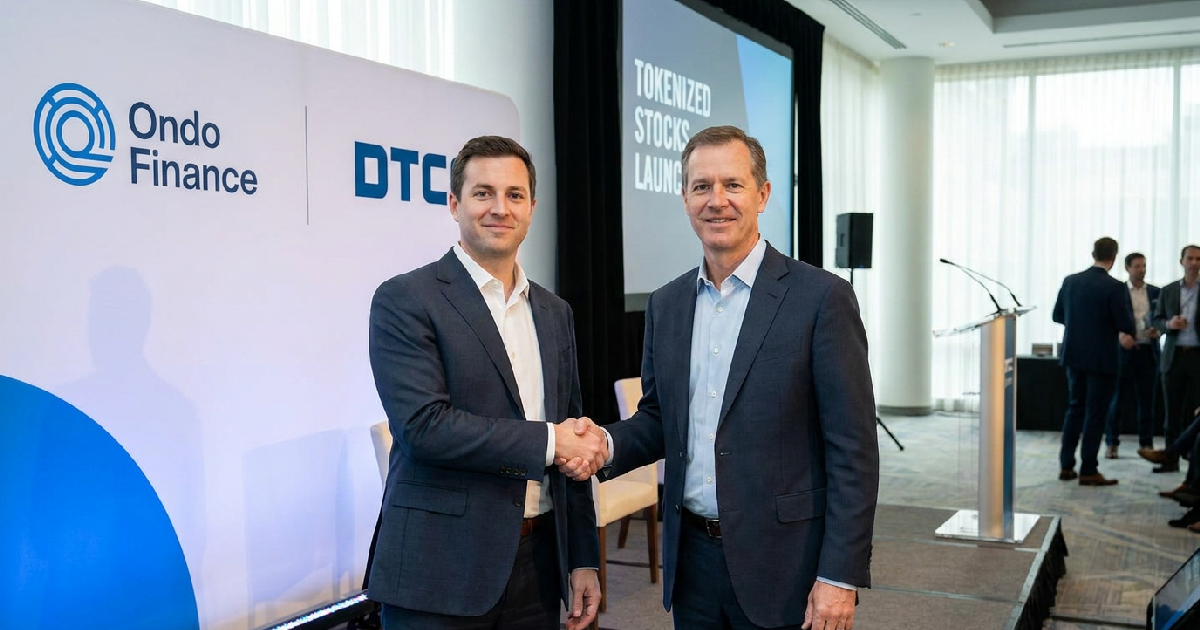

Ondo Finance announced on July 15, 2026, the launch of its first tokenized stock representations, leveraging entitlements from the Depository Trust & Clearing Corporation (DTCC). This move integrates the decentralized finance (DeFi) platform into the DTCC’s extensive tokenization initiative, aiming to bridge traditional finance (TradFi) with blockchain technology.
While the announcement spurred a modest rally in Ondo’s native token, ONDO, with a 5.85% gain to $0.334 within 24 hours and a 50.59% surge in trading volume, analysts remain cautious. A sustained price breakout for the altcoin remains unconfirmed, despite the positive sentiment surrounding the significant institutional collaboration.
Ondo integrates with DTCC’s digital asset initiative
Ondo Finance now joins a growing list of financial heavyweights, including BlackRock, J.P. Morgan, and Goldman Sachs, participating in what the DTCC describes as its largest tokenization effort yet. The initiative allows on-chain investors to access tokenized stocks based on DTC Tokenized Entitlements, expanding the reach of traditional securities.
Ian de Bode, CEO of Ondo Finance, emphasized the company’s strategic position. He stated, “Ondo is the only company simultaneously building all pathways for US securities tokenization.” De Bode added that Ondo Stocks infrastructure is designed to work with, not compete against, existing institutional market infrastructure.
DTCC builds infrastructure for tokenized securities
The DTCC Tokenization Service, which facilitates this integration, uses the same DTC infrastructure that underpins the vast majority of U.S. securities transactions. It records tokenized entitlements, or “digital twins,” of DTC-held securities. These digital assets carry the same CUSIP and symbol as their traditional counterparts and can be delivered to DTC Participant wallets.
Ondo Finance gains access to the DTC participant network through its broker-dealer, Alpaca Markets. Crucially, the underlying securities stay custodied within DTC’s traditional system. This setup ensures a smooth conversion between traditional and tokenized forms, maintaining existing investor protections and ownership rights.
Frank La Salla, President and CEO of DTCC, highlighted the ambition behind the project. He said the service would “institutionalize tokenized markets on day one,” acting as a “critical enabler” for the future digital ecosystem. La Salla believes tokenization could reshape market structure by boosting liquidity, transparency, and efficiency.
The DTCC Tokenization Service started with a limited first phase in July 2026, with a full rollout expected later in the year, aiming for scalable deployment by October 2026. Regulatory backing came in December 2025 when the U.S. Securities and Exchange Commission (SEC) granted DTC permission for a three-year pilot.
This pilot covers highly liquid assets, including parts of the Russell 1000 Index, major U.S. index ETFs, and various Treasuries.
On July 15, 2026, the DTCC processed its initial live tokenization transactions within a controlled production environment. JPMorgan executed the first conversion, turning Invesco’s QQQ ETF into a tokenized version. Other demonstrated applications included collateral pledges, security lending, and various delivery-versus-payment trades.
Digital conversions utilized both HyperLedger Besu, DTCC’s private network, and Canton, a public network, as part of DTCC’s multi-chain strategy. This approach is intended to provide flexibility and robustness for the evolving digital asset landscape.
ONDO token price reacts but breakout remains uncertain
Despite the institutional validation from the DTCC announcement, the ONDO token’s market performance shows mixed signals. The 5.85% price increase pushed ONDO back towards its 50-day Exponential Moving Average (EMA), rebounding from a crucial ascending trendline. However, technical indicators suggest caution.
The token has been trading within a descending triangle pattern, indicating a bearish long-term outlook. A significant swing high at $0.47 was tested but not decisively breached, suggesting persistent selling pressure at higher levels. The $0.31 zone has provided support since June, but local resistance at $0.336 continues to cap upward movement.
Technical analysis from platforms like TradingView notes that neither the Chaikin Money Flow (CMF) nor the On-Balance Volume (OBV) indicates sustained buying pressure. This lack of strong demand signals suggests that the current rally might be speculative rather than a fundamental shift in market momentum. The H4 swing structure also remains bearish.
Traders face resistance around the 50% retracement level at $0.343. A potential breakout from the descending triangle could still encounter rejection at higher resistance levels, specifically $0.372 and $0.394. A confirmed close above $0.35 with strong, sustained volume could open the path towards $0.40, and potentially much higher to $0.70 or even $1.12, but these levels remain distant targets for now.
Conversely, a drop below $0.30 would likely invalidate any short-term bullish outlook. Previous analyses in May and June 2026 had identified other key resistance zones and potential upside projections, but these have largely failed to materialize into sustained breakouts. The market is now waiting for a clear direction.
Broad implications for real-world asset tokenization
Ondo Finance’s participation in the DTCC initiative underscores a broader industry trend toward the tokenization of real-world assets (RWAs). This movement seeks to bring traditional assets onto blockchain networks, promising enhanced liquidity, transparency, and operational efficiency.
The DTCC, as a critical piece of the U.S. financial market infrastructure, is playing an increasingly central role. Its service allows for seamless integration of digital assets into existing frameworks, an approach echoed by other financial titans. BlackRock, for instance, has aggressively pursued tokenized finance, with its BUIDL fund on Ethereum surpassing $2 billion in assets.
This integration of established financial institutions with DeFi protocols like Ondo Finance is crucial for mainstream adoption. It offers a pathway for institutional capital to flow more freely into blockchain-based assets, while ensuring regulatory compliance and investor protections. The focus on “digital twins” that retain the entitlements of traditional securities is a key aspect of this strategy, aiming to provide the best of both worlds.
While the long-term potential for tokenized securities is significant, the market reaction of tokens like ONDO highlights ongoing volatility and the need for sustained buying pressure to confirm new trends. The successful, scalable deployment of DTCC’s service later in 2026 will be a key indicator for the future trajectory of this burgeoning sector.