
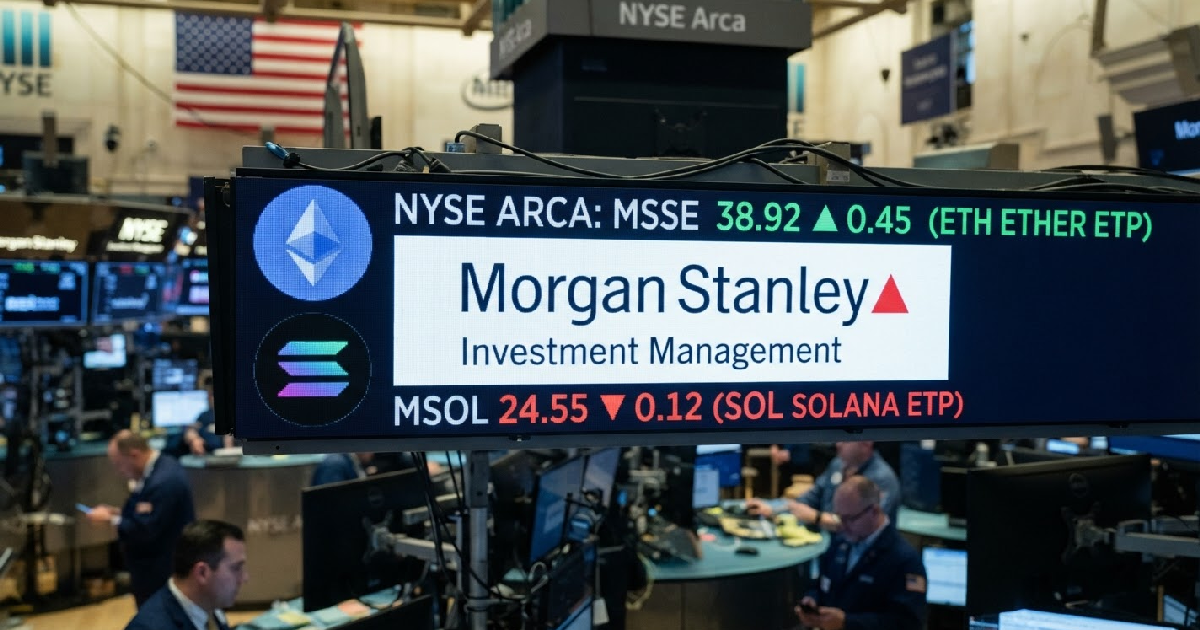

Morgan Stanley Investment Management (MSIM) officially launched its spot Ethereum Trust (MSSE) and Solana Trust (MSOL) on NYSE Arca this Tuesday, July 28, 2026. These new exchange-traded products (ETPs) are set to track the performance of Ether (ETH) and Solana (SOL) and notably incorporate staking rewards, all while boasting an industry-low 0.14% annual expense ratio.
The move marks a significant expansion of institutional access to digital assets. MSIM’s entry into the Ether and Solana spot ETP market, complete with competitive fees and staking, signals a maturation of the sector and could redefine investor expectations for such products.
Morgan Stanley Sets New Low for Ethereum ETF and Solana ETP Fees
The 0.14% sponsor fee applied to both the Morgan Stanley Ethereum Trust (MSSE) and the Morgan Stanley Solana Trust (MSOL) immediately positions them as the most cost-effective options in their categories. This aggressive pricing strategy from a major financial player like Morgan Stanley is a crucial development in the digital asset investment landscape.
For context, competing products such as Grayscale’s Mini Ethereum Trust charge 0.15%, while Franklin Templeton’s Solana ETF comes in at 0.19%. Data from SoSoValue confirms these new MSIM offerings are currently the lowest-fee products available for spot Ether and Solana exposure.
Integrated Staking Rewards Differentiate MSIM Offerings
Beyond the attractive expense ratio, a key differentiator for both MSSE and MSOL is their integrated staking rewards mechanism. Morgan Stanley has partnered with prominent staking providers, including Figment, Galaxy’s blockchain infrastructure business, and Coinbase Canada, to facilitate this feature.
The trusts intend to return approximately 95% of generated staking rewards directly to shareholders through periodic distributions. The remaining 5% is allocated to cover institutional validator fees, a standard practice in the staking ecosystem. Importantly, Morgan Stanley will not retain any portion of these staking rewards, ensuring maximum benefit for the fund’s investors.
Staking Proportions Reflect Network Dynamics
The staking proportions vary between the two trusts, reflecting the distinct characteristics of the underlying networks. The Morgan Stanley Ethereum Trust (MSSE) aims to stake between 50% and 80% of its underlying Ether holdings.
In contrast, the Morgan Stanley Solana Trust (MSOL) may stake up to 100% of its Solana holdings. These proportions are designed to optimize reward generation while maintaining liquidity and operational efficiency.
Navigating Ethereum’s Staking Queue
Ethereum’s staking mechanism currently involves a significant activation queue for new validators. As of July 6, the Ethereum validator activation queue stood at approximately 2.71 million ETH, with an estimated waiting period of 47 days.
During this waiting period, queued Ether does not earn staking rewards. MSSE’s approach to staking a portion of its holdings helps manage exposure to this queue, providing a streamlined experience for investors without direct interaction with network delays.
Solana’s Quicker Bonding Process
Solana, on the other hand, boasts a much faster bonding process for staking, typically taking only two to three days. This allows for a more flexible and efficient staking operation, which contributes to MSOL’s ability to stake a larger proportion of its holdings.
The approximate network reward rates also differ, with Ethereum offering around 1.7% and Solana providing about 3.4%. These yield opportunities, passed on to investors, present a compelling argument for the new ETPs.
Morgan Stanley Deepens Institutional Digital Asset Commitment
This latest launch solidifies Morgan Stanley Investment Management’s growing presence in the digital asset space. Ally Wallace, Global Head of ETFs for Morgan Stanley Investment Management, stated that the addition of MSSE and MSOL reflects the “natural evolution of our product suite.”
The firm seeks to provide simplified access to digital assets through the familiar ETP wrapper, catering to a burgeoning client interest. This strategy helps investors diversify their portfolios across traditional and decentralized asset classes.
Success of Morgan Stanley Bitcoin Trust Paved the Way
Morgan Stanley’s commitment to digital asset ETPs isn’t new. The firm’s bitcoin-based spot ETF, the Morgan Stanley Bitcoin Trust (MSBT), launched in April, has already demonstrated strong performance.
As of July 16, 2026, MSBT held over $381 million in assets under management. It managed to attract $430.86 million in new assets since its inception, approaching $400 million in total assets within just four months, even amidst a bearish market environment.
This success provided a clear mandate for MSIM to expand its offerings. The firm’s overall ETP suite now exceeds $14 billion in assets under management across 22 products, a significant growth since its first ETFs were introduced in 2023.
Broadening Investment Horizons Through Regulated Products
The launch of MSSE and MSOL signifies more than just new products; it represents a deepening of institutional validation for the Ethereum and Solana ecosystems. Amy Oldenburg, Head of Digital Asset Strategy at Morgan Stanley, emphasized the goal of allowing investors to diversify portfolios while adhering to the firm’s rigorous standards.
These standards cover governance, infrastructure, and risk management, which are crucial for attracting traditional investors to the nascent digital asset class. The trusts hold physical tokens, partnering with institutional crypto custodians to ensure secure storage and operations.
Impact on the Competitive ETP Landscape
Morgan Stanley’s entry with such competitive features is poised to intensify competition within the altcoin ETP market. Prior to this, other firms had already launched ETFs tied to tokens like XRP and HYPE.
Solana and Hyperliquid ETFs have collectively dominated non-Bitcoin and Ethereum ETF volume, accounting for nearly 80% as of a week ago. Solana ETFs alone held over $900 million in cumulative assets under management, demonstrating significant existing demand for altcoin exposure.
The arrival of MSOL with its low fee and staking rewards will undoubtedly pressure existing Solana ETPs to innovate or adjust their pricing. Similarly, the Morgan Stanley Ethereum Trust sets a new bar for future Ether ETPs, influencing the broader market for institutional crypto investment vehicles.
What This Means for the Ethereum Ecosystem
For the Ethereum ecosystem specifically, the launch of MSSE offers regulated access to staking yields for a wider pool of traditional investors. It simplifies the complex process of direct staking, which can be daunting for institutions due to technical requirements and the illiquidity of staked assets.
By bundling staking rewards into an easily tradable security, Morgan Stanley removes significant barriers. This could lead to increased institutional demand for Ether, potentially bolstering network security and further integrating Ethereum into the global financial system.
The CoinDesk Ether Benchmark 4PM NY Settlement Rate will be used to measure MSSE’s performance. This benchmark aggregates trade volume across major spot cryptocurrency exchanges at 4:00 p.m. ET, providing a transparent and consistent valuation standard.