
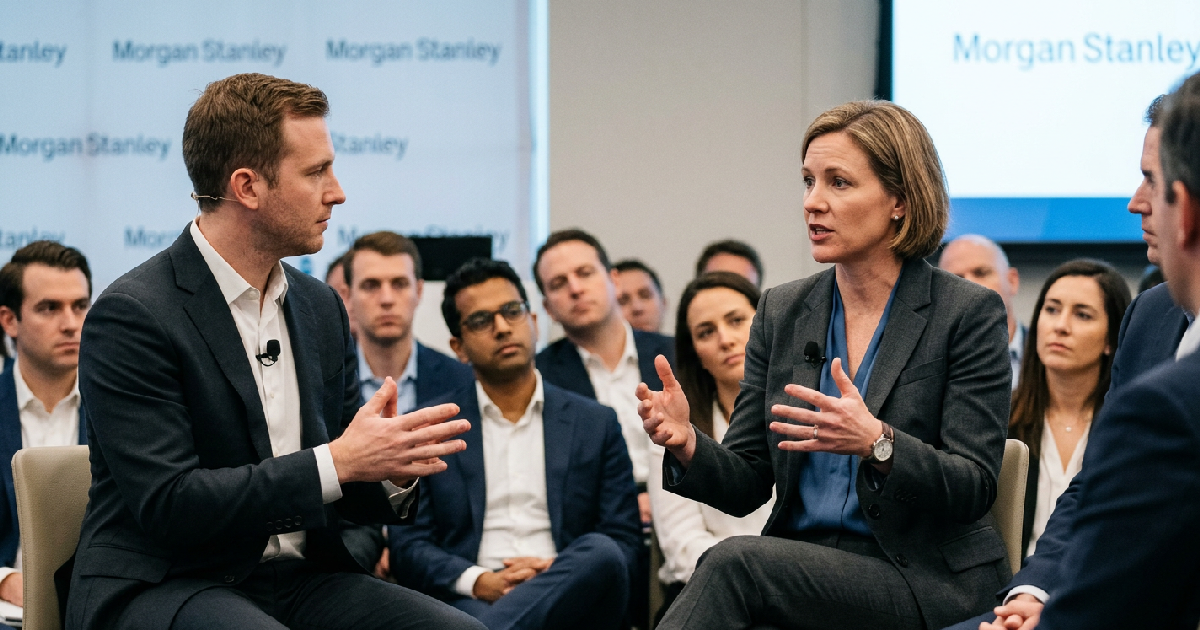

Amy Oldenburg, Head of Digital Asset Strategy at Morgan Stanley, stated on June 10, 2026, that the primary hurdle to widespread Bitcoin adoption on Wall Street is a lack of investor and advisor education rather than a scarcity of financial products.
Speaking at a panel moderated by Tyler Evans, Oldenburg spent nearly an hour arguing that while the technical infrastructure for digital assets is now available, internal “wealth machines” remain hesitant due to fundamental misunderstandings of the asset class.
Oldenburg, a 26-year veteran of the bank, pointed out that many clients and advisors still fail to distinguish Bitcoin from the broader crypto category. This confusion often ties Bitcoin’s reputation to industry failures like FTX. “We have to start with bitcoin,” Oldenburg said, emphasizing its $1.
5 trillion market cap and its unique role as a decentralized store of value compared to other digital assets. The bank currently manages roughly $9.3 trillion in client assets and leads a force of 16,000 advisors.
The executive’s focus on education comes as Bitcoin signals market structure shifts that have historically confused traditional fiduciaries. Morgan Stanley’s Global Investment Committee has already recommended a 2% to 4% crypto allocation for aggressive investors. However, internal simulations show that adding even a 6% crypto position to a growth-oriented portfolio can nearly double overall volatility, making education a prerequisite for risk management.
Strong debut for Morgan Stanley Bitcoin Trust
The firm launched its own exchange-traded product, the Morgan Stanley Bitcoin Trust (MSBT), on April 7, 2026. While initial daily figures vary by analyst, the MSBT pulled in over $100 million in its first week of trading. It currently stands as the cheapest Bitcoin ETF in the U.S.
market with an expense ratio of 0.14%. This competitive pricing undercuts BlackRock’s IBIT by 11 basis points as the bank seeks to capture a larger share of institutional flows.
To deepen its integration, Morgan Stanley has opened new sophisticated avenues for eligible wealth management clients. As of June 5, 2026, clients referred by the bank can lend Bitcoin, Ethereum, or Solana to Galaxy Digital in exchange for ETP shares.
For these specific Morgan Stanley-referred clients, the minimum transaction size was lowered from $25 million to $5 million, facilitating easier access to digital asset lending for high-net-worth individuals.
This institutional push follows a massive whale accumulation during futures-led selloffs seen elsewhere in the market. Despite recent price volatility, where Bitcoin briefly touched $60,000 in early June 2026 after falling from an October 2025 peak near $126,200, the bank is continuing its methodical expansion into digital finance. This includes plans for spot trading capabilities on the E*TRADE platform for Bitcoin, Ethereum, and Solana.
Regulatory hurdles and the shift toward direct custody
Morgan Stanley occupies a different regulatory tier than independent asset managers like BlackRock because it is a global systemically important bank (G-SIB). Governed by the Federal Reserve, the firm faces strict capital treatment requirements. These mandates historically made Bitcoin less efficient to hold on a balance sheet compared to traditional assets.
Oldenburg noted that for U.S. banks to hold Bitcoin directly, the industry requires capital treatment reform to remove these punitive burdens.
In a move to bring more control in-house, the bank applied to the Office of the Comptroller of the Currency (OCC) in February 2026. The application seeks a national trust bank charter for a new entity, the Morgan Stanley Digital Trust National Association.
If approved, this would allow the bank to act as its own Bitcoin custodian, handling fiduciary staking and token transfers without relying on third-party vendors that have proven fragile in past market cycles.
This push for direct control is mirrored by Morgan Stanley’s caution regarding other digital innovations. While the bank has one tokenized money market product live, it continues to monitor legislative movements. For instance, the recent U.S. Treasury CBDc rejection by key officials shows that private-sector solutions like Bitcoin may remain the dominant alternative to the traditional fiat system for the foreseeable future.
Addressing volatility and the finite supply of Bitcoin
The bank is currently training its 16,000 advisors to handle the extreme swings associated with digital assets. The Global Investment Committee expects annualized volatility for crypto to be approximately 55%. This figure is roughly four times that of the S&P 500 Index.
Oldenburg’s team tells advisors that “you can present it as a yield, but the underlying asset is bitcoin,” helping them frame the risk-reward profile for clients seeking growth.
As of early 2026, most of the eventual Bitcoin supply has already entered circulation. Approximately 20 million Bitcoin—roughly 95% of the total eventual supply of 21 million coins—have already been created. This scarcity is a central pillar of the bank’s “digital gold” narrative. Morgan Stanley currently holds approximately $1.24 billion in Bitcoin across its various holdings, signaling a long-term commitment to the asset’s survival.
Looking forward, Oldenburg believes the “crystallization” of Bitcoin’s use case will continue to evolve. She suggested that while products like MSBT provide necessary access, it may take further stress on traditional financial infrastructure to make Bitcoin’s borderless properties clear to the average investor.
For now, the bank remains focused on its formal educational materials to move Bitcoin from a speculative “fad” to a standard institutional allocation.