
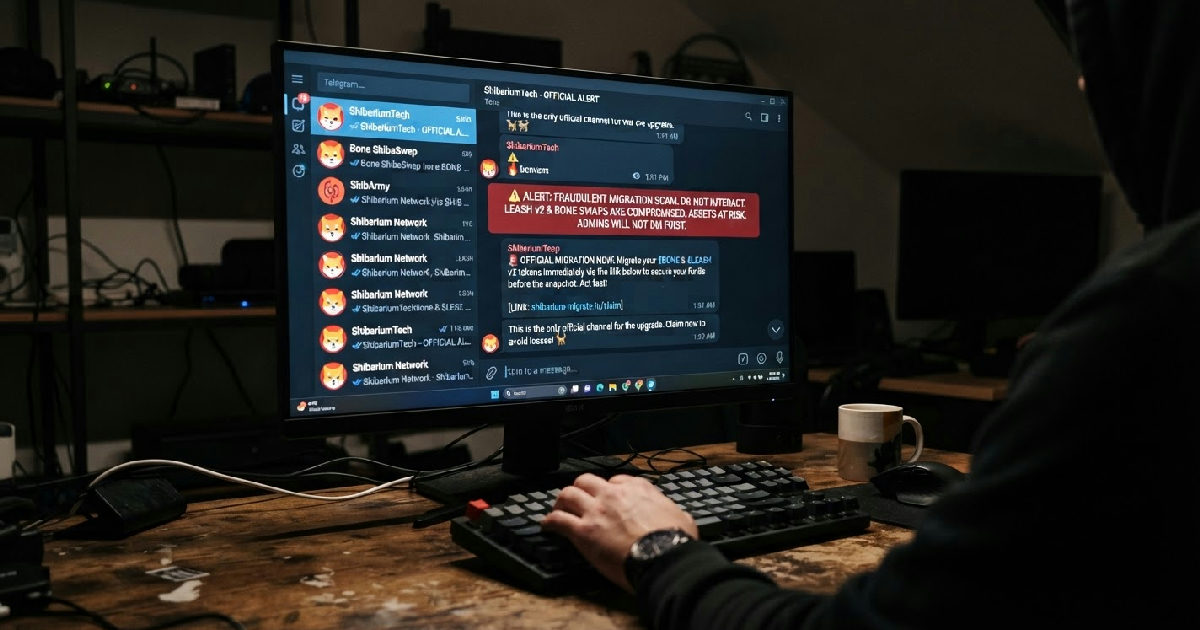

Shiba Eternity game advisor Mazrael issued a critical security alert on August 16, exposing a coordinated campaign of fake Shibarium token migrations on Telegram. A malicious actor identified as “someonesmart” has been infiltrating community channels to promote fraudulent token swaps designed to drain assets from unsuspecting users.
The scammers specifically targeted the Bone ShibaSwap and ShibariumTech Telegram groups. By exploiting administrative vulnerabilities, the attackers managed to mute official communication channels and systematically ban legitimate developers from the chat. This isolated users, leaving them exposed to fraudulent instructions that mirror another recent fake token warning across the broader decentralized finance sector.
How Scammers Orchestrate Fake Shibarium Token Migrations
The primary objective of this coordinated attack is to convince users holding legitimate BONE tokens that a network transition is underway. Scammers instruct victims to swap their holdings for an alleged replacement token through unauthorized smart contracts. These contracts are explicitly engineered to capture user funds permanently.
Mazrael confirmed that no official migration is taking place for the BONE asset. He explicitly directed users to retain their original tokens for staking on the Layer-2 network or providing liquidity on the decentralized exchange. The network requires no mandatory asset transitions for existing BONE holders.
Operating within isolated Telegram groups allows bad actors to control the entire narrative without immediate pushback from core developers. Once the legitimate moderators were banned by the “someonesmart” account, the scammers posted their own alternative group links. Victims joining these secondary channels face aggressive social engineering tactics.
Security teams across the blockchain sector consistently emphasize the danger of engaging with unfamiliar contracts under manufactured time pressure. Sometimes verifying a threat requires extreme measures, such as a sacrificial crypto loss to prove malicious intent, but individual users should simply disconnect their wallets immediately.
The Legitimate LEASH v2 Upgrade Narrative
The success of these deceptive tactics often relies on twisting real development news into an urgent threat. Currently, the ecosystem is preparing for an authentic protocol upgrade involving the LEASH asset. This genuine development provides the baseline narrative that scammers are currently exploiting to confuse retail participants.
Developers discovered a hidden flaw within the original LEASH smart contract that undermined its fixed-supply architecture. The foundational code contained a dormant rebase mechanism capable of altering the total token supply under highly specific conditions. This vulnerability remained active even after the initial deployment keys were verifiably burned.
To neutralize this risk, the development team engineered a completely new contract designed to prevent any future minting functions. The full supply of this upcoming v2 iteration has already been securely generated and deposited into a multisignature wallet. No official launch date for this transition has been established.
When the authentic LEASH v2 transition finally occurs, the process will involve locking or permanently burning the original v1 tokens. In exchange, the multisignature wallet will release the new assets to holders in direct proportion to their verified entitlement. Until this exact mechanism is formally announced, all swap requests are fraudulent.
Expanding Threats Across the Layer-2 Network
The current Telegram takeover represents just one vector in an escalating series of attacks targeting the Layer-2 blockchain. Impersonation tactics and social engineering have surged across the digital asset industry. Security analysts noted that cryptocurrency fraud resulted in an estimated $17 billion in stolen capital throughout 2025 alone.
Earlier this year, organizations like Shibarium Trustwatch identified a sharp rise in deceptive practices, including advanced crypto address misuse. Attackers frequently utilize wallet spoofing by sending minuscule transaction amounts from fraudulent addresses that visually match the first and last characters of a victim’s frequent contacts.
When users carelessly copy addresses from their recent transaction history, they unknowingly route their assets directly to the attacker. This strategy requires no smart contract interaction or wallet approvals, relying entirely on human oversight during routine transfers. It highlights a critical need for manual address verification.
Exploiting Past Vulnerabilities for New Scams
Fraudsters also consistently recycle historical network events to manufacture new traps. Following a notable bridge exploit in September 2025, the community introduced a legitimate “Shib Owes You” recovery portal. Scammers quickly capitalized on this by circulating counterfeit recovery tokens through unsolicited airdrops.
Official channels clarified that authentic recovery assets are never airdropped directly into individual wallets. Legitimate claims strictly require manual minting through an authenticated decentralized application. Unsolicited tokens appearing spontaneously in a portfolio balance almost always function as malicious phishing hooks.
Recognizing Phishing and Smishing Vectors
Beyond compromised discussion groups, security alert channel Susbarium has tracked an alarming volume of targeted phishing campaigns. Scammers frequently deploy fake websites explicitly designed to mimic the interface of legitimate swap portals. These fraudulent sites initiate malicious smart contract approvals the moment a user connects their wallet application.
The attack vectors now extend well beyond decentralized applications into direct mobile communications. Fraudsters have orchestrated smishing campaigns by impersonating centralized exchanges like Binance through SMS text messages. These texts claim suspicious account activity and provide fake support numbers to capture user credentials directly.
Victims who dial these fraudulent support numbers are systematically manipulated into transferring their remaining on-chain balances to a supposed safe haven wallet. This highlights why verified communication protocols remain the only reliable defense against increasingly aggressive digital asset theft operations.
Baseline Security Directives for Ecosystem Participants
The core development team has issued an absolute directive to disregard any communication demanding urgent asset transfers. Users must verify all protocol updates exclusively through primary official handles, notably the lead developer Shytoshi Kusama and the core X accounts. Telegram announcements lacking secondary confirmation are highly suspect.
Market participants are instructed to interact exclusively with the recognized ecosystem assets. The core protocol officially supports only the following tokens for network operations:
- SHIB: The foundational digital asset of the ecosystem.
- BONE: The primary governance and gas token for the Layer-2 network.
- LEASH: A specialized token currently awaiting its v2 upgrade.
- TREAT: An upcoming reward asset integrated into network operations.
Any secondary tokens claiming direct affiliation or promising enhanced yield carry an extreme risk of immediate capital loss. Staking requirements are always handled through the primary official portal rather than secondary message boards.
The removal of community moderators from the Bone ShibaSwap group serves as a stark reminder of the fragile nature of social media channels. Administrative compromises happen frequently, meaning the platform hosting the message can never guarantee the technical safety of the underlying request.
As the protocol expands its decentralized finance capabilities, the sophistication of these targeted attacks will inevitably scale alongside it. Protecting digital assets now requires treating every unsolicited protocol interaction with outright skepticism, regardless of where the initial communication originated.