
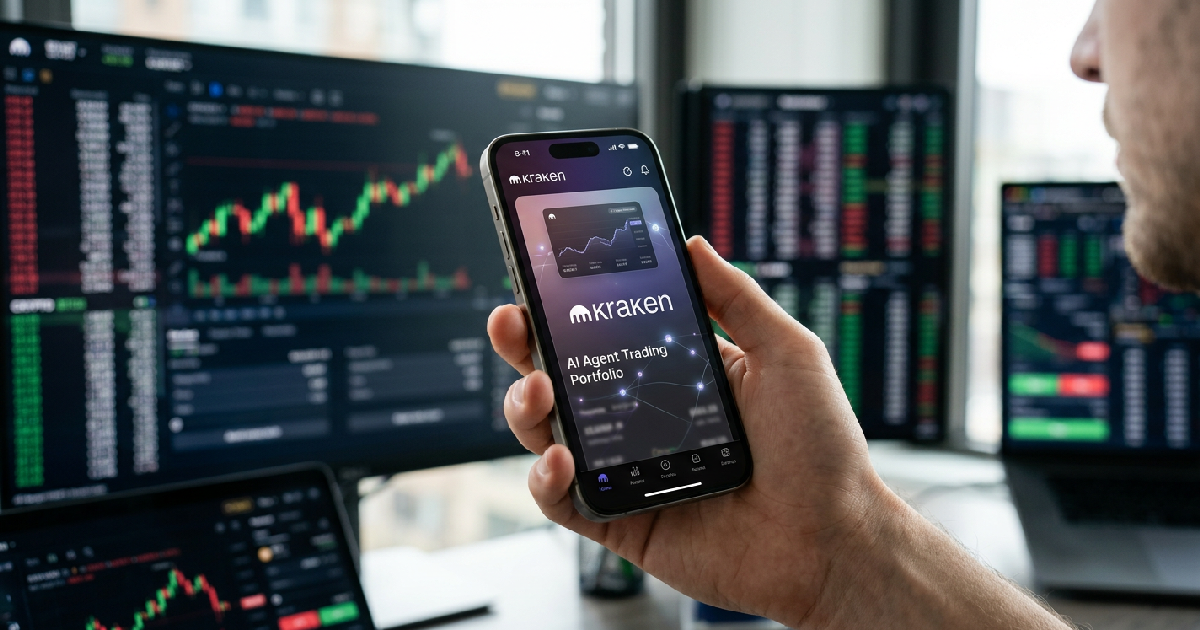

Cryptocurrency exchange Kraken announced on July 11, 2026, that it is relaunching its mobile application with autonomous AI trading agents at its core. This initiative represents a complete revamp of the existing platform rather than a standard update.
Chief Data Officer Kamo Asatryan stated that the technology is designed to give everyday investors the same market awareness as the exchange’s most active traders, allowing them to respond to market conditions using “plain English.”
The technical framework of agentic trading
The overhaul introduces “agentic trading,” where software monitors global markets around the clock to identify and recommend opportunities based on user-defined goals. While the agents can draft portfolios and suggest transactions, Kraken emphasizes that the system functions as a decision-support tool.
Users maintain final authority over every trade, and the AI does not execute transactions without explicit approval. This transition comes as bitcoin price analysis remains a primary focus for retail traders seeking professional-grade tools.
Automating market insights and portfolio management
The new app promises to simplify decision-making through personalized portfolio updates and investment suggestions, all tailored to each user’s specific holdings. During onboarding, the AI learns user profiles to build draft portfolios and delivers curated insights. It explains recommendations clearly, allowing users to review, adjust, and approve them before any action takes place.
This approach transforms Kraken from a basic exchange into a more comprehensive financial services platform. Its aim is to democratize sophisticated trading capabilities, making them accessible to a broader user base and expanding beyond simple buy-and-sell functions.
The centerpiece of this new platform is the Kraken CLI (Command Line Interface), an open-source execution engine built as a single-binary Rust tool. It supports 134 commands covering spot trading, futures, staking, and subaccount transfers.
The system produces NDJSON output designed for machine consumption and comes preloaded with 50 agent skills that manage trading strategies and market analysis. By utilizing built-in Model Context Protocol support, the tool provides a native environment for these AI agents to operate.
Testing strategies with paper trading
For users wary of live market volatility, the interface includes a paper trading mode. This allows investors to test their strategies against real-time prices without risking actual capital. The move is intended to bridge the gap between retail users, who often enter the market at peaks, and professional traders who stay engaged through all cycles.
Asatryan highlighted that this technology offers “everyday people” the chance to become high-frequency traders, all through simple language commands. The initiative seeks to close the performance gap often seen between retail traders, who frequently buy at market highs and sell at lows, and their professional counterparts.
This level of automation is becoming vital as the Ethereum network outlook continues to evolve with increased decentralized activity.
Regulatory boundaries and risk management
The integration of AI-driven advice requires strict legal separation within the United States. In the U.S., investment advice regarding cryptocurrency assets is provided by Payward Interactive, Inc. (PWI). Conversely, advice on securities is managed by Kraken Adviser LLC, an SEC-registered investment adviser. These are distinct legal entities, a structure designed to comply with existing federal oversight while waiting for specific AI-related trading rules from regulators.
The Financial Industry Regulatory Authority (FINRA) has recently highlighted risks associated with AI in finance, including customer protection and compliance with Regulation Best Interest (Reg BI). Kraken’s requirement for manual user approval on every trade serves as a guardrail against the risks of autonomous systems.
The company also includes crucial risk management features, tied to each user’s preset risk tolerance levels. These safeguards are intended to prevent autonomous systems from increasing potential losses significantly, a common concern in AI-driven trading. As crypto market liquidation analysis often shows, automated tools can exacerbate losses if they are not aligned with a user’s specific risk tolerance.
Competitive landscape and expansion
Kraken is the latest major exchange to pivot toward high-level AI integration, joining Gemini, Coinbase, and Binance in a race to automate retail finance. However, Kraken’s approach differentiates itself by placing the agents at the center of the application fabric rather than treating them as an optional “copilot” feature.
Gemini opened its platform to users’ AI agent setups in April 2026, while Coinbase launched its AI adviser and agent-driven trading features in June 2026. Other players like Bitget, OKX, and Revolut have also expanded their AI capabilities, signaling a broader industry shift toward more intelligent trading tools.
Kraken’s strategic vision and public listing
There is no additional cost to use the Kraken AI features, though standard fees still apply for approved trades and fund movements. This means accessibility won’t be a barrier for users looking to leverage these advanced tools.
This development occurs alongside other AI-focused shifts within the company’s ecosystem. On July 7, 2026, the Kraken-owned broker NinjaTrader appointed Brian Weis as its first Chief Innovation and AI Officer. NinjaTrader CEO Martin Franchi stated that AI is set to “fundamentally reshape how people invest and trade,” underlining the strategic importance of these developments.
These moves come as Kraken continues preparations for a possible public listing, a process that began last year. The company confidentially filed a draft S-1 with the SEC in November 2025, initially targeting a Q1 2026 IPO at a $20 billion valuation. While these plans were paused in March 2026 due to market conditions, and its valuation adjusted to approximately $13.3 billion after a $200 million investment from Deutsche Börse in April 2026, investors currently anticipate a third-quarter listing, although the company has not confirmed a specific date for an initial public offering.
Future implications for crypto trading
Kraken’s focus on core AI integration could redefine the role of cryptocurrency exchanges. By moving beyond simple transactional platforms, Kraken aims to become a more comprehensive financial services provider. This includes potential expansion into payments, banking, and lending, transforming the user experience from mere trading to holistic financial management.
The push towards accessible, sophisticated tools suggests a future where even novice investors can engage with complex market strategies. But it also raises questions about market efficiency and regulatory oversight. As more exchanges adopt similar systems, the market could see increased volatility if numerous AI agents react to the same signals simultaneously.
But for Kraken, the intention is clear: empower retail traders and keep them engaged throughout market cycles, regardless of whether prices are rising or falling. The relaunched app could be a significant step in achieving that goal.