
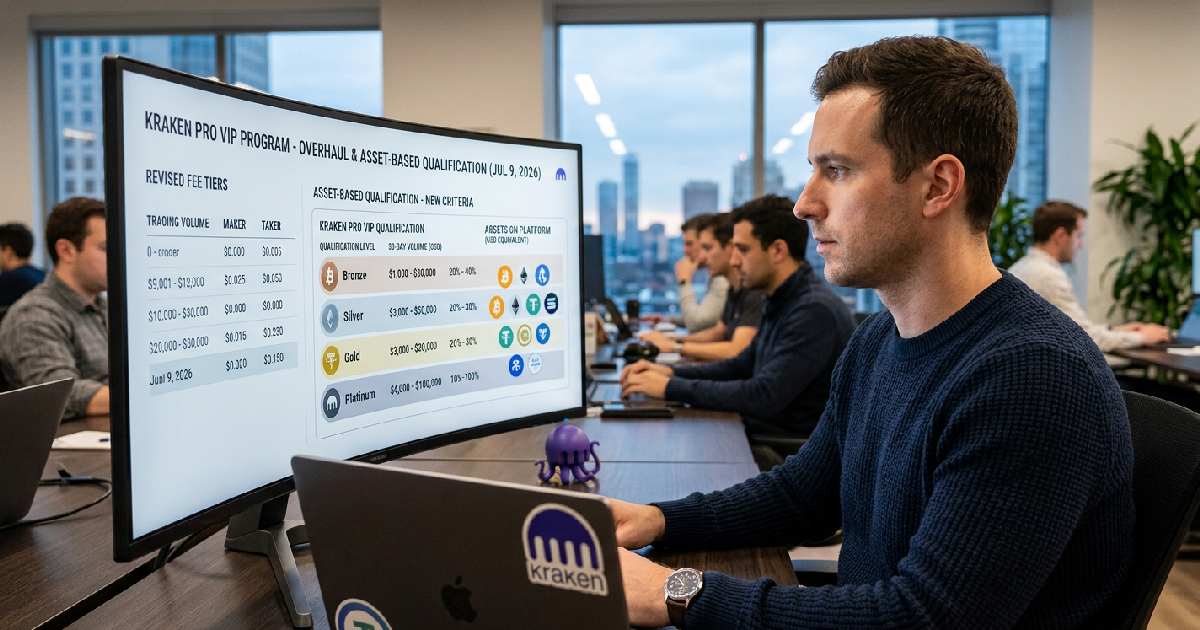

Kraken Pro officially implemented a comprehensive overhaul of its VIP fee tier structure on July 9, 2026, introducing a multi-dimensional qualification system designed to reward long-term exchange loyalty. The San Francisco-based exchange, led by Co-CEOs David Ripley and Arjun Sethi, has moved away from a volume-only model to one that incorporates “Assets on Platform” (AOP) as a primary metric for determining trading costs.
This strategic shift represents a fundamental change in how professional cryptocurrency trading venues compete for liquidity in 2026. By allowing eligible holdings to qualify users for better fee tiers even without recent trading activity, Kraken Pro is attempting to lock in high-net-worth individuals and institutional players who may hold significant capital but trade sporadically based on specific market signals.
Kraken Pro fee tiers introduce asset-based qualification metrics
The updated system now determines a user’s fee tier based on the best of three specific measures: spot trading volume, futures trading volume, or total assets held on the platform. Whichever metric places the user in the highest possible tier is automatically applied across both spot and futures markets, effectively streamlining the cross-platform experience for active traders.
Under the previous regime, Kraken Pro maintained siloed fee structures where spot tiers were calculated only by spot volume and futures tiers were separate.
The inclusion of AOP is a direct response to a more competitive environment where bitcoin exchange supply sits at multi-year lows, forcing platforms to provide deeper incentives for users to keep their assets on-site rather than moving them to cold storage or decentralized protocols.
For traders in the United States, Canada, and New Zealand, the futures component of the qualification remains restricted due to local regulatory frameworks. In these regions, tiers are determined solely by spot volume and AOP. This regional nuance highlights the ongoing friction between global exchange ambitions and the fragmented nature of international financial oversight.
Breaking down the new makers and takers rates
The revised schedule consists of 17 distinct levels, ranging from Tier 1 for small retail users to Pro 5 for massive institutional liquidity providers. At the entry level, taker fees start at 0.80%, but these drop rapidly as volume or asset holdings increase.
For instance, Tier 3 requires either $10,000 in 30-day spot volume or $20,000 in assets on the platform, bringing maker fees down to 0.22%.
The elite “Pro” tiers are where the most aggressive price fighting occurs. A user with $100 million in assets on the platform qualifies for the Pro 5 tier regardless of their monthly volume, granting them a 0.0% maker fee and a rock-bottom 0.05% taker fee.
This creates a powerful incentive for “whales” to consolidate their holdings on Kraken Pro to ensure they always have access to institutional pricing when they decide to move.
It is worth noting that spot trading volume calculations include crypto-cash and crypto-crypto pairs but specifically exclude stablecoin-to-stablecoin conversions and “Instant Buy” transactions. This distinction ensures the exchange rewards true price discovery and market activity rather than simple treasury management or high-frequency stablecoin rotations that offer little organic liquidity to the broader market.
Strategic loyalty mechanisms and the INK Points program
Beyond the raw fee percentages, the overhaul integrates more tightly with the broader Kraken ecosystem, including the VIP Program and the “INK Points” rewards system. The VIP Program provides a personalized layer for clients managing at least $10 million in average monthly balances or maintaining $7.5 million in rolling 30-day spot volume.
These high-tier clients receive more than just lower fees; they gain access to dedicated relationship managers and private 1:1 sessions with Kraken’s Chief Economist and security analysts. This move mirrors traditional private banking models, attempting to humanize the digital asset experience to prevent churn toward emerging competitors or the growing decentralized exchange sector that has seen increased activity throughout 2026.
The INK Points program adds a gamified layer to this loyalty stack. By earning points through staking and platform engagement, users move through levels that provide leaderboard status and invite-only access to exclusive events.
Unlike the fee tiers, which are based on hard math, the rewards program focuses on “stickiness”—ensuring that the cost of leaving the exchange is measured not just in dollars, but in lost status and rewards.
Market competition and the shifting regulatory backdrop
Kraken’s decision to overhaul its pricing comes as the industry faces a dual challenge of fee compression and regulatory evolution. With the CLARITY Act advancing through Congress, American exchanges are under pressure to professionalize their operations and clarify their fee models to meet potential new standards for transparency.
While Binance.US and Coinbase have also tweaked their models recently to attract institutional flow, Kraken’s use of asset-based triggers is a specific bet on the “holding” culture of the current market cycle. By rewarding AOP, Kraken is essentially paying users to keep the platform liquid, which in turn attracts more takers and creates a flywheel effect for the exchange’s order books.
However, the exchange must also navigate its history with federal agencies. Having settled previous charges with the SEC regarding staking services and faced fines from the CFTC for unregistered futures activity, this new transparent, math-heavy fee structure appears to be part of a broader “compliance-first” rebranding.
By automating the tier placements and clearly defining what does and does not count toward volume, the platform is removing the ambiguity that often triggers regulatory red flags.
What this means for the global trading environment
The immediate impact of these changes will likely be felt in the slippage and depth of Kraken Pro’s major pairs. As more high-volume makers are incentivized to place limit orders to maintain their status, the bid-ask spreads should theoretically tighten. For the average retail trader, this means better execution prices even if they don’t personally qualify for the lower fee tiers.
Furthermore, the real-time assessment of asset holdings allows for a more dynamic trading environment. If a user deposits a large amount of capital today, they don’t have to wait 30 days to build up volume before they get professional rates; the AOP check can elevate their tier status almost immediately.
This “instant VIP” path is clearly aimed at institutional desks that need to move quickly when market opportunities arise.
If this asset-based model proves successful in retaining users, expect other major venues to follow suit. The industry is moving away from seeing exchanges as mere “toll booths” and toward seeing them as comprehensive capital hubs. For Kraken Pro, the goal is simple: make it so expensive to leave that the whales never do.