
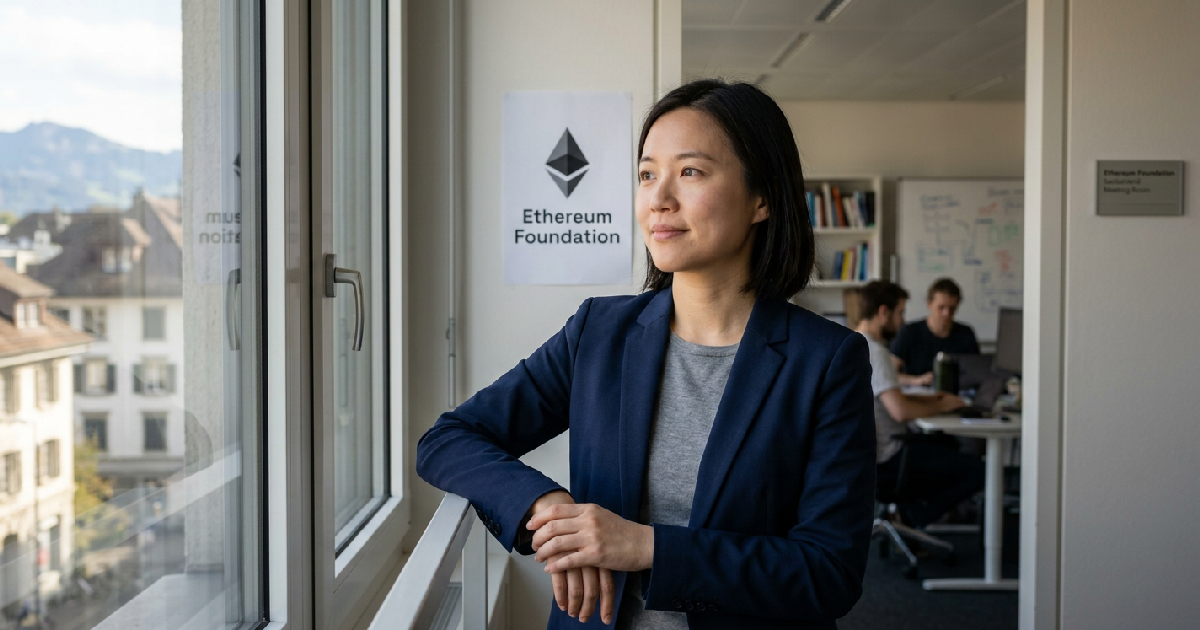

Ethereum Foundation Co-Executive Director Hsiao-Wei Wang resigned from her management roles and board seat on June 18, 2026, marking a significant leadership shift for the Swiss nonprofit. Wang, who was the first Chinese Executive Director at the organization, stepped down following a sabbatical that allowed her to reassess her future plans.
She cited a desire to prioritize her personal life and family as the primary reason for leaving her dual positions within the Foundation’s executive and board layers.
Wang joined the Ethereum Foundation (EF) in mid-2017 as a core protocol researcher and became a fundamental contributor to the network’s technical roadmap. She was heavily involved in the development of the Beacon Chain and played a critical role in ‘The Merge’ of 2022, which transitioned Ethereum to a proof-of-stake system.
Her rise through the EF saw her promoted to the Board of Directors on March 10, 2025, before being named Co-Executive Director just one week later.
In her resignation statement, Wang reflected on the decentralized nature of the network, noting that “Ethereum has always been bigger than any one role, any one organization, or any one moment.” She emphasized that the protocol’s power comes from a global collective of researchers, validators, and developers.
While leaving her formal post, she intends to remain an active community member, stating she is still “contemplating what my next steps should be” regarding her future career path.
Rising turnover in Ethereum Foundation leadership
Wang’s exit is the second departure of a Co-Executive Director in roughly four months, contributing to a period of heightened internal change. Tomasz Stanczak resigned from the same role on February 13, 2026, later officially leaving the post at the end of that month to focus on artificial intelligence.
These high-level departures have occurred as the Ethereum network outlook strengthens due to rising activity on decentralized exchanges and layer-2 solutions.
The Foundation has seen at least eight senior figures depart within the last five months, which has drawn closer scrutiny from the Ethereum community. In response to Stanczak’s earlier exit, Bastian Aue was appointed as Co-Executive Director. Aue has taken on a larger interim role during Wang’s sabbatical and will continue to manage the leadership transition as the organization addresses the current executive vacancies.
Aya Miyaguchi, the Foundation’s longtime executive leader, remains a central figure as President, a role she moved into during a 2025 restructuring. This executive turmoil coincides with a sensitive time for the asset in public markets. The protocol continues to navigate key technical support as investors react to institutional fund flows and adjustments in the broader cryptocurrency regulatory environment.
Legacy of technical upgrades and community building
Beyond her administrative duties, Wang was a key figure in major protocol milestones that defined the modern Ethereum ecosystem. She contributed to the Shapella upgrade, which enabled staked ETH withdrawals, and the Dencun upgrade, which introduced proto-danksharding to lower transaction fees. These technical achievements were central to her tenure, positioning the network for current scaling efforts and improved efficiency.
Founder Vitalik Buterin praised Wang as a “steadfast contributor” for nearly a decade, highlighting her dual impact on protocol research and community development. Buterin specifically noted her work in building an active Ethereum community in Taipei, Taiwan. He stated that Wang accepted the Foundation’s most difficult management responsibilities during a period of transition, fulfilling her missions with a high level of professionalism.
As of April 2025, the Foundation’s board included four members: Vitalik Buterin, Aya Miyaguchi, Patrick Storchenegger, and Hsiao-Wei Wang. Following Wang’s resignation, the current composition of the board remains under observation. The EF board and its leadership team, including Aue and Miyaguchi, must now steady the organization as it continues to oversee the infrastructure collectively maintained by global node operators and developers.