
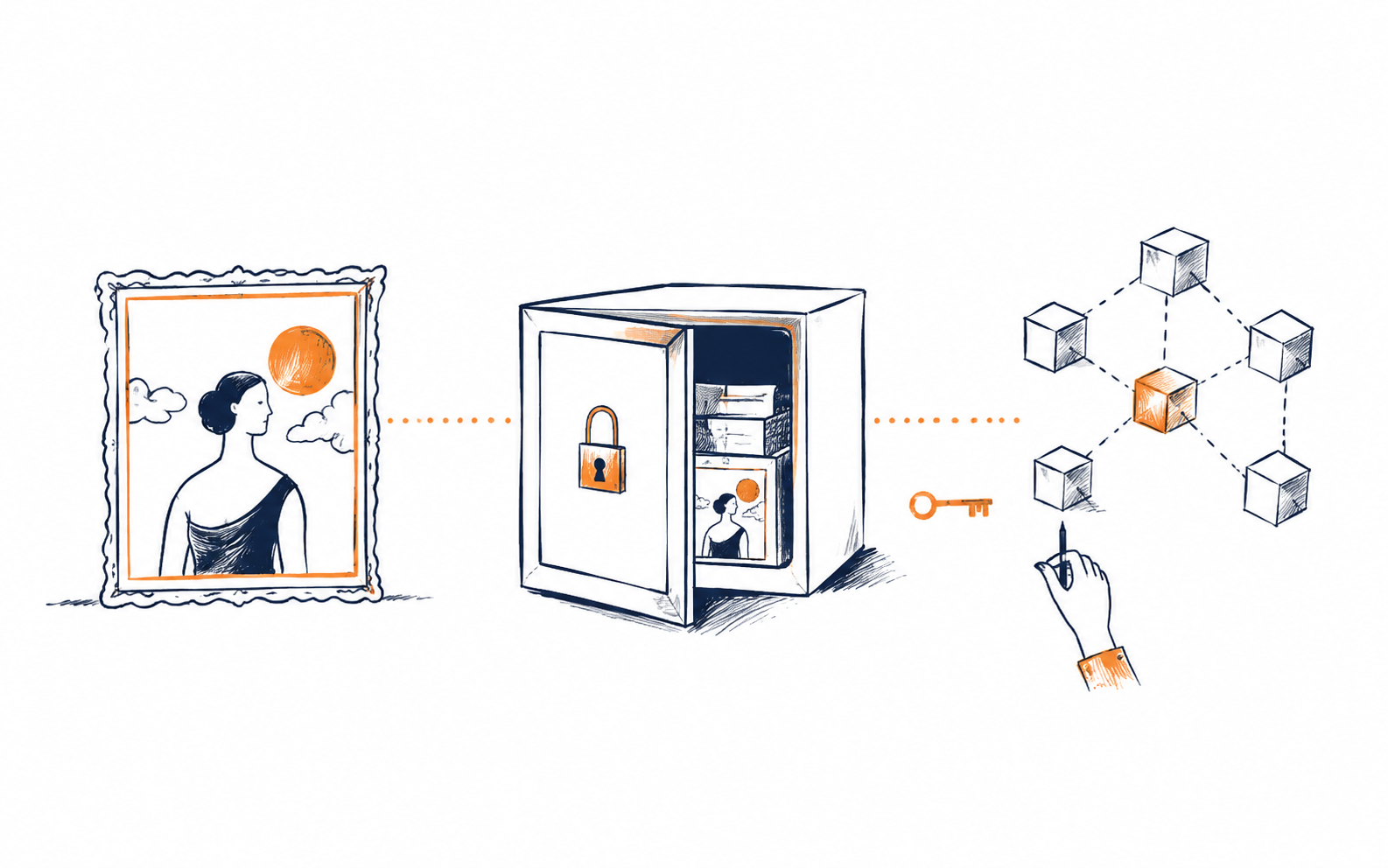

An NFT may appear in a crypto wallet as a picture, video or digital collectible. But the file you see on screen is not necessarily stored on the blockchain itself.
That distinction matters because buying an NFT does not always mean putting the entire digital asset inside a permanent blockchain record. The token, the smart contract, the metadata and the media file can all sit in different places.
So when people ask how are NFTs stored, the valuable question is not simply whether an NFT is “on the blockchain”. It is which parts of the NFT are actually on-chain, and which parts depend on outside infrastructure?
That is where the subject becomes more interesting — and more practical for anyone who owns or is considering an NFT.
The NFT in your wallet is only one layer of the asset
Start with the part the blockchain is designed to handle: the token itself.
An NFT is a unique token associated with a particular blockchain account and smart contract. In Ethereum’s ERC-721 standard, for example, each NFT is identified through the combination of a contract address and a token ID. The token can then be transferred from one wallet to another according to the rules of the smart contract.
The smart contract is another layer. It is the blockchain-based code that defines how the NFT behaves, including functions related to ownership and transfers.
Then there are the metadata, which describe the asset. Metadata can include a name, description, traits and a reference to an image or other media. In ERC-721, the tokenURI function can point to a JSON document containing this information, including an image field.
This creates a structure that is easy to miss when looking at a marketplace interface:
the token is not necessarily the artwork.
The blockchain can record ownership of the token while another system stores the content that gives that token its visual identity.
Where are NFT images actually stored?
The simplest way to understand NFT storage is to imagine a digital collector buying a piece of artwork.
The blockchain might record that wallet A owns token 1847. The smart contract identifies the collection and controls transfers. The NFT metadata might contain a reference to a JSON file. That JSON file, in turn, can contain a reference to the artwork itself.
The final image might be stored somewhere completely outside the blockchain.
This is known as off-chain storage. Rather than putting a large image directly into the blockchain, the project stores the file elsewhere and uses the NFT’s metadata to point towards it.
There is a straightforward reason for this approach: blockchains are not generally designed to behave like cheap, high-capacity file storage systems. Ethereum’s own NFT documentation notes that metadata can be stored on-chain, on a centralised server or through IPFS, with different trade-offs involved.
For a large collection containing thousands of high-resolution files, storing every byte directly on-chain can become an impractical design choice.
That does not make off-chain NFTs inherently flawed. It simply means the NFT depends on more than the blockchain itself.
On-chain storage offers permanence, but comes with a trade-off
An on-chain NFT goes further by putting more of the relevant data directly onto the blockchain.
The obvious advantage is reduced dependence on external infrastructure. If the data itself is part of the blockchain’s records, there is no ordinary web server that needs to keep serving the file for the blockchain record to remain intact.
But that resilience comes at a cost.
Blockchains require every participating node to process and maintain their records. Large amounts of media data are therefore very different from a small transaction or a compact reference. Ethereum’s ERC-721 documentation explicitly notes that putting all metadata for each asset directly on-chain was considered too expensive as a general approach.
That creates a practical compromise.
Off-chain storage can be more efficient, but introduces dependencies. On-chain storage can reduce those dependencies, but may make the NFT substantially more expensive or technically cumbersome to create and maintain.
So “on-chain” should not automatically be read as “better”. It describes an architectural choice.
Why IPFS is often used for NFT storage
One of the most familiar alternatives to traditional web hosting is IPFS, or InterPlanetary File System.
IPFS uses content addressing rather than relying on a conventional web location alone. Files can be identified using a Content Identifier, or CID, which is derived from the content itself. If the content changes, the resulting identifier changes as well.
That matters for NFTs because the reference is tied to the content rather than simply to a server address.
A project might therefore have an NFT whose metadata points to an ipfs:// location, while the image itself is made available through the IPFS network.
This can reduce dependence on a single server. But there is an important detail that is easy to gloss over: IPFS does not mean that a file is guaranteed to remain available forever.
IPFS documentation makes a distinction between permanence and persistence. Data still needs nodes willing and able to retain and serve it. Pinning is one mechanism used to prevent important content from being removed through routine storage management.
In other words, “stored on IPFS” tells you something useful about the architecture, but it does not answer every question about long-term availability.
What happens when the NFT survives but the image does not?
This is the part that reveals why NFT storage is more than a technical footnote.
Imagine that an NFT’s token remains safely recorded on the blockchain for years. Its ownership history is still visible. The smart contract still functions. The token can still be transferred.
But the image no longer loads.
The blockchain record has not necessarily failed. The external piece connecting the token to the visual asset may have failed instead.
That could happen because a centralised server is shut down, a file is removed or a storage provider stops maintaining the data. With IPFS, availability can also depend on whether the content remains properly hosted or pinned.
This produces an uncomfortable distinction between two ideas that are often treated as identical:
the permanence of ownership and the permanence of the experience are not necessarily the same thing.
A buyer may still own the token while losing access to the image they associate with it.
That is why asking whether an NFT is “on-chain” is often too vague to be useful.
How to tell what an NFT actually stores
You do not need to be a blockchain developer to investigate the architecture behind an NFT.
The first thing to check is the token’s metadata and, where available, its tokenURI. This can reveal whether the metadata points to a conventional web address, an IPFS location or another type of resource. The ERC-721 standard explicitly allows the URI to resolve to a JSON metadata document describing the asset.
Then look one level deeper.
If the metadata contains an image field, where does that reference lead? Is the actual image hosted on a conventional server? Does it use an IPFS CID? Is the content itself embedded directly on-chain?
These distinctions matter more than a project’s marketing language.
A collection can describe itself as decentralised while still relying on several external systems between the blockchain and the image displayed in a wallet. Conversely, a project using off-chain storage is not necessarily poorly designed; it may simply be making a sensible compromise between cost, performance and durability.
The important question is whether you understand that compromise.
The blockchain may preserve the token, not everything around it
The easiest mental model is to think of an NFT as a single object. Technically, it is often closer to a chain of connected components.
The blockchain records the token and its ownership. The smart contract defines its behaviour. Metadata describes the asset and points to additional information. A separate storage system may hold the image, animation, audio or other media.
Each layer can therefore have a different level of permanence.
That is the analytical point worth carrying away from how are NFTs stored: blockchain immutability does not automatically extend to every piece of data associated with a token.
The real durability of an NFT depends on the architecture behind it — and on how many links have to keep working between the blockchain record and the asset the owner actually wants to see.
A token can survive the disappearance of its image. Understanding that distinction is what turns NFT storage from a technical detail into an important part of knowing what you actually own.