
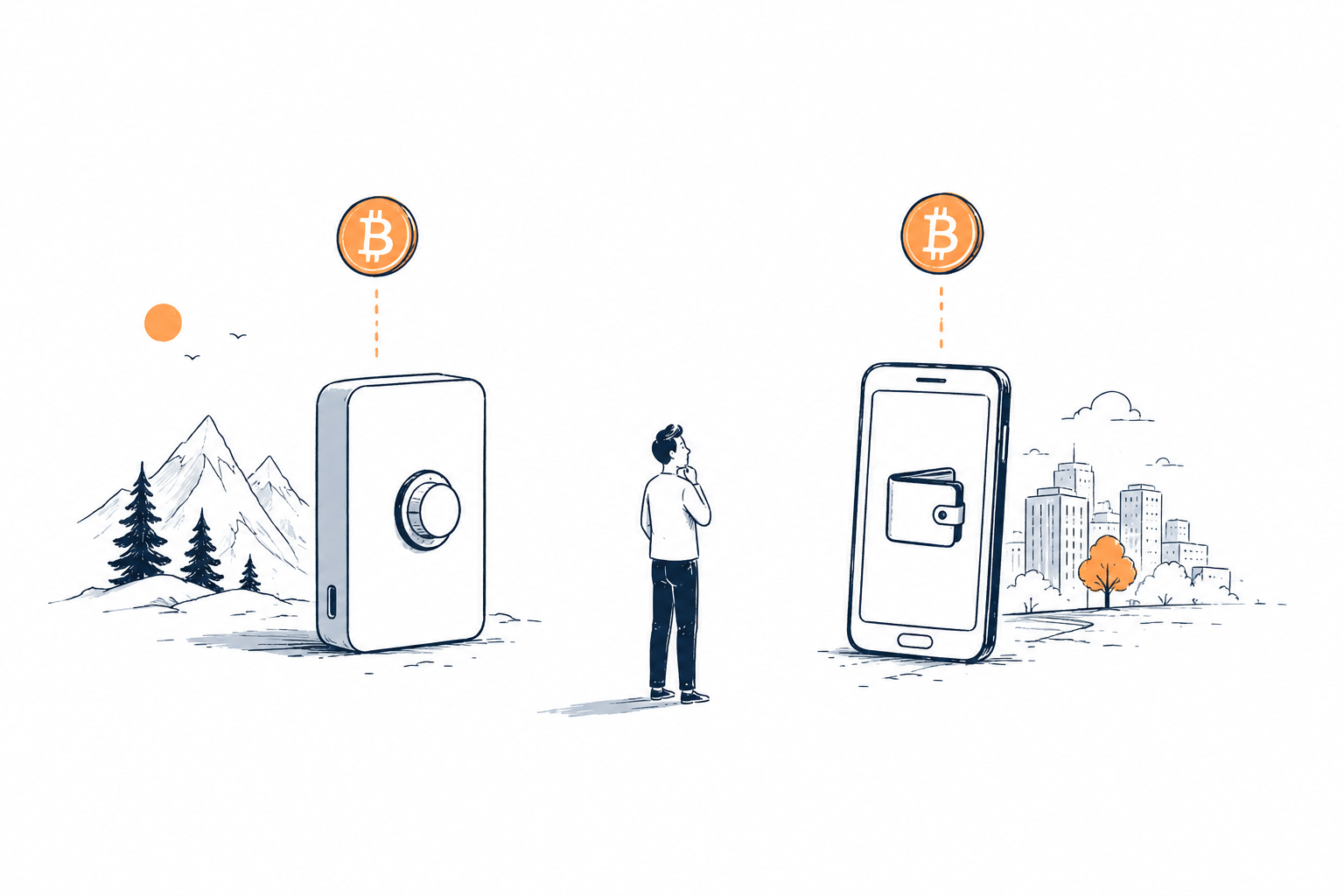

The safer wallet is not necessarily the one you use for everything Should you keep your cryptocurrency in a wallet connected to the internet, or move it into something designed to stay offline?
That is the question behind the hot or cold wallet debate, and the answer matters more once you take control of your own crypto. A hot wallet makes transactions easy because the wallet and its keys are available in a connected environment. A cold wallet is designed to keep the signing keys away from ordinary internet exposure.
Neither approach makes cryptocurrency immune to theft.
The real difference is the kind of risk each one creates — and how often you need to access the funds. That makes the choice less about finding the “best” wallet and more about deciding which assets need to be available and which can afford to stay out of reach.
Connectivity is what separates a hot wallet from a cold one
A hot wallet is typically software that keeps its private key available on a device that connects to the internet. Mobile apps, browser extensions and desktop wallets can all fall into this category.
That constant connection is what makes a hot wallet useful. You can open it, connect to a decentralised application, scan a QR code or send funds without moving assets through an additional device.
It is also what increases the potential attack surface. A connected wallet exists in the same environment as browsers, operating systems, downloads and other software. If that environment is compromised, the private key or the transaction approval process can become a target.
A cold wallet takes a different approach. Its purpose is to keep the keys away from an internet-connected environment, often by using dedicated hardware. The transaction can be prepared on another device and signed without exposing the private key to the connected system.
The important detail is easy to miss: the cryptocurrency itself does not sit inside the hardware wallet. The blockchain records the assets. The device protects the keys used to authorise transactions.
That distinction is useful because it shifts the conversation from “where are my coins?” to the more accurate question: where are the keys that control them?
A hot wallet is convenient precisely because it is more exposed
For someone who regularly uses cryptocurrency, the convenience of a hot wallet is difficult to beat.
Imagine keeping the amount you expect to spend this week in your physical wallet. You would not normally carry every saving you have ever made in it simply because you might need it one day.
Crypto can work in much the same way.
A hot wallet is well suited to smaller balances used for payments, trading or interacting with decentralised applications. Its role is operational: the funds are there because you expect to move them.
The problem comes when the same wallet becomes a storage vault.
A connected wallet can be exposed to phishing attacks, malicious software, fake websites and unsafe applications. DeFi introduces another layer of complexity because interacting with a protocol can require you to approve transactions or token permissions.
A wallet that is used for everything effectively combines spending, experimentation and long-term savings into one target.
That is not automatically unsafe. It is simply a poor way to contain risk.
Cold storage reduces online exposure, but adds another responsibility
This is where cold wallets have their clearest advantage.
Keeping signing keys offline removes much of the exposure associated with an ordinary internet-connected device. It is one reason cold storage is commonly associated with long-term holdings rather than everyday spending.
But offline does not mean invincible.
A cold wallet can still be lost, damaged, misconfigured or replaced incorrectly. More importantly, the backup that allows you to recover the wallet remains critical.
That usually means a seed phrase — a sequence of words used to recreate access to a wallet. Anyone who obtains that phrase may be able to recover the wallet elsewhere, which is why storing it casually can undermine the protection provided by the hardware itself.
A photograph in cloud storage, a message sent to yourself or a website asking you to “verify” your seed phrase defeats the purpose of keeping the keys offline.
There is also a more mundane risk: buying or configuring the wrong device. Cold storage introduces physical and operational steps that a software wallet does not. Security therefore becomes partly a matter of process, not just technology.
The contradiction is worth remembering: a cold wallet can reduce one class of risk while making human mistakes more consequential.
So, is a cold wallet actually safer?
For long-term storage, cold storage generally offers stronger protection against ordinary online attacks because the signing keys are kept away from an internet-connected environment. That does not make every cold wallet safer in every situation, nor does it mean every user needs one.
The better question is how the funds are going to be used.
Someone regularly interacting with DeFi, making payments or moving assets between platforms may find a hot wallet far more practical. Keeping the same activity inside a cold wallet can add friction every time a transaction needs to be signed.
For someone holding Bitcoin or other crypto for months or years without intending to touch it, that friction may be an advantage rather than a disadvantage. If the assets are rarely moved, there is little reason for the keys to remain continuously exposed to a connected environment.
The value of a cold wallet is therefore not just that it is “more secure”. It is that it makes unnecessary access harder.
Why using both can make more sense than choosing one
The hot wallet versus cold wallet debate is often framed as a competition. In practice, the two can perform different jobs.
A simple setup might keep a relatively small operating balance in a hot wallet while the majority of long-term holdings remain in cold storage.
That creates a useful boundary. If the hot wallet is compromised, the potential loss is limited to the funds deliberately kept there. A separate cold wallet does not need to interact with every website, protocol or transaction.
The same logic can apply to DeFi. A wallet used for experimenting with unfamiliar applications does not necessarily need to be the wallet holding everything else.
This is essentially risk compartmentalisation: instead of trying to make one wallet suitable for every possible situation, you limit what each wallet is allowed to do.
There is no universal percentage that needs to sit in hot versus cold storage. A person who rarely uses crypto may need very little in a hot wallet. Someone who uses digital assets every day may need more.
The principle is more useful than the ratio: keep the amount exposed to routine activity proportional to the amount you actually need to use.
The weakest part of a secure wallet may not be the wallet
Wallet security is often discussed as a hardware question: which device should I buy, and which brand has the strongest protections?
That can miss the bigger issue.
The private key is what gives control over the assets, and the recovery process is part of that security model. A sophisticated device cannot compensate for a seed phrase that has been photographed, stored carelessly or entered into a fraudulent website.
The same applies to hot wallets. A reputable application cannot protect a user who approves a malicious transaction after being tricked by a convincing phishing page.
In both cases, the technology provides boundaries. The user determines whether those boundaries hold.
That is why “offline” should not be treated as a synonym for “safe”. It describes one security property. It does not describe the quality of everything surrounding it.
Hot or cold wallet: which should you use?
The simplest answer is to match the wallet to the job.
A hot wallet makes more sense when access and regular transactions matter. It is convenient for smaller balances, payments and interactions with crypto applications.
A cold wallet makes more sense when the priority is keeping assets away from routine online exposure and frequent transactions.
For many users, the most practical arrangement is not one or the other but both: a hot wallet for money that needs to move, and cold storage for money that does not.
That is the more valuable way to think about hot or cold wallet security. The safest setup is rarely the one with the fewest clicks or the most expensive hardware. It is the one that makes the consequences of an everyday mistake smaller.
In crypto self-custody, security is not about eliminating every possible risk. It is about deciding which risks are worth taking — and making sure you are not taking all of them with the same wallet.