
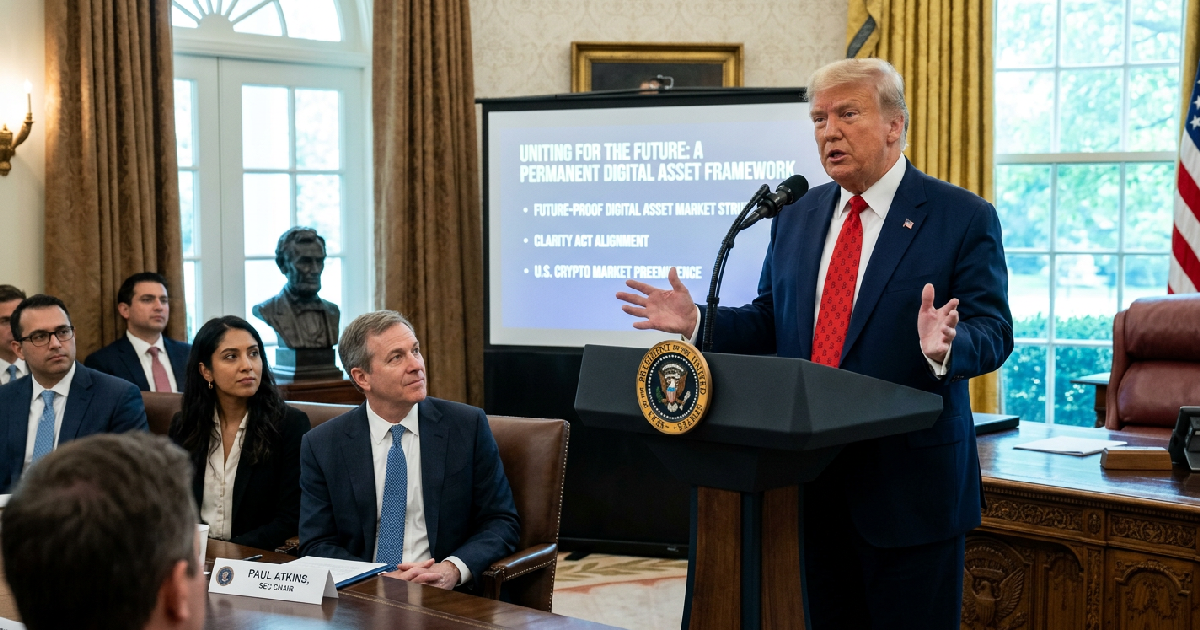

President Donald Trump vowed on May 27, 2026, to codify a “future-proof” digital asset market structure to prevent future political reversals from undoing current regulatory progress. Posting on Truth Social, the president detailed his intent to cement a durable framework that protects the industry from “crypto haters.” This initiative aims to solidify the United States as the global leader in digital asset innovation by moving beyond temporary executive measures toward permanent federal law.
The announcement follows nearly eighteen months of aggressive pro-crypto policy shifts under the Trump administration. Trump accused former Securities and Exchange Commission (SEC) Chair Gary Gensler of nearly destroying the domestic industry by driving bitcoin and innovation offshore. By establishing federal market structure rules, the administration seeks to bring builders and entrepreneurs back to the U.S. and provide the long-term legal clarity that institutional investors have demanded.
A central component of this strategy involves defining regulatory responsibilities between the SEC and the Commodity Futures Trading Commission (CFTC). Current SEC Chair Paul Atkins has moved away from the agency’s prior restrictive stance, working with the administration and Congress to provide clarity. This cooperative approach marks a significant shift from previous eras of “regulation by enforcement” and focuses on reshaping oversight for exchanges, tokens, and derivatives.
Trump seeks permanent rules for bitcoin and crypto perpetuals
The president is pushing for a market structure that resists future political shifts, stating the “new frontier of finance” must be built on American soil. This legislative push aims to embed specific definitions for bitcoin and crypto perpetuals into federal code. By creating clearer rules for token classification and exchange operations, the administration intends to make it difficult for future regulators to unilaterally alter the industry’s legal standing.
This push for permanence coincides with significant legislative momentum in Washington. On May 14, 2026, the Senate Banking Committee advanced the Digital Asset Market CLARITY Act to the full Senate with a bipartisan 15-9 vote. Senator Cynthia Lummis, a key supporter of the bill, warned that without these formal protections, software developers in the digital asset sector could remain targets for prosecution due to lingering legal ambiguities.
The administration’s “future-proofing” efforts are bolstered by the work of the President’s Working Group on Digital Asset Markets. In July 2025, the group released a policy report titled “Strengthening American Leadership in Digital Financial Technology.” This document serves as a blueprint for the current legislative push, emphasizing that “like activities should be subject to like regulation,” a sentiment backed by Rebecca Romero Rainey of the Independent Community Bankers of America.
Rescinding barriers to institutional digital asset adoption
The move to codify regulations aims to lock in changes that have already opened doors for traditional finance. On January 23, 2025, the SEC rescinded Staff Accounting Bulletin (SAB) No. 121, a major hurdle that previously prevented banks from offering digital asset services. Trump’s new market structure seeks to ensure such impediments cannot be easily reinstated, encouraging more domestic banks to follow international trends where Italy’s largest bank exceeded $200M in Bitcoin exposure through ETFs.
Trump’s strategy also includes direct executive action to maintain the sector’s growth. On May 19, 2026, he signed an executive order titled “Integrating Financial Technology Innovation into Regulatory Frameworks.” This followed a major speech at a cryptocurrency conference in Palm Beach, Florida, on April 25, 2026, where he reiterated his goal to make America the “crypto capital of the world.” Analysts like Mark Palmer of Benchmark suggest these moves are designed to offer builders the certainty they need to reinvest in the U.S. market.
While the administration focuses on legislation, the SEC has shifted toward a more facilitative role under Chair Paul Atkins. The agency established a Crypto Task Force in early 2026 and has since dropped or dismissed charges against several industry players, including Coinbase and Kraken. These actions, combined with the proposed “future-proof” structure, represent a coordinated effort to insulate the digital asset market from regulatory volatility for years to come.