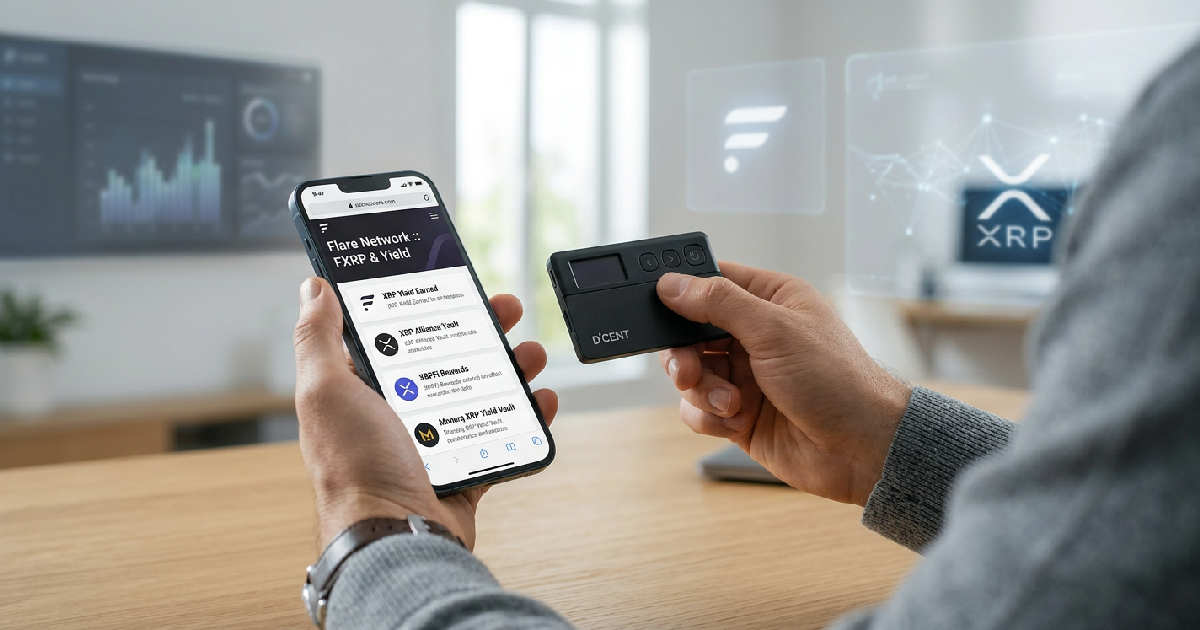
The decentralized finance (DeFi) network Flare and hardware wallet provider D’CENT Wallet announced a new integration on Tuesday, May 19, 2026, to provide users with hardware-secured XRP yield access. This initiative, part of the newly formed XRP Alliance, allows XRP holders to deposit their assets into institutional-grade vaults directly from their cold storage devices. The process requires no movement to a separate blockchain and does not necessitate a new gas token for transactions.
Flare co-founder Hugo Philion confirmed that the integration enables D’CENT users to earn on their XRP without moving it off the devices they trust. The collaboration uses Flare Smart Accounts to treat the XRP Ledger (XRPL) as a control layer, allowing users to execute transactions via two hardware wallet signatures. This development aims to bridge the gap for security-conscious investors who previously had to choose between hardware safety and decentralized yield.
A natural shift in the ecosystem has seen
XRP wallet adoption trends move toward more complex interactions with decentralized finance. This latest project utilizes Flare as a programmable layer for XRP, with “FAssets” providing a trust-minimized on-chain representation of XRP, known as FXRP. These smart contracts ensure that the deposit flow remains fully non-custodial throughout its lifecycle.
Technical logistics of Flare smart accounts
The integration relies on a two-signature verification process conducted directly on the D’CENT device. The first signature reserves collateral on Flare and identifies the target vault. The second signature sends XRP to the Core Vault on the XRPL, which triggers the minting of FXRP and an automatic deposit into the chosen vault. Flare Data Connectors relay proof of these transactions to ensure the Smart Account System executes instructions accurately from a proxy assigned to the user’s address.
IoTrust, the global startup behind D’CENT, reports a user base of 1 million people across 220 countries. Within this ecosystem, D’CENT Wallet specifically serves at least 720,000 users in the United States, United Kingdom, Canada, Japan, and South Korea. According to company data, D’CENT users currently hold billions of XRP in storage. This existing liquidity can now be managed through the Discovery tab of the D’CENT app without requiring the native FLR token for gas fees.
Accessing institutional grade yield vaults
XRP holders participating in this initiative can choose between two primary institutional-grade options. The first is the Monarq XRP Yield Vault (MXRPY), operated by Monarq, an asset manager majority-owned by the digital asset firm FalconX. This vault utilizes a multi-strategy mandate that combines on-chain and off-chain sources of returns. Monarq officially launched the MXRPY vault last week to coincide with the broader XRP Alliance rollout.
The second option is the earnXRP vault, which is curated by on-chain strategy team Clearstar. This product has already demonstrated high demand; when it originally launched on December 22, 2025, it hit its capacity cap of 25 million XRP—worth approximately $33.9 million—within just one week. Both vaults utilize infrastructure provided by Upshift and are accessible directly through the D’CENT hardware interface.
Expanding the XRP alliance coalition
The partnership between Flare and D’CENT is a core component of the XRP Alliance, which was first announced on May 12. Other members set to join the coalition following the launch include Doppler, Banxa, and Squid. These partners are expected to provide additional layers of utility, such as fiat on-ramps and liquidity routing, to the growing “XRPFi” ecosystem.
To mark the launch, D’CENT is running a campaign with a $15,000 reward pool that remains open until June 8, 2026. While the broader market continues to monitor
macro warning signs and rising yields in traditional sectors, the initiative highlights a growing infrastructure for native crypto-denominated returns. For now, the focus is on providing a secure, “production-grade” path for idle XRP capital to generate yield while remaining under the user’s direct control. Management of these vaults is strictly non-custodial, meaning no intermediary takes possession of the user’s private keys or assets during the deposit or withdrawal phases.

 By Michael Fawn