
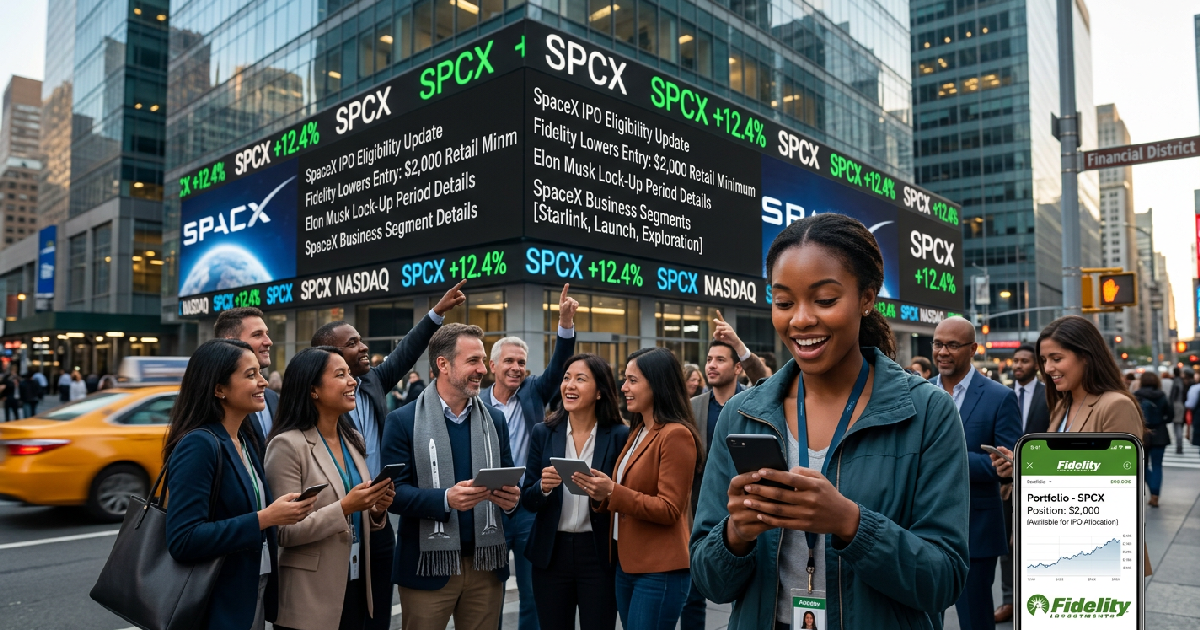

Fidelity Investments has lowered its retail asset requirement for the Space Exploration Technologies Corp. (SpaceX) initial public offering (IPO) to $2,000, significantly widening access for millions of individual traders.
The aerospace giant, led by CEO Elon Musk, officially filed for its public debut on May 20, 2026, and is expected to allocate an unusually large 30% of its 555.6 million share offering to retail clients. With a targeted valuation of $1.
75 trillion, the company is set to list on the Nasdaq Stock Market and Nasdaq Texas under the ticker symbol SPCX as early as June 12, 2026.
The revised eligibility floor is a sharp departure from Fidelity’s typical $100,000 to $500,000 requirement for traditional public offerings. Fidelity noted that the decision to lower the threshold to $2,000 was driven by the record-breaking retail allocation, which allows more ordinary clients to participate in the $75 billion raise.
The roadshow for the offering begins today, June 4, 2026, marking a pivotal moment for the firm which moved its headquarters from Hawthorne, California, to Texas in 2024.
As investor interest peaks, SpaceX is reportedly pursuing a strategy to set a fixed IPO price of $135 per share before the standard bookbuilding process, a move described as highly unusual in financial markets. This all-primary offering means all proceeds will go directly to the company to fund its diverse business segments.
These operations include the Starlink satellite internet service, rocket development, satellite mobile services, Terafab chip design, Grok AI models, and AI infrastructure in space.
Fidelity requirements for SpaceX IPO participation
While the entry barrier has been lowered, local investors must still adhere to five specific rules to qualify for an allocation of SPCX shares. First, clients must maintain at least $2,000 in a retail brokerage account and successfully download and review the preliminary prospectus. This document highlights the company’s 2025 financial performance, which included $18.7 billion in revenue alongside a $4.28 billion quarterly loss.
The third and fourth steps require investors to answer FINRA Rule 5130/5131 qualification questions and submit an Indication of Interest (IOI). Fidelity allows orders for a minimum of one share up to a maximum of 1,000,000 shares. Finally, participants must confirm their IOI after the offering is priced—typically after 10:30 p.m.
local time on the night of pricing—or they will lose their eligibility for the deal entirely.
This surge in demand for high-valuation tech coincides with a period where investors are assessing market resistance levels across various asset classes. The SpaceX listing is expected to trigger significant volatility, given that the free float is estimated at roughly 4%.
To mitigate erratic trading, CEO Elon Musk has agreed to a lock-up period, pledging not to sell his personal shares for approximately one year after the IPO.
Understanding anti-flipping rules and penalties
To ensure long-term stability, Fidelity and other major brokers enforce strict anti-flipping policies that penalize investors who sell their shares too quickly. Fidelity defines flipping as the sale of IPO-allocated shares within 15 calendar days of the start of secondary market trading.
This window is shorter than the 30-day standard used by competitors like Robinhood and SoFi, yet the consequences for early exits remain a deterrent for speculative traders.
Under general brokerage rules, violating an anti-flipping policy can lead to restrictions on participating in future public offerings. A first occurrence typically results in a six-month restriction, while a second violation can trigger a one-year block. These rules prevent the “pump and dump” activity that can occur when retail demand heavily outstrips supply, especially in a listing of this magnitude.
Recent market trends show that macro warning signs and rising yields have made underwriters more protective of high-profile listings. Goldman Sachs, Bank of America, and Citigroup are among the two dozen banks managing the SpaceX debut, and they have reportedly encouraged these holding periods to maintain a stable floor for the stock during its first weeks of trading.
Financial outlook and the path to 2030
The $1.75 trillion valuation rests on aggressive growth projections for SpaceX’s multifaceted business model. While the company reported substantial capital expenditures of $20.7 billion in 2025, analysts at Goldman Sachs have told investors they expect SpaceX AI revenue to surge 100-fold by 2030.
This narrative leans heavily on the potential of the satellite mobile service and space-based AI infrastructure to offset the costs of rocket production.
However, the company remains under the firm control of its founder. Elon Musk will retain approximately 85.1% of the combined voting power of the common stock post-IPO. For retail buyers, this means they are investing in Musk’s long-term vision with limited say in corporate governance.
The unusual fixed-price strategy and the massive losses reported in 2025 serve as a reminder that the aerospace sector carries risks different from traditional tech stocks.
With share sales expected as early as June 11, the competition for the 30% retail pool will be fierce. Personal pitches from bank executives like JPMorgan’s Jamie Dimon to high-net-worth clients suggest that institutional interest remains the primary driver of the deal.
For the retail sector, the $2,000 minimum is the starting point, but the ability to hold through early volatility will be the true test of this investment.