
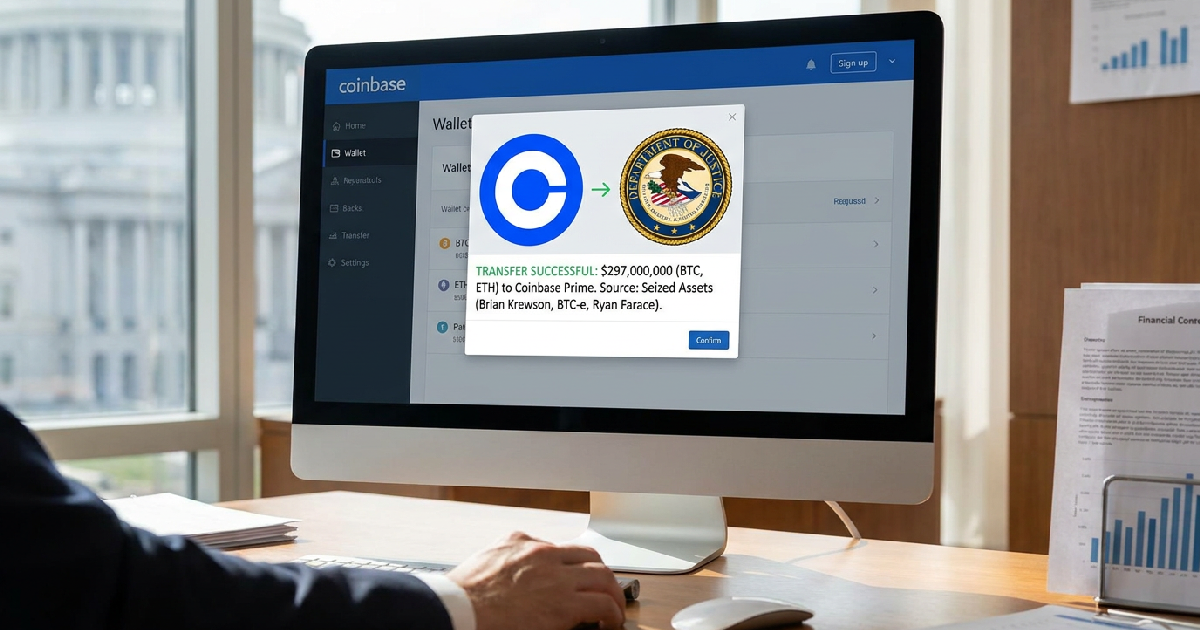

The United States government moved approximately $297 million in seized Bitcoin (BTC) and Ether (ETH) to Coinbase Prime on Monday, July 13, 2026. This significant transfer, tracked by blockchain intelligence firm Arkham, has ignited fresh debate over the federal authorities’ strategy for managing its substantial digital asset holdings.
The funds originated from three high-profile criminal forfeiture cases involving Brian Krewson, the defunct BTC-e exchange, and dark web drug dealer Ryan Farace. While transfers to institutional platforms like Coinbase Prime often precede liquidation, federal officials have yet to confirm any intent to sell these assets.
Federal Agencies Consolidate Digital Assets
The Monday transfers saw a total of 3,940 Bitcoin, valued at about $243.95 million, and 30,014 Ether, worth approximately $53.09 million, enter Coinbase Prime wallets. Arkham reported an initial deposit of $8.8 million, followed by a larger $288.33 million transfer just three hours later.
Coinbase Prime, the institutional arm of the popular cryptocurrency exchange, offers services specifically designed for large clients, including government entities. These services encompass secure custody, wallet management, and over-the-counter (OTC) trading options, which can help minimize market impact from substantial sales.
These assets stem from criminal activities that led to their forfeiture to the U.S. government. The cases include funds linked to Brian Krewson, an Oracle employee implicated in a $54 million crypto laundering scheme, as well as the notorious BTC-e exchange.
Tracing the Origins of Forfeited Crypto
Brian Krewson played a role in storing and laundering $54 million in cryptocurrency for two convicted drug traffickers, according to the Department of Justice. His actions contributed to the Ether portion of the recent transfer.
The defunct BTC-e exchange operated as an unlicensed platform from 2011 to 2017, processing over $9 billion before its eventual shutdown by authorities. Assets from this case form a considerable part of the government’s seized Bitcoin.
Additionally, the transfers include funds from Ryan Farace, known as “xanaxman,” a dark web drug dealer who generated more than 9,138 Bitcoin through illicit sales. Farace received a 54-month sentence in 2023 for his involvement.
Policy Clash: Executive Order Versus Transfers
The movement of these significant crypto holdings comes against a backdrop of evolving U.S. policy regarding digital assets. President Donald Trump’s March 2025 executive order established a Strategic Bitcoin Reserve, partly aiming to restrict the government from selling its Bitcoin holdings.
However, this executive order remains a presidential decision, not a binding statute. Congress introduced a bill in May 2026 to legally codify a 20-year holding period for such reserves, but the legislation hasn’t progressed beyond the committee stage.
These recent Bitcoin price and Ether transfers to Coinbase Prime therefore reignite questions about how various federal agencies will interpret and act under this complex policy environment. Alex Thorn, Head of Galaxy Research, confirmed that these movements were comprised of coins seized from Ryan Farace and the defunct crypto exchange BTC-e.
A Recurring Pattern of Movement, Not Always Sales
It’s worth noting this isn’t the first time the U.S. government has moved seized cryptocurrency to Coinbase Prime without an immediate sale. Similar transfers occurred in January 2026, leading to rumors of a large Samourai Bitcoin sale that ultimately didn’t materialize.
In June 2026, seized FTX Chainlink tokens found their way to Coinbase Prime, and prior to that, in May 2026, seized Alameda altcoins were also transferred. An earlier instance in April 2026 involved approximately 8.2 Bitcoin tied to the 2016 Bitfinex hack also being sent to the institutional platform.
None of these previous large-scale transfers resulted in confirmed liquidations. This suggests that while moving assets to Coinbase Prime could be a preparatory step for a sale, it doesn’t automatically confirm an imminent one. The Treasury or the U.S. Marshals Service have yet to issue any official comment on the government’s intentions for these specific holdings.
Implications for the Broader Crypto Market
The federal government holds an estimated $20.6 billion in digital assets, including roughly 325,000 Bitcoin, making its every move in the crypto space closely watched. Any potential sale of such substantial holdings could significantly influence market sentiment and Ethereum price outlook.
This ongoing pattern of transfers underscores the government’s professionalization in handling forfeited digital assets. Rather than signaling a definitive bearish outlook, these actions indicate efforts towards operational efficiency and secure management of ill-gotten gains now in federal custody.
For investors, these transfers highlight the persistent impact of regulatory actions and law enforcement on the crypto ecosystem. They also serve as a reminder that the U.S. government remains one of the largest and most influential holders of cryptocurrency, with its decisions capable of moving markets and shaping crypto liquidations.
Looking Ahead: Federal Crypto Policy Under Scrutiny
As the U.S. government continues to seize and manage a growing portfolio of digital assets, its policies are under increasing scrutiny from both industry participants and lawmakers. The current transfers to Coinbase Prime exemplify the tension between the desire to maintain a strategic reserve and the need for efficient asset management.
The stalled legislative efforts to codify a long-term holding period for seized Bitcoin mean executive decisions largely dictate the path forward. This leaves room for ongoing speculation whenever large amounts of crypto shift between government-linked wallets and institutional platforms.
The coming months will likely see continued debate over the optimal approach for the U.S. government to handle its substantial digital asset hoard. Whether these transfers are purely for administrative convenience or precursors to a future sale remains a key question for the crypto community.