
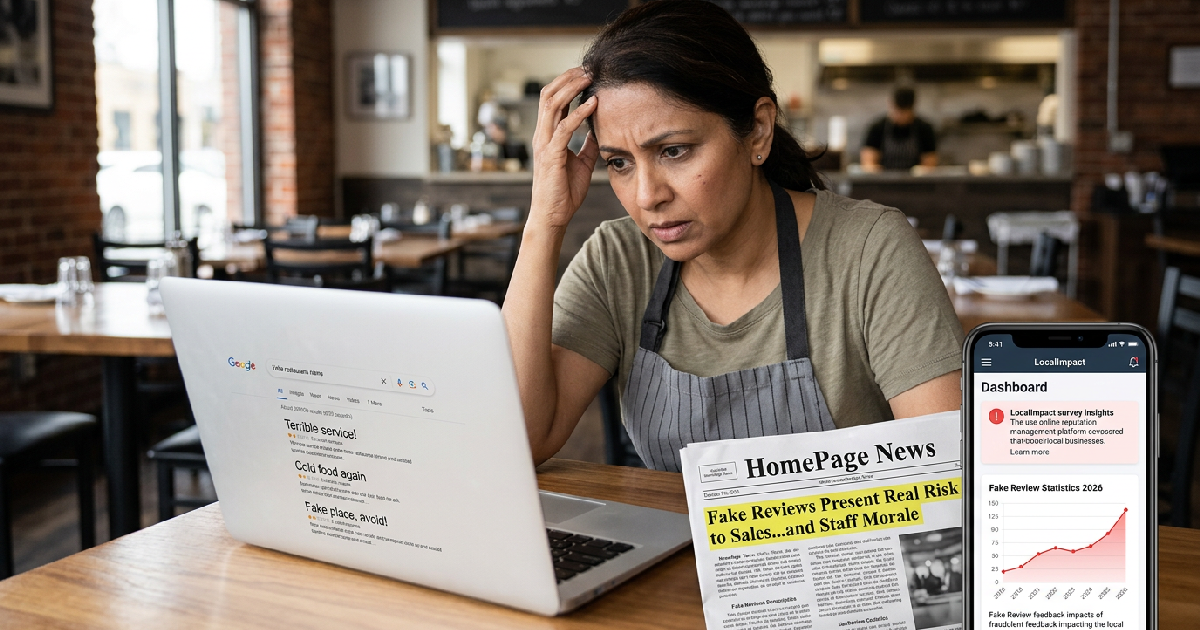

A survey sponsored by the reputation management platform LocalImpact reveals that 72% of brick-and-mortar business owners received at least one fake review in the last 12 months. The findings, published on June 15, 2026, by HomePage News, indicate that fraudulent digital feedback has evolved into a recurring operational risk.
Retailers, restaurant owners, and medical providers reported that these reviews now actively harm sales and internal staff morale.
The scale of the problem is significant, with approximately 75% of owners stating that fake reviews have hurt their operations in some way. Beyond isolated incidents, 79% of respondents believe they have been targeted by a coordinated fake review attack at some point. This organized harassment often forces owners to divert resources away from growth to focus on digital damage control.
The operational toll includes a direct hit to the bottom line, as 28% of business owners reported reduced revenue due to fraudulent feedback. Another 33% believed they lost potential customers who were deterred by the fake complaints. While high-level market confidence and geopolitical shifts often dominate financial news, for local owners, a single fraudulent star rating can be equally disruptive.
Fake reviews damage staff morale and hiring efforts
The survey highlights a growing human cost to digital fraud that goes beyond financial metrics. Twenty-four percent of business owners cited increased staff stress or morale issues as a direct result of fake reviews. Employees are often forced to handle public, fabricated complaints about service they never actually provided.
Attracting new talent has also become more difficult due to the prevalence of “review bombing” and misinformation. Twenty percent of owners maintained that fake reviews have made it harder to attract new hires. This creates an additional hurdle for medical practices and home services that rely on a strong reputation to recruit specialized staff.
Staff retention suffers when workers feel their performance is being evaluated against impossible, often nonexistent, scenarios created by bad actors. Just as odds analysis and performance metrics shape professional sports, digital scores are increasingly dictating the perceived culture of a local workforce.
Competitor interference and high frequency of attacks
Competitive sabotage appears to be a driving force behind the surge in fraudulent activity. Seventy percent of business owners suspect their competitors of using fake positive reviews to artificially inflate their own ratings. This creates a skewed market where honest businesses are disadvantaged by both false negatives on their pages and false positives on their rivals’.
The frequency of these incidents is also rising, with a quarter of owners receiving six or more fake reviews in a single year. Seven percent of respondents were hit by more than 20 fake reviews in the same period. Conversely, only 8% of business owners were confident they had received zero fake reviews during the past 12 months.
Platform response times remain a major pain point for the business community. Only 28% of owners said that fake reviews they reported were removed promptly by host platforms. This slow action leaves businesses vulnerable to “star rating” erosion, a concern cited by 52% of the survey participants.
Adoption of review management platforms as a defense
Faced with persistent digital attacks, many businesses are turning to third-party reputation management tools. The LocalImpact survey found that 31% of business owners have already adopted a dedicated review management platform. These services aim to provide more robust monitoring than what is currently offered by standard search and social media sites.
Despite the rise of these tools, overall confidence in handling a sudden crisis remains quite low. Only 36% of respondents said they would feel very well-equipped to handle a sudden spike in phony negative reviews. This suggests that without better platform-level oversight, most businesses remain in a reactive posture.
Managing the fallout of fraud is also a time-consuming endeavor. Forty percent of owners pointed to meaningful time spent managing or responding to reviews they knew were fake. This labor-intensive process draws attention away from core services in retail, medical, and home maintenance sectors where owner oversight is critical.