
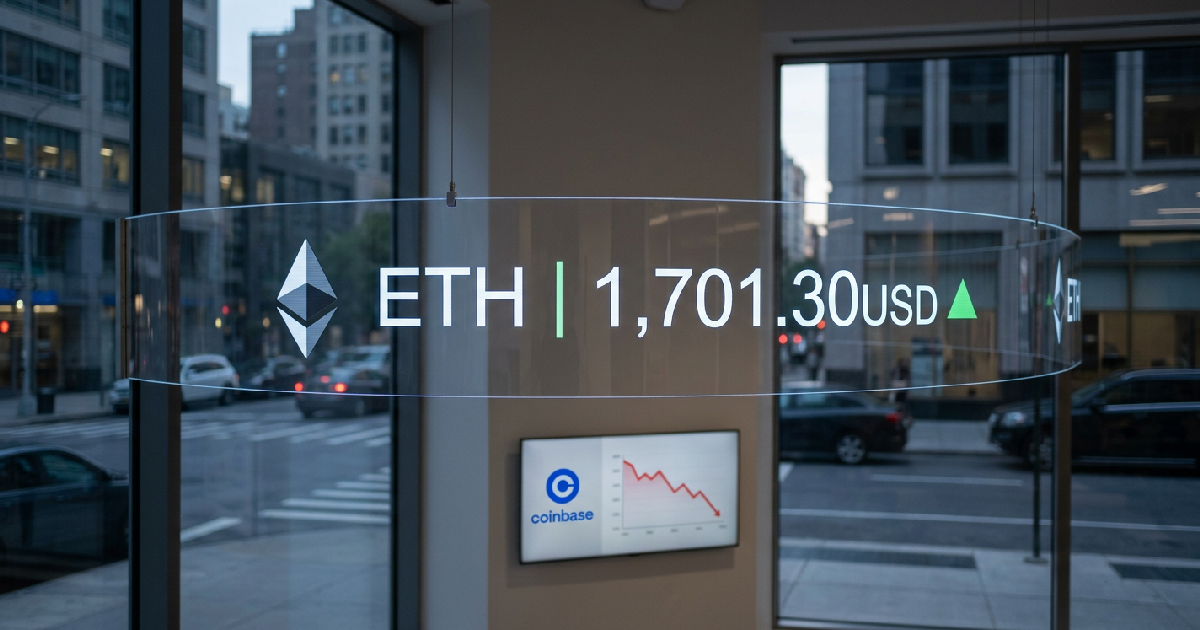

Ethereum (ETH) traded near $1,666 on June 8, 2026, as the second-largest cryptocurrency attempted a recovery from one of its steepest price drops this year. After stabilizing in the $1,500 to $1,600 range, the digital asset briefly climbed above $1,700 earlier in the session, marking a rebound of more than 6% from its recent lows.
The price action follows a broader shift in sentiment as Bitcoin reclaimed the $63,000 level, triggering short liquidations in oversold assets.
Despite the current 3.5% uptick over the last 24 hours, Ethereum faces significant historical and institutional headwinds. June is typically a weak month for the token, with prices closing in the red in seven of the last ten years. This follows a difficult May 2026, where Ether fell 12.
6%, snapping a two-year streak of gains for that month. As Bitcoin signals market structure shifts, Ethereum traders are closely watching if this bounce can overcome persistent institutional selling pressure.
Market data points to specific localized selling as a primary cause for the recent slump. The Coinbase Premium Index fell to -0.16 on May 28 before a slight recovery to -0.13, suggesting consistent exit volume from U.S. entities.
Furthermore, ETH spot ETFs recorded sixteen straight days of outflows as of June 3, with total May outflows reaching $401.62 million. While some investors consider altcoin opportunities during such dips, the flight of institutional capital has left the price struggling to maintain long-term support levels.
The critical $1,800 floor and technical hurdles
Technical analyst Ted Pillows has identified the $1,800 mark as a vital “last important support zone” for Ethereum. While this level currently sits above the spot price as a resistance target, its role as a historical floor means losing it as support has significant implications for new lows.
If buyers can push back above this point, the $1,750 to $1,800 range becomes the immediate field of battle for market control.
There are several specific price levels that will dictate the strength of this rebound:
- $1,700 and $1,750: Immediate resistance levels, with $1,750 representing the 50% Fibonacci retracement of the move from the $2,005 high to the $1,505 low.
- $1,885 and $1,920: Subsequent resistance zones if bulls successfully clear the $1,800 psychological barrier.
- $2,088: The 100-period Simple Moving Average, a benchmark for reclaiming a medium-term bullish trend.
On the downside, initial support rests at $1,650 and $1,620. Should these fail, the $1,500 to $1,600 area, where prices recently stabilized, will be the final line of defense. Traders often prioritise the 200-day moving average in these volatile periods to determine if the trend is truly reversing or simply forming a temporary peak.
Prediction markets and derivative volume signals
The derivatives market saw a massive spike in activity as June began. On June 1, 2026, futures volume surged 53.66% to reach $31.88 billion. This volatility proved costly for bullish speculators; long positions absorbed exactly $50.63 million in 24-hour liquidations, compared to just $10.96 million for short positions, highlighting the severity of the downward move before the current rebound.
Forecasting data suggests that while the floor is currently holding, a massive breakout remains unlikely this month. As of June 3, Gate prediction market probabilities indicated a 100% chance for ETH staying above $1,600 and a 99% chance of it being above $1,700. However, the probability of ETH breaking $1,800 was marked at 93%, while the chance of it crossing $2,000 fell to just 1%.
Updated data from June 4 showed a 77% probability that Ethereum will trade below $1,800 at some point in June. With a 47% chance of a move below $1,700 and a 15% chance of dropping under $1,500, the market data reflects a cautious outlook.
For now, the successful defense of the $1,500 stabilization zone has provided a reprieve, but reclaiming the $1,800 support zone remains the primary objective for the month ahead.