
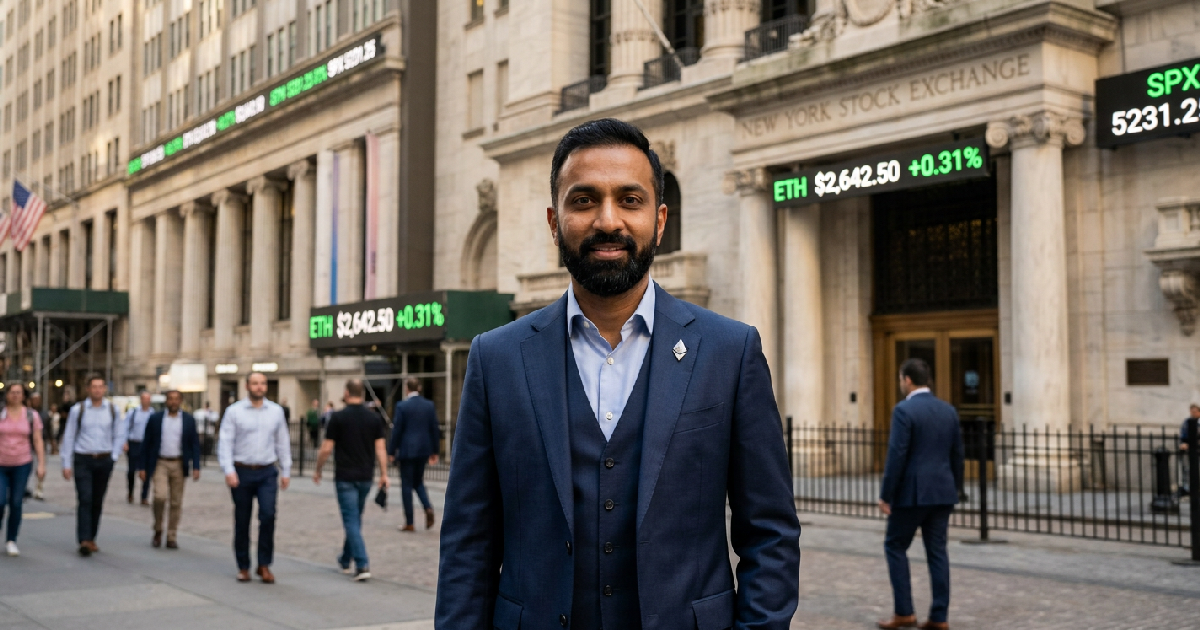

Vivek Raman, co-founder and CEO of Etherealize, told reporters on June 13, 2026, that Wall Street financial institutions are moving past experimental crypto pilots and integrating deeper into the Ethereum ecosystem. Raman noted that the industry’s perception has shifted over the last 18 months, with major firms now treating public blockchains as real operating infrastructure.
This transition marks a departure from “proof-of-concept” testing toward jumping “head first” into public chains, much like the adoption of the internet decades ago.
The New York-based company Etherealize was established with the specific mission of making Ethereum the default public blockchain for legacy financial institutions.
While Raman leads as CEO, he co-founded the firm alongside three other key industry figures: President Danny Ryan, a former Ethereum Foundation researcher; CSO Grant Hummer, a long-time advocate with close ties to Vitalik Buterin; and CTO Zach Obront.
The team brings a decade of Wall Street experience in trading fixed income and leveraged loans to the decentralized space.
In September 2025, Etherealize secured $40 million in a Series A funding round led by Electric Capital and Paradigm. This followed an earlier market discovery grant from Vitalik Buterin and the Ethereum Foundation. This capital infusion supports the firm’s 14 employees in New York and Austin as they help legacy firms navigate the shifting market structure and move tokenized assets on-chain.
Infrastructure readiness meets long institutional sales cycles
Despite the influx of institutional interest, the price of ETH remains at $1,673 as of mid-June 2026. Raman attributes this disconnect to the exceptionally long sales cycles inherent to Wall Street. He argues that while the “piping” is largely in place, the scale of adoption has yet to be fully reflected in the asset’s valuation.
As more assets move on-chain, he believes the market will eventually reevaluate ETH’s role as the security layer for the global financial system.
The convergence around Ethereum’s programming standards is driven by the network’s liquidity and established network effects. Because Ethereum started as a hub for liquidity, consumers and firms are now looking to bring other assets onto the ledger. This includes a diverse range of products from traditional stocks and bonds to fixed income and real estate.
This utility is a sharp contrast to high-risk ventures, such as the unauthorized unbacked stablecoin sales seen in recent market exploits.
Institutional confidence is also tied to the ability of smart contracts to automate settlement. By reducing reliance on slow, manual reconciliation, blockchains offer an efficiency that traditional systems lack. This is already visible in existing products like BlackRock’s BUIDL fund, which manages $2.9 billion in tokenized Treasuries, and Franklin Templeton’s BENJI platform, which handles $750 million in government funds.
The Ethereum Foundation shift and decentralized governance
Raman also addressed recent scrutiny of the Ethereum Foundation, particularly regarding leadership changes. He argued that the foundation’s willingness to step back from a central coordinator role is a strategic strength rather than a flaw. In his view, the substrate for the global financial system cannot be controlled by a single party. This decentralization ensures the network remains universal and open.
Instead of manual coordination, the foundation is shifting its focus toward protecting core values like censorship resistance, security, and privacy. Long-term technical priorities now include zero-knowledge technology and quantum resistance. This neutral status is critical for institutions that require stable, non-proprietary infrastructure for digital dollar settlement, especially as stablecoin risks embed in U.S. debt markets.
By late 2025, Ethereum was already processing over $5 trillion in quarterly transaction volume, demonstrating its capacity for high-value operations. Raman concludes that when history looks back at this period, it will be viewed as the “internet moment” for the global financial system.
The ultimate measure of success for the network will be its actual utility and the sustainable assets it hosts, rather than short-term price fluctuations.