
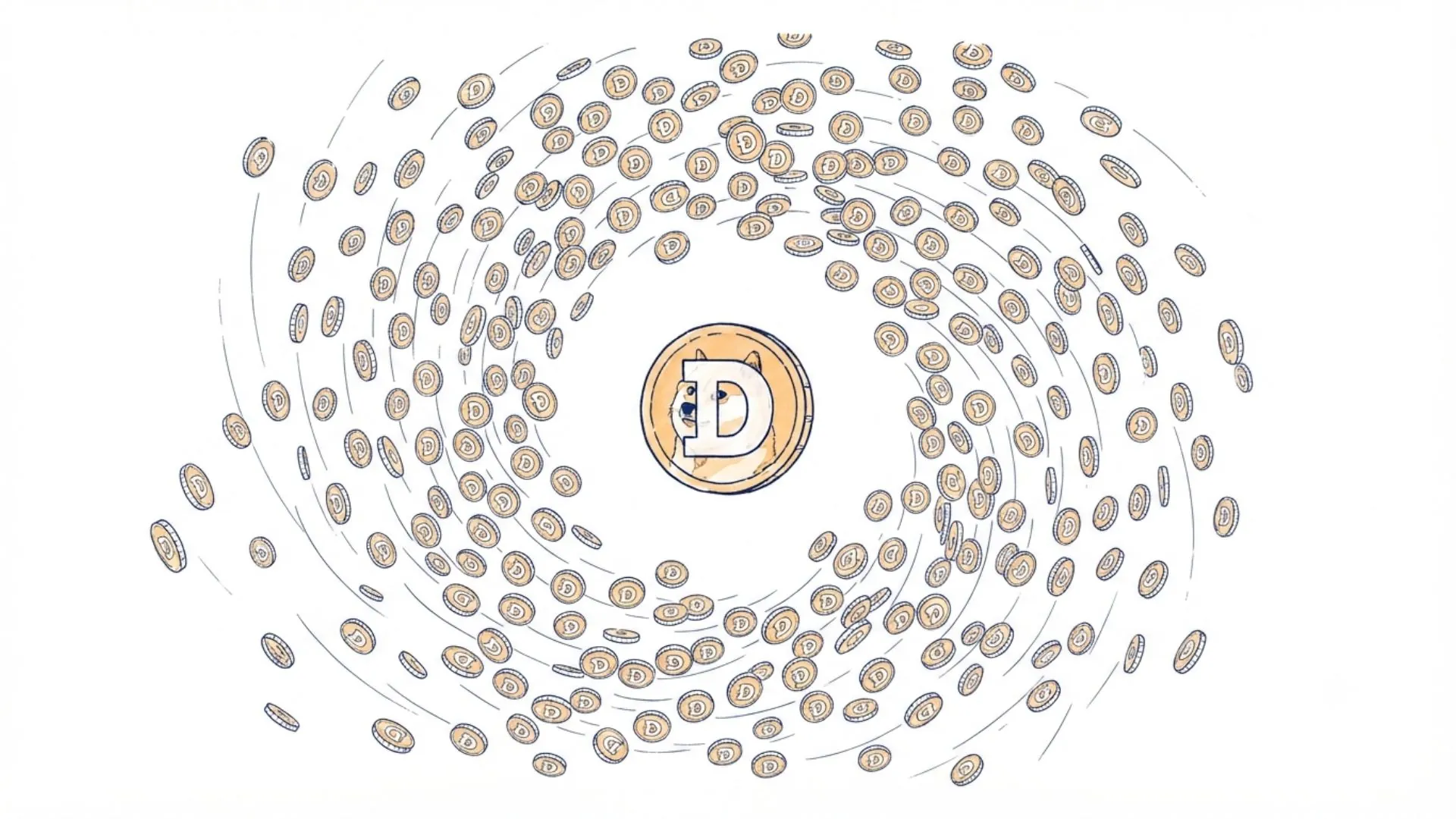

If you spend any time browsing crypto exchanges like Binance or Coinbase, you will inevitably run into the market’s most famous paradox. Dogecoin started as an internet joke, yet it commands a multi-billion dollar market capitalization. But for anyone looking at the fundamental metrics of this digital asset, one detail usually stops them in their tracks: the Dogecoin infinite supply.
How can a digital currency hold any long-term value if it never stops printing new coins?
This is the exact question that confuses traditional investors and crypto beginners alike. In a financial ecosystem where Bitcoin is praised for its absolute scarcity, a coin with no maximum cap feels like a red flag. However, the lack of a supply cap is not a coding mistake or a leftover punchline from its meme origins. It is a deliberate technical choice that dictates how the network functions and how the asset should be evaluated.
To truly understand if DOGE deserves a spot in a diversified portfolio, we need to strip away the hype. We have to look at the mechanics of its blockchain, the reality of its inflation rate, and how utility can sometimes offset endless issuance. Let us break down exactly how this model works, why it was created, and what it means for the future price of the asset.
The future of cryptocurrency: beyond the hype to real-world utility
What You Need to Know Before Diving In
Before we analyze the specific mechanics of the dog-themed coin, we need to establish a baseline for how digital assets are valued. The secret lies in a concept called tokenomics.
Tokenomics is simply a combination of the words “token” and “economics.” It describes the mathematical rules governing a cryptocurrency’s supply, distribution, and overall economic design. When you evaluate an asset on platforms like Kraken, you are essentially looking at its tokenomics in action.
To make sense of these rules, you need to understand three core metrics of supply.
First, there is the circulating supply. This is the amount of coins that have already been created and are currently moving around the open market. When you buy a coin today, you are buying from the circulating supply.
Second, there is the total supply. This includes everything in circulation, plus any coins that have been created but are locked up in smart contracts or reserve wallets and are not yet tradable.
Finally, there is the maximum supply. This is the absolute hard cap. It is the exact number of coins that will ever exist in the lifetime of that specific software protocol.
This last metric is where the fundamental division in crypto philosophies happens. Some assets are designed to be strictly deflationary or entirely capped, meaning their scarcity is mathematically guaranteed. Other assets are designed to be inflationary, prioritizing network fluidity over raw scarcity.
When you hear about the Dogecoin infinite supply, it simply means the protocol has a circulating supply that grows every single day, and a maximum supply that literally does not exist.
How the Dogecoin Infinite Supply Actually Works
The architecture of this network was not originally designed to print coins forever. The current economic model is the result of a critical pivot made early in the project’s life to save the blockchain from collapsing.
To understand why this choice was made, we have to look back at the early days of the network and the practical realities of keeping a decentralized system secure.
The Historic Pivot: Why the 100 Billion Cap Was Removed
When software engineers Billy Markus and Jackson Palmer launched the project in 2013, they designed it as a lighthearted counter-culture movement against the extreme seriousness of early crypto adopters.
Initially, the code mirrored the standard scarcity logic of the era. The founders placed a hard limit of 100 billion coins on the network. The expectation was that this cap would be reached gradually over many years.
However, the internet operates at a different speed. The community grew so rapidly that miners—the network participants who dedicate computer power to process transactions—ended up minting half of the total supply in just a few months.
This rapid expansion created a massive security threat. In a Proof-of-Work network, miners secure the blockchain. They verify transactions and protect the network from hackers. In exchange for this expensive computer work, they receive block rewards, which are newly minted coins given to them by the protocol.
The developers realized that if the 100 billion cap was hit, the block rewards would drop to zero. Without the incentive of new coins, miners would unplug their machines. If the miners left, the network would become vulnerable to attacks and essentially die.
To prevent this fatal scenario, the developers and the community made a bold decision. They updated the core code to remove the maximum cap entirely. This singular update ensured miners would always be paid, securing the network indefinitely.
The 5 Billion DOGE Annual Rule
By removing the cap, the developers introduced a permanent inflationary mechanism. But they did not make it chaotic or unpredictable.
The protocol operates on a very strict mathematical schedule. Every single year, exactly 5 billion new DOGE are created and added to the circulating supply. This number does not change based on market conditions, the price of the asset in USD, or the number of users on the network.
These 5 billion coins are injected into the ecosystem through block rewards. Every minute, a new block of transactions is verified by the miners. For every block solved, the network generates a fixed amount of coins and awards them to the successful miner.
Unlike Bitcoin, this network does not experience halving events. A halving is a coded rule that cuts the miner rewards in half every few years to increase scarcity. Dogecoin skipped this complexity. The reward is flat, constant, and mathematically guaranteed forever.
The Blockbuster Franchise Analogy: Decreasing Inflation Explained
The most common misconception about an infinite supply is that it means infinite, out-of-control inflation. Mathematically, this is false. The inflation rate of the network is actually decreasing predictably every single year.
Think of it like a massively successful blockbuster movie franchise.
Imagine a studio launches a new cinematic universe. In the first few years, they have exactly five movies in their catalog. If they release one new movie the next year, they have just increased their entire catalog by 20 percent. That is a massive expansion, and the new movie takes up a huge portion of the brand’s identity.
Fast forward twenty years. The franchise now has 100 movies in its catalog. If the studio releases that exact same one movie this year, it only expands the catalog by 1 percent. The raw output is identical—one movie per year—but the percentage impact on the total universe is drastically smaller.
The Dogecoin tokenomics work exactly the same way.
Because the issuance is fixed at exactly 5 billion coins per year, the percentage of inflation drops as the total circulating supply grows. In the early years, adding 5 billion coins to a small supply created double-digit inflation. Today, adding that same 5 billion against a circulating supply of over 140 billion coins results in an annual inflation rate of roughly 3.5 percent. Next year, that percentage will be even lower.
This is a predictable, decreasing inflation rate. It is entirely transparent and coded into the software, making it far more reliable than traditional fiat currencies, where central banks can change the money supply at will.
Dogecoin vs. Bitcoin vs. Ethereum: Supply Philosophies Compared
To truly evaluate the merit of this infinite issuance, you have to compare it to the heavyweights of the digital asset class. The broader crypto market relies on three distinct philosophies regarding supply.
Bitcoin is the pioneer of absolute scarcity. Its code enforces a hard cap of exactly 21 million coins. Furthermore, its halving mechanism ensures that the rate of new coins entering circulation gets slashed by 50 percent roughly every four years. It is designed to be the ultimate deflationary asset, earning it the narrative of digital gold. The primary use case here is wealth preservation over long time horizons.
Ethereum takes a dynamic, middle-ground approach. It does not have a strict maximum supply cap, but its tokenomics are highly flexible. The network utilizes a mechanism where a portion of the transaction fees is permanently “burned” or destroyed. Depending on how busy the network is, Ethereum can actually become deflationary, meaning more coins are destroyed than created on a given day. Its supply reacts to user demand.
Dogecoin sits on the opposite end of the spectrum from Bitcoin. It offers zero supply shocks, no halvings, and no fee-burning mechanisms to reduce the circulating supply. It produces a flat, unchangeable 5 billion coins annually.
While this makes it a poor candidate for digital gold, it makes it an excellent candidate for digital cash. By keeping the supply abundant, the protocol ensures that transaction fees remain incredibly low and that the currency is actually spent, rather than hoarded in cold storage wallets.
Is Dogecoin Still a Good Investment With No Supply Cap?
From a professional wealth management perspective, assessing an asset with an infinite supply requires a completely different valuation framework than evaluating a scarce asset.
If you view the Dogecoin infinite supply through the lens of traditional reserve assets, it looks like a terrible investment. The constant issuance creates a permanent, structural sell pressure. Because 5 billion new coins are generated every year, the network requires a massive influx of new capital just to keep the price exactly where it is. For the price to appreciate in USD terms, buyer demand must significantly outpace the relentless output of the miners.
Institutional investors who want a hedge against the devaluation of fiat currency will almost always choose Bitcoin. Scarcity protects purchasing power, and DOGE is simply not scarce.
However, evaluating this asset solely as a store of value is a fundamental analytical error. It was not built to be a vault; it was built to be a payment rail.
The Bull Case for Utility
The true value proposition of this network lies in its transactional efficiency.
Because the inflation incentivizes miners to keep the network highly secure and liquid, the blockchain excels at microtransactions. Moving capital across this network costs pennies and settles in minutes. This makes it highly functional for internet tipping, creator economies, and retail payments.
Furthermore, the lack of scarcity removes the psychological barrier to spending. People do not want to buy a coffee with Bitcoin because they fear that fraction of a Bitcoin might be worth thousands of dollars in a decade. Dogecoin’s abundant supply encourages people to use it as an actual currency.
For the price to experience sustained growth despite the inflation, the asset relies heavily on network effects and adoption. Speculation about integrations into major social media ecosystems or global payment gateways acts as a primary catalyst for demand.
If the asset successfully transitions from a speculative meme into a heavily utilized backend payment rail for the internet, the transaction volume and utility demand can easily absorb the 3.5 percent annual inflation.
Navigating the Volatility
Retail investors must also account for the asset’s behavioral economics. More than almost any other digital asset, its price action is deeply tied to market sentiment, cultural relevance, and macroeconomic liquidity.
During bull markets, when capital is abundant, retail enthusiasm easily overpowers the 5 billion annual emission, leading to aggressive price spikes. During bear markets, when liquidity dries up, the continuous miner dumping creates a heavy downward drag on the price.
Therefore, from a portfolio construction standpoint, this is not a set-it-and-forget-it retirement asset. It is a tactical exposure play. It belongs in the higher-risk, utility-focused sleeve of a broader digital asset portfolio, actively managed based on market cycles and real-world adoption metrics.
Conclusion
The Dogecoin infinite supply is not a flaw in the code. It is a deliberate engineering choice made in 2014 to ensure the permanent security of the blockchain by guaranteeing that miners always have an incentive to process transactions.
While it lacks the mathematical scarcity that made Bitcoin famous, it replaces that scarcity with high liquidity, incredibly low fees, and a predictable, decreasing inflation rate.
Evaluating this project requires you to stop asking if it will become scarce, and start asking if its utility and cultural adoption can outpace its predictable inflation. It is designed to be the internet’s spending money, not its savings account. Understanding that distinction is the key to navigating the crypto market without falling prey to hype.
Beyond Bitcoin: The Beginner’s Guide to the 8 Types of Crypto Tokens
This content is for informational purposes only and does not constitute financial advice.