
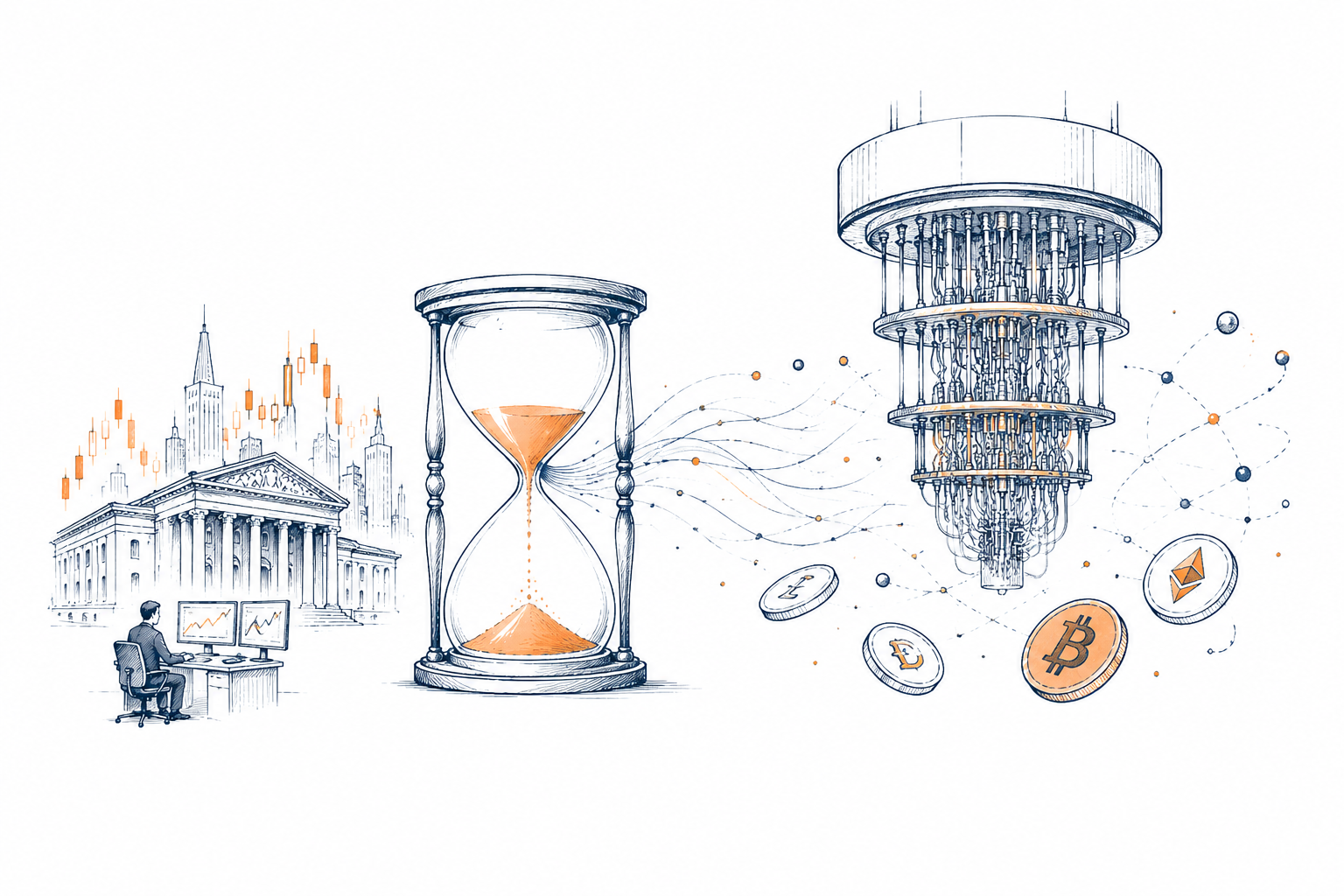

Quantum computing was viewed as one of cryptocurrency’s biggest theoretical risks – a technological breakthrough that could eventually challenge the cryptographic foundations of Bitcoin, Ethereum and much of the digital economy. The problem was always considered real, but distant.
That perception is beginning to change.
Governments, technology companies and blockchain developers are no longer asking whether quantum-resistant cryptography will eventually be needed. Instead, the conversation has shifted toward how to prepare for a transition that could take years to complete.
The immediate threat has not changed. The industry’s timeline has.
The challenge is not today’s computers
Current quantum computers are still far from being capable of breaking the cryptographic algorithms that secure major blockchain networks.
Security researchers continue to debate when that milestone could realistically be reached, with estimates ranging from a decade to much longer depending on future technological breakthroughs.
However, the absence of an immediate threat does not eliminate the need for preparation.
Replacing the cryptographic standards used across financial systems, governments, cloud infrastructure and blockchain networks would require years of engineering, testing and global coordination. Waiting until quantum computers become capable enough could leave critical infrastructure with too little time to adapt.
The transition has already started
The shift is visible across multiple industries.
The U.S. National Institute of Standards and Technology (NIST) has already finalized new post-quantum cryptographic standards designed to replace existing encryption methods over time. Major technology companies, including Google, Microsoft and IBM, continue investing heavily in quantum computing research while simultaneously exploring quantum-resistant security solutions.
Blockchain developers are following the same trend.
Several Ethereum researchers have discussed future migration paths toward quantum-resistant cryptography, while Bitcoin developers continue evaluating how the network could eventually upgrade without compromising decentralization or backward compatibility.
The discussion is increasingly focused on implementation rather than theory.
Bitcoin and Ethereum face different technical challenges
Although both networks rely on public-key cryptography, their paths toward quantum resilience are unlikely to be identical.
Bitcoin’s largest long-term concern involves addresses whose public keys have already been exposed through previous transactions. If sufficiently powerful quantum computers ever become available, those addresses could theoretically become more vulnerable than wallets whose public keys remain hidden.
Ethereum faces similar cryptographic questions but benefits from a development model that allows more frequent protocol upgrades, potentially offering greater flexibility when future security changes become necessary.
Neither network, however, can migrate overnight.
Any transition would require extensive testing, community consensus and careful coordination across the broader ecosystem.
Quantum computing has become an infrastructure issue
Perhaps the biggest misconception is that this discussion is only about cryptocurrencies.
The same cryptographic algorithms that protect blockchain networks also secure online banking, government communications, cloud services, payment systems and countless other digital applications.
That means post-quantum security is becoming a global infrastructure challenge rather than a crypto-specific concern.
Digital assets simply happen to be among the first industries openly discussing how that transition might unfold.
Preparing early may become the industry’s greatest advantage
Historically, cybersecurity has often evolved in response to attacks.
Quantum computing presents a different scenario.
The crypto industry is increasingly preparing for a technological shift before the underlying threat becomes operational. That proactive approach reflects a growing understanding that replacing cryptographic foundations across decentralized networks could become one of the largest engineering projects the industry has ever faced.
Whether quantum computers reach that level in ten years or twenty may ultimately matter less than one simple reality:
The migration will likely take so long that the safest time to begin planning is before anyone is forced to act.