
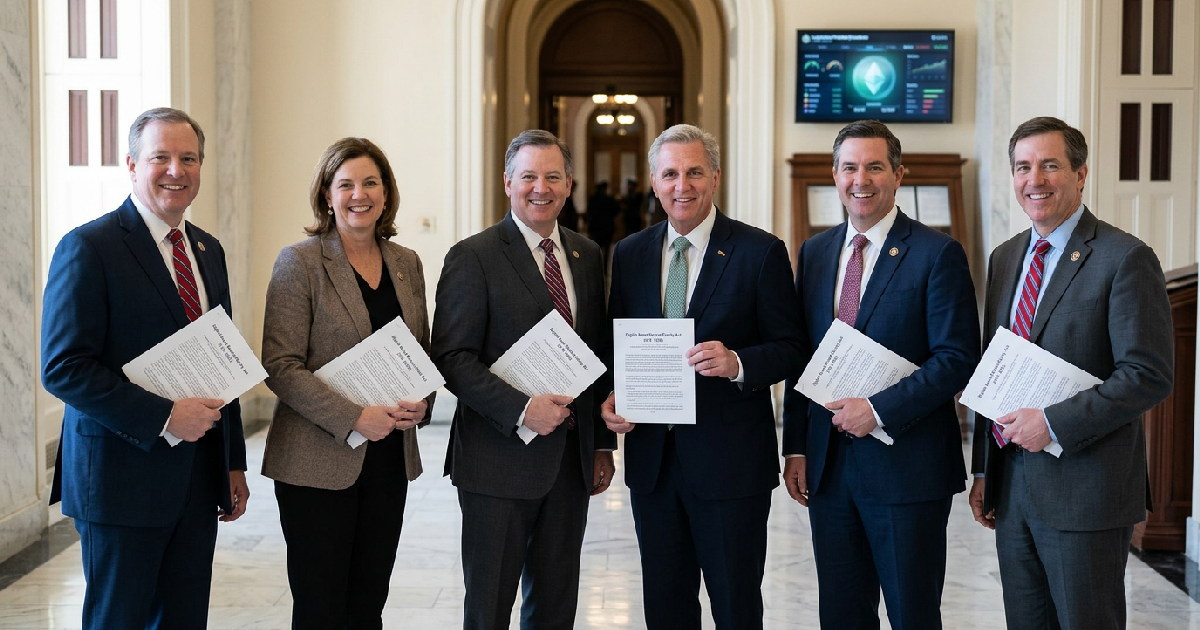

Congress Advances Clarity is at the centre of this story. The U.S. Congress is pushing ahead with the “Digital Asset Market Clarity Act” (H.R. 3633), often called the “Clarity Act,” a landmark piece of legislation aiming to establish a comprehensive regulatory framework for digital assets. This move is poised to significantly impact the cryptocurrency market, with many analysts suggesting it could solidify Ethereum (ETH) as a prime investment this summer.
Lawmakers are working to untangle the long-standing jurisdictional ambiguities that have plagued federal regulators, seeking to foster innovation while also enhancing consumer protections. The Senate is expected to publish the final text of the Act this weekend, between July 6-7, 2026, setting the stage for a critical vote after July 13.
Congress Advances Clarity: Legislative Journey of the Clarity Act
The journey for the Digital Asset Market Clarity Act began in May 2025. It was introduced by House Committee on Financial Services Chairman French Hill and House Agriculture Committee Chairman G.T. Thompson, quickly gaining bipartisan traction. The bill passed the House of Representatives on July 17, 2025, with a notable vote of 294 to 134, including support from over 70 Democrats.
Senate progress and looming vote deadline
After its successful passage through the House, the Clarity Act moved to the Senate. Here, it continued to advance, with the Senate Banking Committee giving its approval on May 14, 2026, through a 15-9 vote. This showed continued bipartisan backing, with 13 Republicans and 2 Democrats supporting the measure.
Just weeks later, on June 1, 2026, the Act was officially placed on the Senate legislative calendar (Calendar No. 423), making it eligible for a full Senate floor consideration.
Key details
Senator Bill Hagerty indicated on July 3, 2026, that a full Senate vote is now more likely after Congress reconvenes on July 13, replacing earlier hopes for a July 4 signing. The Senate is expected to publish the final text of the CLARITY Act this weekend, between July 6-7, 2026.
The clock is ticking, however. The Senate has only 25 working days until August 10 to pass the CLARITY Act before its annual August recess. Should it fail to advance during this narrow window, its next realistic opportunity could well slip into 2027, delaying vital regulatory clarity for the crypto market.
This timeline underscores the political complexities involved in enacting significant new regulations. While Bloomberg Intelligence estimates a 60% chance of the Clarity Act passing in July 2026, Galaxy Research offers a more cautious outlook, lowering the chances of passage to 50% for the entire year. This suggests investors might need to wait until 2027 to see the full regulatory impact.
For the bill to become law, it must still be reconciled with the Senate Agriculture Committee’s version, pass a 60-vote Senate floor vote, be reconciled with the House-passed version, and finally be signed by the President. This multi-stage process means the outcome, while promising, isn’t guaranteed.
Redefining Digital Asset Oversight
At its core, the Digital Asset Market Clarity Act seeks to establish a precise and workable framework for classifying digital assets. This has been a long-standing demand from industry players. The bill proposes dividing crypto assets into three distinct categories: digital commodities, investment contract assets, and permitted payment stablecoins.
This structured approach aims to provide much-needed clarity on which regulatory body, the Securities and Exchange Commission (SEC) or the Commodity Futures Trading Commission (CFTC), holds primary jurisdiction over different types of digital assets. The Act grants the CFTC “exclusive jurisdiction” over “digital commodity” spot markets, ending much of the jurisdictional squabbling that has historically characterized crypto oversight.
Meanwhile, the SEC would maintain its jurisdiction over investment contract assets, particularly during fundraising, initial sales, and other capital formation activities. The bill also includes a “mature blockchain test,” which could allow certain tokens to transition from SEC oversight to CFTC oversight once their networks achieve sufficient decentralization.
Ethereum’s Commodity Status Takes Shape
A crucial element of the Clarity Act for the Ethereum ecosystem is its potential to formalise the asset’s regulatory status. U.S. Securities and Exchange Commission (SEC) Chair Paul Atkins has informally characterised Ethereum (ETH) as a non-security digital commodity. He also called for Congressional action to provide more durable clarity for the industry.
This perspective is echoed by former Commodity Futures Trading Commission (CFTC) Chairman Rostin Behnam, who agreed that the CFTC should be the primary regulator for any commodity asset. This informal consensus among key regulatory figures already offers a glimpse into Ethereum’s likely future under commodity oversight, removing a significant layer of regulatory uncertainty that has long impacted the asset.
Broader Market Impact and Investment Perspective
The anticipated passage of the Clarity Act is expected to have far-reaching implications for Ethereum and the broader crypto market. For banks, corporations, and established financial institutions, the bill is set to clarify the “rules of the road,” making it considerably easier for them to adopt blockchain- and crypto-based solutions.
This newfound certainty could unlock a wave of institutional investment that has largely been on the sidelines.
Kristin Smith of the Solana Policy Institute noted that many asset allocators are exploring digital asset investments but have been holding off, awaiting such regulatory clarity. The Act’s passage could be the catalyst they need. Geoffrey Kendrick of Standard Chartered initially projected an ETH target price of $7,500 by end-2026, contingent on the bill’s passage, though he later revised this down to $4,000.
Even the revised figure represents significant upside, reflecting the market’s optimism for a more defined regulatory environment. The CEO of Crypto Council for Innovation, Ji Kim, stated that a “significant portion of the digital asset ecosystem… function like commodities rather than traditional securities.” This view aligns perfectly with the Clarity Act’s approach and Ethereum’s classification.
Key details
This legislative push, combined with a strengthening network outlook, provides a robust foundation for Ethereum’s continued growth. It suggests a future where innovation can thrive under predictable rules, encouraging more widespread adoption of blockchain technologies.
Cross-Party and Industry Endorsement
The Clarity Act has garnered significant bipartisan support, a rarity in today’s fractured political landscape. Beyond its initial sponsors, Senator Tim Scott has publicly championed the Act, stating it would establish clear standards, improve consumer protections, and help keep financial innovation within the U.S.
This broad backing extends to various organizations, including the National Organization of Black Law Enforcement Executives (NOBLE), which endorsed the Act’s Blockchain Regulatory Certainty Act provisions (Section 604).
Further demonstrating widespread support, the Blockchain Association sent a letter of strong endorsement to Senate majority and minority leaders on June 2, 2026. This letter was notably co-signed by 160 former national security and law enforcement officials, underscoring the bill’s appeal across different sectors.
Even the Major County Sheriffs of America (MCSA) shifted from opposition to a neutral stance on H.R. 3633 on July 3, 2026, following constructive discussions around Section 604.