
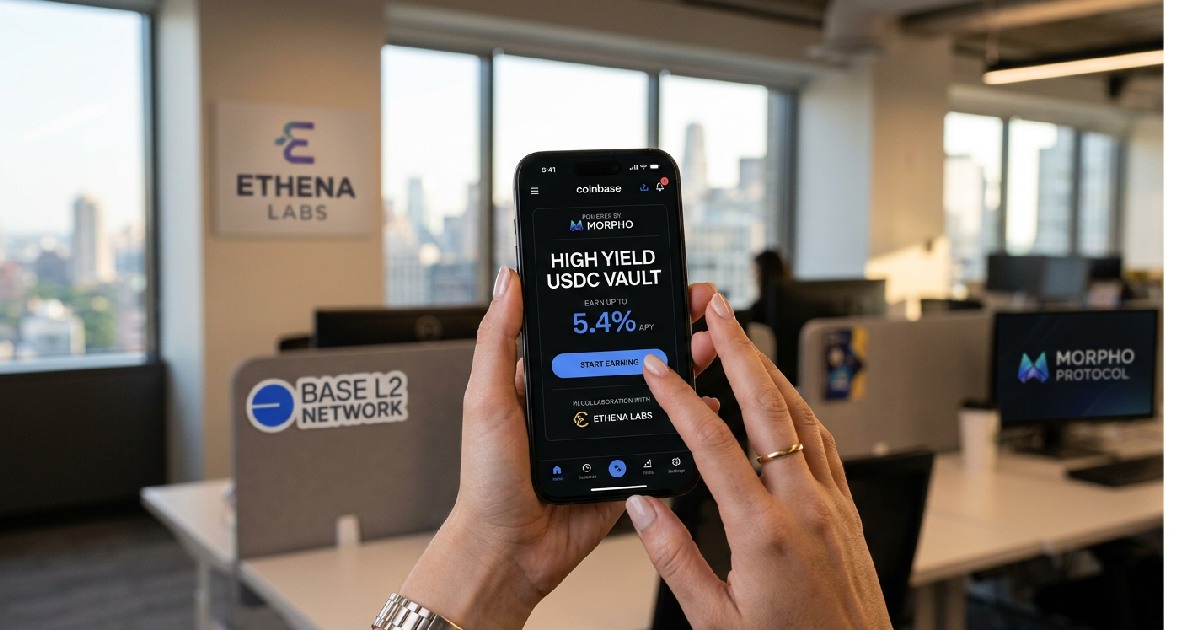

Coinbase and Ethena Labs officially launched a High Yield USDC Vault on Thursday, June 11, 2026, marking a significant shift in how centralized exchanges integrate decentralized finance (DeFi) protocols.
The new product, powered by the Morpho lending protocol and curated by Steakhouse Financial, allows eligible Coinbase users to access higher interest rates by lending their stablecoins against more diverse and risk-sensitive collateral.
This launch represents the first live collaboration between Coinbase and Ethena, utilizing the USDe synthetic dollar ecosystem to drive market-based returns on the Base layer-2 network.
The introduction of this vault adds a more aggressive tier to Coinbase’s existing on-chain financial services. Unlike the “Core USDC vault” launched in September 2025—which primarily accepts blue-chip collateral like Bitcoin and Ethereum—the High Yield USDC Vault incorporates Ethena-linked assets, including USDe and the newly resurgent USDtb.
For users, the process is streamlined: they deposit USDC through the standard interface, while a smart contract wallet backend manages the complex routing into Morpho’s lending markets. This convenience bridges the gap for retail investors who may be wary of manual DeFi interactions.
Understanding the High Yield USDC Vault risk profile
While the prospect of higher returns is the primary draw, the vault’s underlying mechanics require a different level of scrutiny compared to traditional savings products. The “High Yield” label is a direct reflection of the collateral accepted from borrowers.
By allowing synthetic stablecoins like USDe to back loans, the vault can offer more competitive interest rates. However, these assets carry unique risks involving market liquidity and the stability of the Ethena protocol itself. If the collateral loses its peg or liquidity dries up, the ability for lenders to exit positions could be impacted.
Institutional interest in this specific yield strategy is already evident in the data. Steakhouse Financial currently manages approximately $2.03 billion in Total Value Locked (TVL) across various Morpho vaults. This level of professional curation is intended to balance yield optimization with risk management, but it doesn’t eliminate the inherent volatility of DeFi markets.
Investors should note that Bitcoin supply on exchanges remains at historic lows, often driving traders toward these high-yield stablecoin alternatives as they seek returns outside of direct spot holdings.
Coinbase Ventures and the Ethena ecosystem integration
The timing of this launch coincides with deepening financial ties between the participating entities. In June 2026, Coinbase Ventures disclosed its first open-market purchase of ENA, the governance token for Ethena. This investment signals a long-term interest in the protocol’s success, even as Coinbase maintains that the vault is an independent product offering.
Ethena has seen rapid expansion recently, with USDe circulation reaching $4.48 billion across 28 different blockchain networks.
The collaboration also highlights the growing importance of the USDtb stablecoin, which saw its supply climb back above $1 billion earlier this month. This asset is a key component of the collateral mix managed by Steakhouse Financial. As more users move toward these yield-bearing instruments, analysts are closely monitoring com/bitcoin-signals-market-structure-analysis-2026/”>shifting market structures to determine if decentralized lending will eventually rival traditional fintech savings rates in sustained volume.
Geographical restrictions and technical infrastructure
Access to the High Yield USDC Vault remains tiered based on regulatory environments. Currently, the product is available to eligible users in the United States, with the notable exception of New York residents. Select international markets have also gained access, though Coinbase has not released a full list of supported countries.
This cautious rollout mirrors the broader industry trend of navigating complex regional laws while attempting to scale on-chain products.
Built on Base, Coinbase’s proprietary layer-2 solution, the vault benefits from lower transaction costs and faster settlement times. This technical foundation is essential for a product that relies on frequent rebalancing and market-responsive interest rates.
Morpho Labs, the protocol facilitating the lending, recently underscored its growing influence by raising $175 million in a funding round that valued the company at $2 billion. With over $6.5 billion in TVL managed through its various protocols, Morpho has become a cornerstone of the modern DeFi stack.
Future implications for centralized exchange yield products
The success of the Ethena and Coinbase partnership could set a precedent for how other major exchanges handle DeFi integration. By packaging “yield-as-a-service” through audited smart contracts, platforms are moving away from the opaque lending practices that characterized the 2022 market downturn.
Transparency is now the priority, as evidenced by the real-time data provided by DefiLlama, which shows Steakhouse-curated vaults using USDtb yielding approximately 8.79% annually.
And while these yields are attractive, they remain dynamic. Returns in these systems are not guaranteed and fluctuate based on market utilization. If too many lenders enter the vault, the annual percentage yield (APY) will naturally compress.
For now, the focus remains on whether Coinbase’s 100 million users will embrace the increased risk for the chance to earn significantly more than the 10.8% peak yields seen in the more conservative Core vault.
This rollout is a clear signal that the “on-site” DeFi experience is becoming the new standard for digital asset management.