
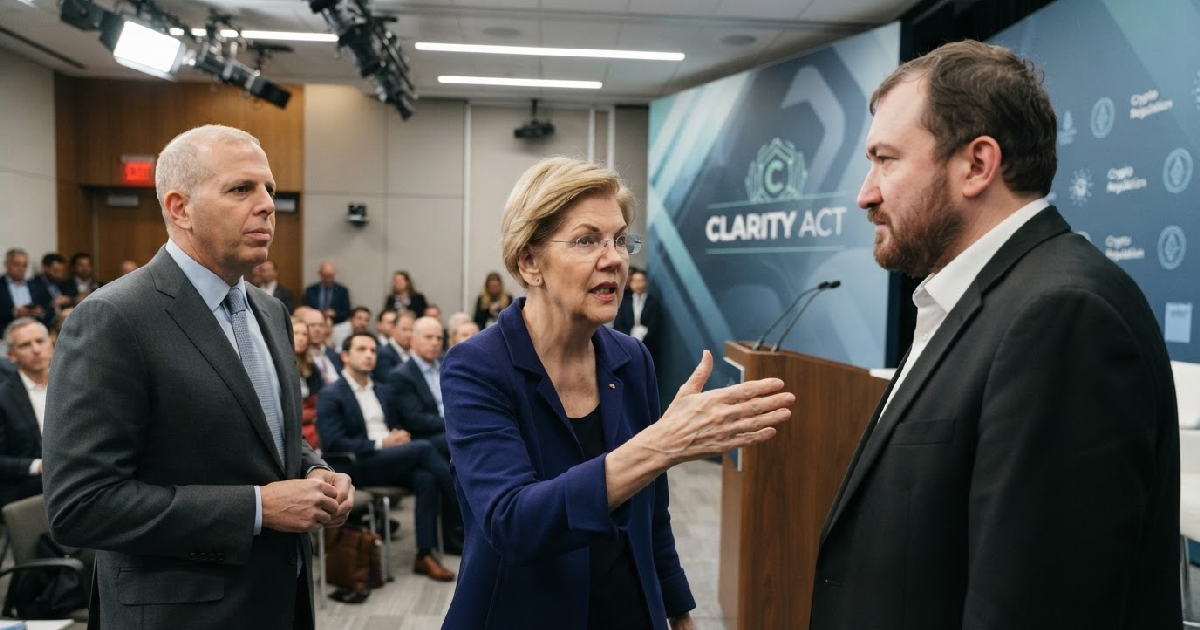

The revised Digital Asset Market Clarity Act of 2025 (H.R. 3633), also known as the CLARITY Act, is facing significant hurdles in securing a Senate vote. R. 3633), known as the CLARITY Act, is creating unforeseen divisions across Wall Street, Washington, and the cryptocurrency industry as lawmakers struggle to secure a Senate vote.
Goldman Sachs Chief Executive David Solomon has publicly urged Congress to advance the bill, breaking ranks with other major banks. Meanwhile, Cardano founder Charles Hoskinson has aligned with Senator Elizabeth Warren, voicing strong opposition to particular aspects of the bill concerning President Donald Trump’s involvement in digital asset markets.
Goldman Sachs breaks with traditional banking opposition
These contrasting positions underscore the complex and often unexpected coalitions forming around the legislation. Senators are now seeking compromises on critical issues like stablecoin rewards, government ethics, and financial regulation, as the bill’s path to passage continues to narrow.
Goldman Sachs CEO David Solomon has taken a notably different stance from many of his banking industry peers. He recently told Politico he was “very supportive” of moving the CLARITY Act forward. Solomon believes establishing a clear market structure and fostering innovation should take priority, even while acknowledging the bill remains imperfect.
This position puts Goldman Sachs at odds with a coalition of banking groups. These include the American Bankers Association, Bank Policy Institute, Consumer Bankers Association, Financial Services Forum, Independent Community Bankers of America, and National Bankers Association. They argue that the latest Senate draft still threatens the deposits crucial for US lending.
Stablecoin rewards fuel industry dispute
The core of the banking industry’s opposition centers on provisions regarding interest-like payments for holding stablecoins. These groups warn that allowing such rewards could siphon deposits away from banks. This reduction in available funding would impact small-business, mortgage, and agricultural lending across the country.
They have urged lawmakers to strengthen restrictions on these payments. JPMorgan Chase Chief Executive Jamie Dimon has also raised concerns about the framework, placing Solomon on the opposite side of a growing public debate within Wall Street.
Goldman Sachs’ support suggests it’s willing to tolerate these disputes to secure a broader federal framework for crypto markets, even as major financial institutions deepen their involvement in blockchain-based finance.
Hoskinson backs Warren on executive crypto ethics
Political divisions are also complicating matters within the crypto industry itself, particularly concerning President Donald Trump’s personal involvement in digital assets. Cardano founder Charles Hoskinson has notably sided with Senator Elizabeth Warren on this specific ethical concern, arguing that a sitting president should not participate in crypto markets.
In an X post, Hoskinson attributed the increasing partisanship of crypto policy to the Trump administration. He stated that Democrats have increasingly framed the issue as “Crypto = Trump = Corruption,” hindering bipartisan legislative efforts. “No progress can be made if crypto is partisan,” Hoskinson wrote, emphasizing the need for a non-partisan approach.
The implications of presidential market participation
Hoskinson backed Warren’s argument that Trump’s position creates a conflict with direct participation in financial markets. Warren has consistently criticized Trump’s crypto ventures, arguing the current bill could “supercharge Trump’s crypto corruption.” Hoskinson posited that “the president shouldn’t be a market participant” because “he is the ultimate insider” whose policies directly influence the industry.
This nuanced stance places Hoskinson alongside one of crypto’s most persistent critics on a narrow but consequential issue, stopping well short of opposing broader market-structure legislation. Crypto firms generally want Congress to establish federal rules for digital asset markets.
Chris Dixon, who leads crypto investing at Andreessen Horowitz, acknowledged that “No law is perfect,” but argued for the bill’s passage to provide clear US rules and prevent financial innovation from moving to other jurisdictions.
Coinbase President Emilie Choi also emphasized the bill’s importance for consumer protection and federal oversight. She stated, “Whether you like crypto, hate crypto, or don’t care, you should want this bill passed. It’s now down to the Senate to help America set the standard.” These views highlight the industry’s desire for regulatory clarity despite internal disagreements.
CLARITY Act’s path to passage narrows
These emerging divisions are occurring as Democratic opposition and a shrinking Senate calendar make the CLARITY Act’s path through Congress increasingly difficult. Seven Democratic senators who participated in negotiations have stated the updated bill still falls short. These include Sens. Angela Alsobrooks, Cory Booker, Catherine Cortez Masto, Ruben Gallego, John Hickenlooper, Mark Warner, and Raphael Warnock.
They indicated that provisions covering elected-official ethics, consumer protection, illicit finance, conflicts of interest, and market integrity still need strengthening. Their stance is significant because the CLARITY Act needs 60 votes to advance in the Senate. This requires bipartisan support from Democrats who are willing to negotiate but not prepared to back the current text.
Legislative hurdles and looming deadlines
The window for the bill’s passage has also narrowed considerably. Senate Majority Leader John Thune reportedly does not expect the Senate to complete the legislation before lawmakers leave for their August recess. This likely delay undercuts an informal deadline negotiators had used to force compromises on outstanding disputes.
This postponement pushes the bill deeper into an election-year calendar already crowded with other legislative priorities. Sen. John Kennedy had warned that failure to secure a positive vote before the August break would shift the odds against supporters. He reflected concerns that reaching an agreement could become harder once senators return.
Despite these challenges, CLARITY Act supporters continue to press for passage. Sen. Bill Hagerty, a Republican lawmaker backing the legislation, said “the time for CLARITY is now.” He argued that the US needs clearer digital asset rules to protect consumers and retain investment and jobs within the country.