
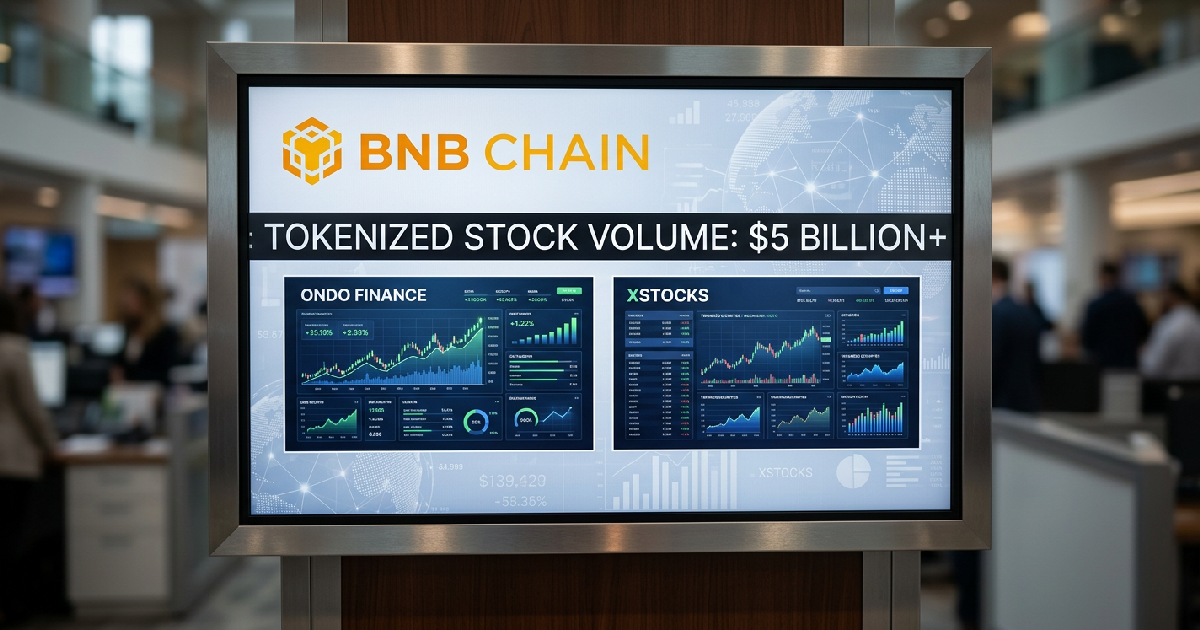

BNB Chain has officially surpassed a cumulative trading volume of $5 billion for tokenized stocks and real-world assets (RWAs) as of June 27, 2026. This milestone is driven largely by institutional integrations and a surge in on-chain demand for traditional financial instruments according to reports from market participants including Ondo Finance and xStocks.
The technical achievement highlights a structural shift in how retail and institutional investors access global equity markets, utilizing the blockchain’s 24/7 infrastructure to bypass traditional brokerage hours.
Institutional integration fuels RWA volume on BNB Chain
The rise to the $5 billion mark has been accelerated by the deployment of over 260 tokenized U.S. stocks and exchange-traded funds (ETFs) across the network. Platforms like Ondo Global Markets have been central to this growth, providing investors with digital versions of high-demand assets such as NVIDIA (NVDA), Tesla (TSLA), and Apple (AAPL).
These assets are issued as BEP-20 tokens, allowing them to be traded seamlessly within the decentralized finance (DeFi) ecosystem while maintaining a connection to the underlying value of the traditional securities.
This development comes as the broader digital asset market seeks more stable, yield-bearing products. While many investors still focus on volatile assets, a growing cohort is looking toward the VanEck and Grayscale spot BNB ETF discussions as a sign of increasing institutional legitimacy.
The success of RWAs on BNB Chain suggests that tokenization is no longer a fringe experiment but a core component of the network’s long-term utility strategy.
The surge in volume is not merely a result of retail speculation; it reflects deep-seated institutional adoption. Major financial players have been integrating with BNB Chain to leverage its low transaction costs and sub-second block times.
In early 2026, Franklin Templeton’s Benji Technology Platform announced it would allow institutional clients to use tokenized money market fund shares as off-exchange collateral for trading on Binance. This move effectively bridged the gap between traditional liquidity and crypto-native execution environments.
Furthermore, the BlackRock USD Institutional Digital Liquidity Fund (BUIDL) reached a significant presence on the chain through partnerships with Securitize and Wormhole. These integrations allow for “programmable money” where traditional treasury yields can be put to work in DeFi protocols without the friction of bank-mediated settlement cycles.
Key details
As of mid-April 2026, BUIDL alone accounted for approximately $507 million in value, showcasing the scale at which major asset managers are now operating on-chain.
The speed of this growth is staggering when compared to previous cycles. Since January 2026, the number of RWA holders on the network has surged by more than 567%, reaching nearly 60,000 unique wallets by mid-year. This rapid expansion indicates that the user base is diversifying beyond simple token transfers toward complex financial management.
Such trends are reflected in the Bitcoin exchange supply analytics, which show investors increasingly moving assets into self-custody or specialized smart contracts rather than leaving them on centralized platforms.
The role of synthetic and equity-backed tokenization
It is important to distinguish between the two primary types of tokenization contributing to this $5 billion figure. Equity-backed tokens, such as those issued by Backed Finance (e.g., AAPLx and TSLAx), are reportedly backed 1:1 by real shares held in regulated custody.
These tokens offer a transparent link to the stock market, though they do not typically grant the holder voting rights in the company. Their value lies in price exposure and the ability to use the tokens within DeFi as collateral or for yield farming.
On the other hand, synthetic tokenized products track stock prices using real-time oracle data without necessarily holding the underlying shares. While more flexible, these products carry different risk profiles. The arrival of platforms like xStocks, which went live on BNB Chain on April 30, 2026, has expanded the availability of these products.
Offering over 50 tokenized U.S. equities tradeable with as little as $10, xStocks has lowered the barrier to entry for global users who were previously locked out of the U.S. financial system.
Network infrastructure and decentralized exchange dominance
The technical capabilities of BNB Chain have played a non-negotiable role in reaching this volume milestone. With average fees reduced to roughly $0.027 per transaction in the first quarter of 2026, the cost of rebalancing a portfolio of tokenized stocks is negligible compared to traditional brokerage fees.
The network processed over 1.2 billion successful transactions during the same period, proving its ability to handle high-frequency trading activity without the congestion often seen on other Layer-1 networks.
Liquidity for these assets is primarily concentrated in decentralized exchanges (DEXs). PancakeSwap, which handled over 60% of spot DEX volume on the chain in early 2026, has been the primary venue for trading these tokenized assets.
Key details
The integration of 1inch and CowSwap is expected to further deepen this liquidity, allowing for better price execution and lower slippage for large institutional orders. This robust DEX environment ensures that 24/7 trading is not just a theoretical benefit but a practical reality for RWA holders.
The broader market impact of this volume cannot be ignored. While investors watch Ondo Finance price trends for signals of market fatigue, the underlying volume data suggests that the demand for the products themselves remains resilient. The ability to swap from a volatile altcoin into a tokenized U.S.
Treasury fund like VBILL during periods of market stress offers a new type of “safe haven” within the crypto ecosystem that didn’t exist in previous years.
Future outlook for tokenized traditional assets
Looking ahead, the trajectory for RWAs on BNB Chain appears geared toward further professionalization. The recent $1.5 million funding round for Renaiss, a liquidity infrastructure project, indicates that venture capital is still flowing into the plumbing required to support these assets.
Val Gui, General Manager of xStocks, noted that the goal is to turn equities into programmable assets that can move seamlessly across different blockchain applications, ultimately creating a more liquid global financial system.
As the “BC Fusion” plan completes the integration of the Beacon Chain functions into the main Smart Chain, the ecosystem is expected to become even more streamlined. This technical simplicity is vital for attracting the next wave of “conservative” capital that requires high degrees of reliability and uptime.
If BNB Chain continues to outpace its competitors in holder growth and volume, it may cement its position as the primary hub for the “on-chaining” of the world’s $100 trillion equity and bond markets.
While regulatory hurdles remain a constant factor, the current momentum suggests that the technical and economic advantages of tokenization are outweighing the friction. The $5 billion milestone is likely just the beginning of a broader trend where the distinction between “crypto” and “traditional finance” becomes increasingly blurred, replaced by a single, unified digital ledger for all global assets.