

Bitcoin (BTC) is trading around $64,171 as of June 18, 2026, marking a 1% decline over the last 24 hours and extending a week of persistent selling pressure. The digital asset has struggled to maintain footing, falling over 45% from its October 2025 all-time high of $120,000 as traders weigh a mix of institutional outflows and bearish technical signals.
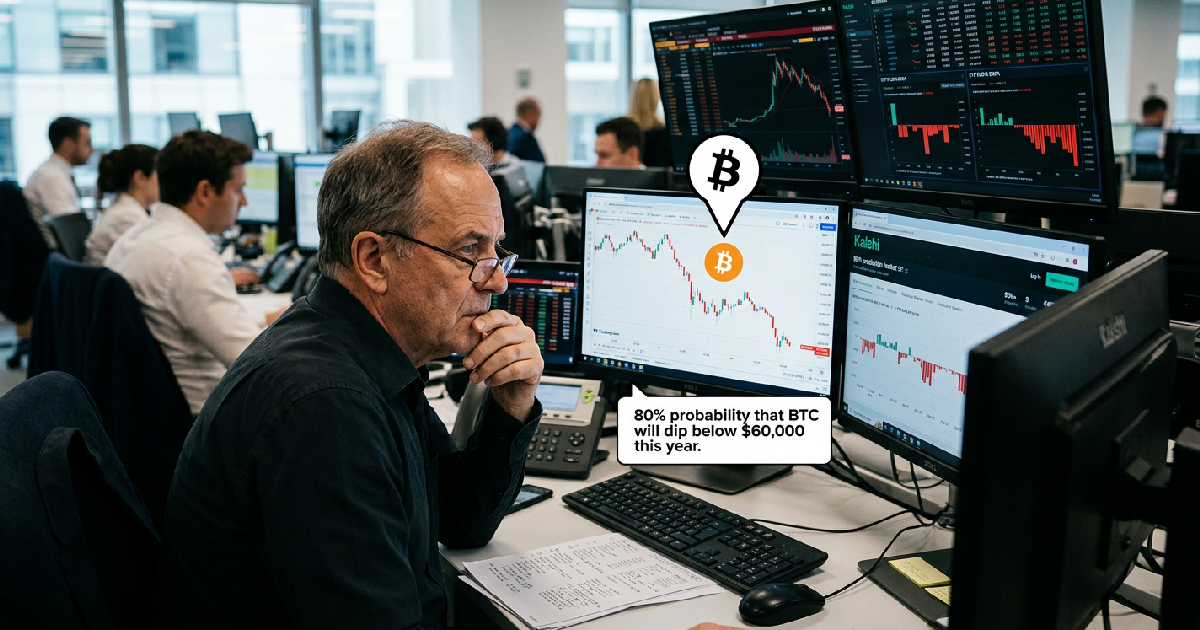
Market participants are now closely watching the 2026 yearly low of $59,000, amid signs that further downside may be imminent. Data from Kalshi, a regulated prediction exchange, showed on June 5, 2026, an 80% probability that BTC will dip below $60,000 this year.
Such a move would establish a new low for 2026, surpassing the early February benchmark that has so far acted as a floor for the market.
Traders anticipate potential move toward $55,000 support
The potential for a “liquidity sweep” is adding to the volatility. Liquidation data indicates that more than $4 billion in leveraged positions are concentrated near the $59,000 level. This setup often acts as a magnet for price action, as a drop into this zone could trigger forced selling.
However, seasoned analysts caution that the market frequently moves in the opposite direction of levels attracting widespread attention.
Sentiment on prediction markets has turned increasingly defensive as Bitcoin fails to reclaim key resistance levels near $76,000. Beyond the immediate threat to the $60,000 mark, Kalshi traders also assigned a 52% probability that Bitcoin could dip below $50,000 in 2026. This pessimistic outlook aligns with Bitcoin price analysis from experts like Crypto Candy, who expects a move toward $55,000 if current weakness persists.
Technical indicators suggest that institutional support is currently lacking. U.S. spot Bitcoin ETFs recorded nearly $606 million in net outflows between June 17 and June 18. This trend reflects a broader cooling of demand, with approximately $6.3 billion in net outflows from these funds over the past month. CryptoQuant analyst Alex Adler Jr.
noted that the market lack fresh capital, as the New Investor Flow indicator dropped to roughly -$1.2 billion.
The on-chain environment is further strained by the fact that over 50% of Bitcoin’s circulating supply, roughly 10.5 million BTC, is now being held at a loss. While this often signals market despair, similar conditions appeared near major bottoms in 2011, 2018, and 2022.
Analysts are monitoring the $58,400 support level; if it breaks, the next major historical support sits near $46,700, a level last seen in early 2024.
Negative funding rates create potential for short squeeze
Despite the prevailing bearish expectations, derivatives data provides a contrarian signal that may protect against an extended collapse. Bitcoin funding rates turned negative on June 15, 2026, suggesting that short positions are now dominant. Historically, negative funding rates indicate that bulls have deleveraged, which sometimes serves as a reliable indicator of a local buying opportunity.
This positioning has created a potential “short squeeze trap” for bears. Specifically, bearish positions built up heavily between $63,000 and $66,000 have placed roughly $2.6 billion of short positions at risk. A rally back to $66,000 could forceThese participants to cover their trades, inadvertently driving prices higher. For more on how other assets are performing, Ethereum price outlook has also weakened following recent technical breakdowns.
Market orderbooks are also beginning to show signs of stabilization. The Binance Spot Orderbook Depth Imbalance has shifted decisively in favor of bids. This suggests that while traders expect lower prices, buy-side liquidity is now outweighing sell orders by the widest margin in months. This suggests that large buyers are waiting to absorb supply at lower prices rather than selling into the current rallies.
Market sentiment hits low point as supply pressure persists
The current period of stagnation is also affecting the broader altcoin market, where Ondo Finance approaches critical support amid intensifying sell-side pressure. But some veterans in the space view the extreme negative sentiment as a signal of exhaustion. Gemini co-founder Tyler Winklevoss noted on X that poor sentiment has historically preceded market turnarounds.
Furthermore, exchange inflows from mid-sized investors across platforms like Binance and Coinbase Prime fell to their lowest levels since April 4 on June 19. Lower deposits generally suggest that holders are less inclined to sell at current price points. While this does not guarantee immediate new demand, it indicates that one major source of near-term sell pressure has significantly eased.
As the market approaches late June, the interaction between concentrated liquidations at $59,000 and the potential for a $2.6 billion short squeeze will likely define the direction for the rest of the quarter. For now, the Stochastic RSI remains deeply oversold, a condition that often precedes a relief bounce once late-market short positions are flushed out.