
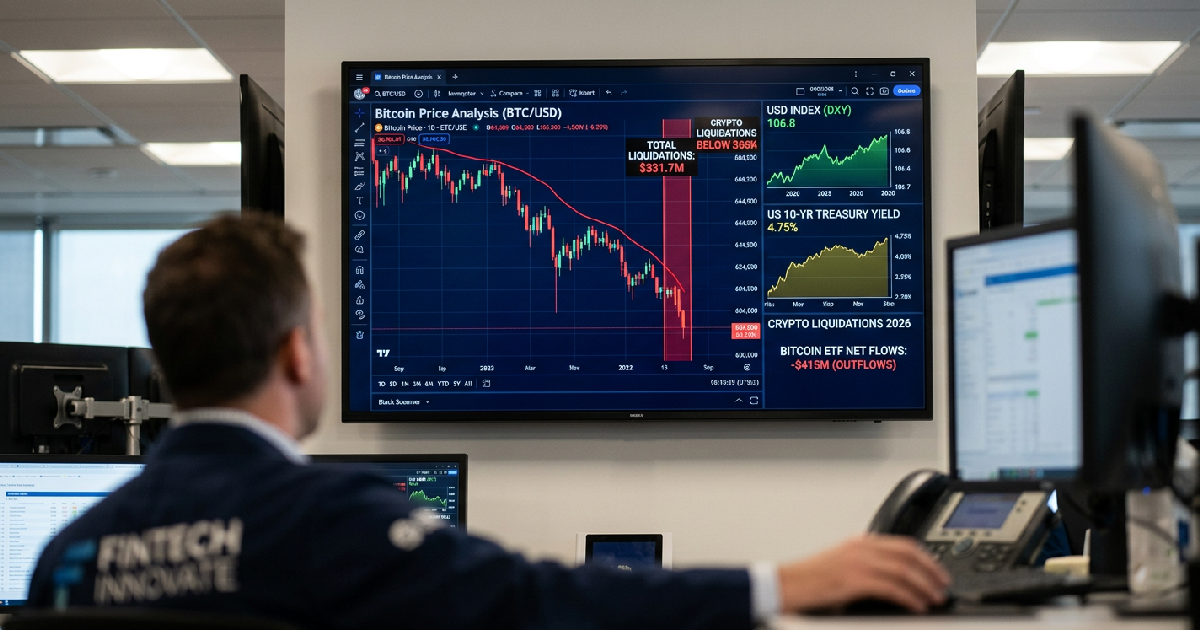

Bitcoin price action tumbled below the $64,000 threshold on June 18, 2026, as the digital asset decoupled from a resilient tech sector and tested support levels near $60,000. This sharp pullback followed a failed attempt to reclaim the $67,200 mark earlier in the week, triggering $330 million in bullish liquidations.
While the Nasdaq 100 stayed within 1% of its all-time high, Bitcoin fell to an intraday low of roughly $62,000 before stabilizing, highlighting a significant shift in the correlation between crypto and equities.
The selloff has been fueled by a strengthening U.S. dollar and elevated Treasury yields, which typically sap demand for non-yielding assets. Furthermore, a hawkish Federal Reserve outlook has dampened risk appetite after the central bank held benchmark rates at 3.50% to 3.75%.
Bitcoin price performance diverges from Nasdaq resilience
Updated projections from the Fed signaling fewer rate cuts and the possibility of further hikes have added to the selling pressure. This shift in the macroeconomic environment has caught many leveraged traders off guard.
Market data as of June 18, 2026, shows that institutional enthusiasm may be cooling in the short term. U.S.-listed spot Bitcoin ETFs recorded $2.30 billion in outflows throughout May, the largest monthly exit of the year. This institutional retreat, combined with the Fed’s stance, has pushed Bitcoin’s Fear & Greed Index into a score of 22, indicating “Extreme Fear” among market participants.
The recent divergence between Bitcoin and the Nasdaq 100 has left analysts questioning the asset’s “digital gold” narrative. While tech stocks remain buoyed by intense interest in artificial intelligence (AI) equities, Bitcoin has struggled to maintain its momentum.
The failure to hold the $67,200 level on Monday accelerated the decline, leading to a 7% drop from that local peak. This trend is particularly evident as resistance levels at key technical markers continue to reject upward price movement.
Specific on-chain metrics suggest that current holders are feeling the pinch. The 30-day simple moving average of the Realized Profit/Loss Ratio has fallen to 0.53, meaning realized losses are currently outweighing gains. Additionally, Bitcoin is trading at a 15% discount to its True Market Mean of $77,200. This suggests that while long-term value may exist, the immediate trend remains firmly bearish for short-term speculators.
Impact of liquidations on market volatility
The volatility has taken a heavy toll on leveraged positions across the crypto market. Over the 24-hour period ending June 18, total crypto liquidations reached $492.05 million, affecting more than 116,649 individual traders. Long positions accounted for the vast majority of these losses, with $368.90 million wiped out.
The single largest liquidation event occurred on Binance, where a BTCUSDT trade worth $4.96 million was forcibly closed.
This cascade of liquidations often creates a feedback loop, where falling prices trigger more sales, which in turn drives the price lower. As Bitcoin tests the $60,000 support level, the concentration of put options near this strike indicates that traders are hedging against further downside. This coincides with a period where com/bitcoin-exchange-supply-eight-year-lows-analysis/”>exchange supply remains at multi-year lows, though this scarcity has yet to translate into a price floor.
Federal Reserve shifts and interest rate uncertainty
The Federal Reserve’s recent policy updates have been a primary driver of the bearish sentiment. Fed Chair Kevin Warsh recently signaled a departure from explicit forward guidance, creating a cloud of uncertainty across global financial markets. By maintaining interest rates between 3.50% and 3.75% and projecting a tighter policy path, the central bank has discouraged the kind of liquidity expansion that historically favors Bitcoin.
This hawkish stance has also bolstered the U.S. dollar index, which climbed to its highest level in over a year. A stronger dollar typically presents a headwind for Bitcoin, which is priced globally in USD. For investors, the choice between zero-yield digital assets and Treasury yields that remain elevated has become increasingly weighted toward the latter.
Approaching the June 26 options expiry
Looking ahead, the June 26 Bitcoin options expiry is expected to be a major volatility catalyst. There is currently $10.5 billion in open interest tied to this date. While call options are clustered heavily around the $80,000 strike, the “max pain” level—the price at which the most options would expire worthless—sits at $74,000.
Despite the current bearish trend, some technical analysts remain optimistic about the long-term structure. Technical analyst Frank Fetter noted that the $60,000 to $70,000 range is essentially building a “meaningful Bitcoin floor” after months of consolidation. However, with the Short-Term Holder MVRV metric sitting at 0.90, the market remains below the critical break-even level of 1.0, suggesting further turbulence before any sustained recovery begins.