
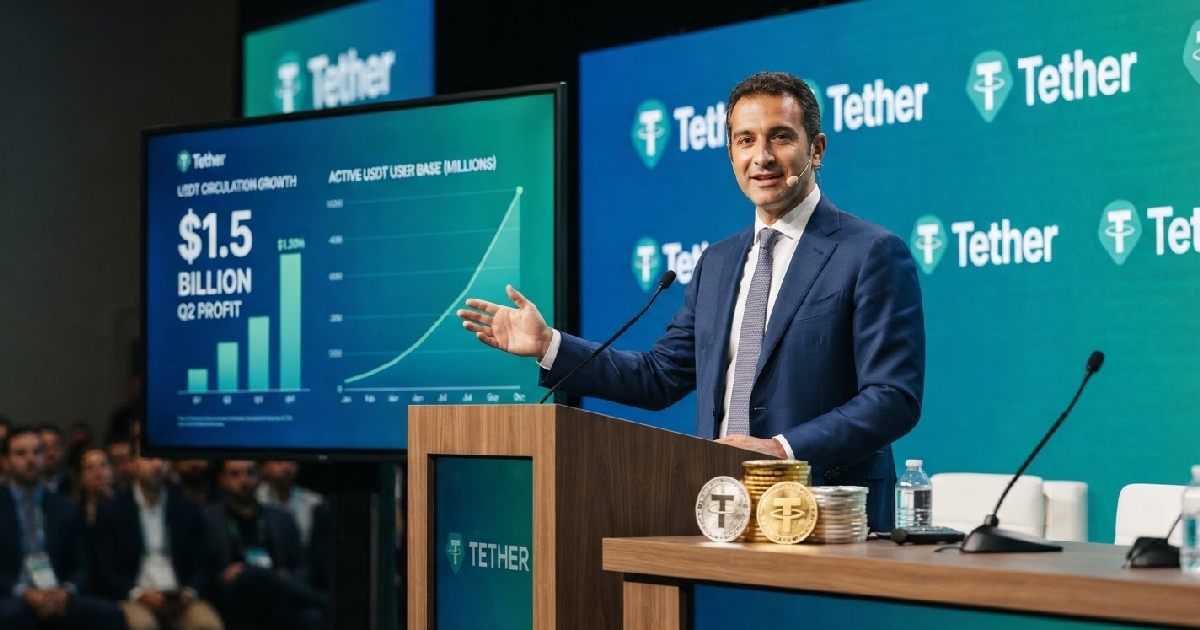

Tether, the world’s largest stablecoin issuer, has reported a net operating profit of $1.5 billion for the second quarter of 2026. This strong financial performance coincided with its USDT stablecoin achieving a new all-time high user base exceeding 650 million. While the wider stablecoin market contracted, USDT’s circulation actually increased, though its reserve buffer saw a significant reduction during the same period.
The latest attestation, released on July 31, 2026, offers a look into a quarter marked by both robust operational gains and underlying market shifts. Tether CEO Paolo Ardoino lauded the company’s “great second quarter,” underscoring its evolving position in a dynamic global financial landscape.
Tether’s record profits defy market headwinds
Tether’s $1.5 billion net operating profit in Q2 2026 represents a 44% increase from its $1.04 billion profit in the first quarter. This substantial growth came primarily from strategic investments in U.S. Treasury bonds and repurchase agreements (repos), generating significant returns for the issuer.
The company also expanded its physical gold holdings, increasing them by 10.5% from 132.2 tons to over 146 tons during the quarter. Paolo Ardoino emphasized the firm’s resilience, noting its performance came “despite highly volatile global markets.”
Treasury bonds and gold drive earnings
The majority of Tether’s Q2 earnings were derived from its substantial portfolio of U.S. Treasury bonds, which surpassed $97.6 billion, setting a new all-time high. This makes Tether one of the largest private holders of U.S. Treasuries globally.
Alongside its Treasury holdings, the stablecoin issuer’s gold reserves also grew, with approximately 14 additional tons purchased. These holdings were valued at roughly $18.84 billion at the close of Q2, highlighting Tether’s ongoing diversification strategy.
Expanding user base, shrinking reserves
Despite its financial successes, Tether’s reserve surplus, or excess reserves, saw a considerable decline. This buffer, designed to handle unforeseen USDT redemption emergencies, fell by approximately 50%, from a record $8.23 billion at the end of Q1 2026 to $4.11 billion by June 30, 2026.
This reduction occurred even as the global USDT user base expanded significantly, adding over 30 million new users in Q2 to reach a total of more than 650 million. Tether attributes much of this user growth to emerging markets, where USDT serves as a tool for financial inclusion amidst geopolitical uncertainty.
USDT adoption grows in emerging markets
Tether has actively pursued expansion into developing economies, particularly across Latin America and Africa. The company’s focus on these regions reflects a strategic shift towards markets with high demand for stable, dollar-pegged assets.
This growth is driven by factors such as local currency inflation and the need for reliable remittance channels. Tether CEO Paolo Ardoino views this as the company delivering “financial inclusion” to populations often underserved by traditional banking systems.
Latin America and Africa spearhead growth
In Latin America, countries like Venezuela and Bolivia have demonstrated massive USDT usage. Venezuela’s USDT trading on Binance hit $1.4 billion, a figure now rivaling the country’s oil exports and central bank foreign exchange reserves.
Similarly, the rising demand for U.S. dollars in Bolivia has made USDT a de facto alternative, with the government reportedly considering making it legal tender. Banks and businesses there are already actively using it.
Kenya tokenization plans face hurdles
Earlier this week, Tether announced a plan to collaborate with Kenya on a study concerning the tokenization of local stocks and enabling settlements in USDT. This ambitious project aims to expand crypto adoption across the continent.
However, the success of such initiatives will likely depend heavily on overcoming regulatory friction and bureaucratic hurdles endemic to many African nations. Should the Kenyan model prove viable, Tether indicates it may expand the tokenization plan to other African countries.
USDT circulation grows amid market contraction
Despite a challenging period for the wider stablecoin sector, Tether’s flagship stablecoin, USDT, experienced growth in its circulation during Q2 2026. USDT circulation reached approximately $184.6 billion as of June 30, 2026, marking an increase of about $446 million from the previous quarter.
This expansion occurred even as the overall stablecoin market declined from $322 billion to $307.6 billion during Q2, representing a 5% drop. Tether’s market share exceeded 60% of the global stablecoin market, showcasing its increasing dominance.
Broader stablecoin sector contracts
The general downturn in the overall stablecoin sector highlights the persistent volatility impacting digital asset markets, but USDT bucked the trend. Data from Artemis shows that Tether’s main competitors, including USDC and DAI, also experienced declines in their market caps during the same period.
Even Tether’s US-focused stablecoin, USAT, designed to build on USDT’s dominance, has seen slow growth, maintaining a market cap of only $185 million. This indicates that new stablecoin offerings face significant headwinds in the current environment.
Reserve strategy and asset composition under scrutiny
The decline in Tether’s excess reserves, combined with the company’s asset composition, has drawn scrutiny regarding its reserve strategy. Total assets stood at $187.75 billion against total liabilities of $183.64 billion, with issued digital tokens accounting for $183.62 billion.
Tether holds approximately $5.80 billion in Bitcoin and $18.84 billion in physical gold, both of which experienced significant price fluctuations in Q2. Gold fell 15%, and Bitcoin declined from $68,200 to $58,000. Paolo Ardoino conceded that these reserve assets faced “significant market volatility” but maintained that USDT remained fully backed and its peg near $0.9986 held throughout the period.
Looking ahead for the largest stablecoin
Tether continues its commitment to a full “Big Four” audit, confirming that work remains ongoing. This move aims to enhance transparency and address perennial concerns surrounding its financial disclosures.
Part of Tether’s Q2 profits has also been reinvested into various strategic projects aimed at supporting its broader ecosystem. These initiatives underscore the company’s ambition to diversify its offerings and solidify its position beyond simply issuing stablecoins.
The company’s Q2 report paints a picture of a profitable entity aggressively expanding its user base and circulation, particularly in regions where financial stability is most needed.
But the decrease in its reserve buffer suggests that balancing rapid growth with the imperative of maintaining robust, transparent reserves will remain a critical challenge for Tether in the coming quarters. Its ability to navigate these dual pressures will largely determine its long-term stability and leadership in the stablecoin sector.