
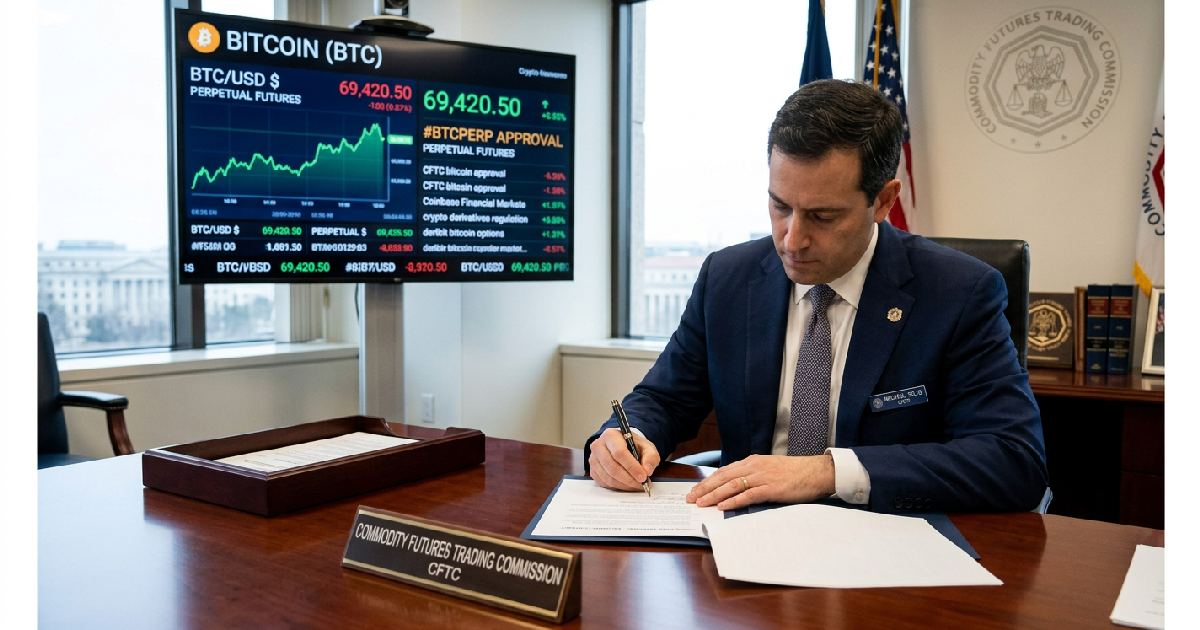

The U.S. Commodity Futures Trading Commission (CFTC) officially opened the domestic market for Bitcoin perpetual futures on Friday, May 29, 2026, approving the first U.S.-listed perpetual contract and granting major regulatory relief to Coinbase Financial Markets, Inc. CFTC Chair Michael Selig confirmed the agency greenlit KalshiEX, LLC to list its BTCPERP contract while simultaneously issuing no-action relief that allows Coinbase to route American institutional traders into global derivatives liquidity pools, including offshore venues like Deribit FZE.
This coordinated regulatory shift marks a pivot toward onshoring a massive segment of the digital asset economy that previously existed almost entirely outside of U.S. borders. Perpetual futures, which lack a set expiration date and allow traders to hold positions indefinitely, have long been the primary vehicle for crypto speculation and hedging worldwide. Until this morning’s announcement, U.S. traders were largely restricted from these instruments due to strict domestic oversight of leveraged products that often permit leverage as high as 50-to-1.
The significance of this move is reflected in the scale of the unblocked market. Coinbase CEO Brian Armstrong noted on X (formerly Twitter) that U.S. users had previously been shut out of approximately 80% of global crypto markets. By bringing these products into a regulated framework, the CFTC aims to provide a compliant alternative to the offshore platforms in Asia, Europe, and the Bahamas that have traditionally dominated the space. This shift may also impact how investors manage risk at key resistance levels during volatile price cycles.
Kalshi and Coinbase lead the push for bitcoin perpetual futures
The approval of KalshiEX, LLC’s BTCPERP contract provides the first local venue for these trades. The contract references the spot price of Bitcoin through the CF Benchmarks Bitcoin Real Time Index and operates as a fully regulated product on Kalshi’s designated contract market. Unlike traditional futures that require rolling over contracts, this product trades continuously, 24 hours a day, seven days a week, allowing for constant price exposure.
Parallel to the Kalshi approval, the CFTC’s Market Participants Division cleared a path for Coinbase Financial Markets to act as a bridge to global liquidity. Under the new no-action position, Coinbase can offer digital commodity derivatives listed on its affiliated board, Deribit FZE. Institutional clients can begin onboarding with Coinbase Financial Markets immediately to access these global markets. This development follows a period where investor sentiment has shifted toward institutional-grade custody and regulated trading environments.
Initially, the platform will offer options on Deribit, with perpetual futures contracts and various collateral types scheduled to follow. This structure allows American firms to access Deribit—which currently holds over $31 billion in Bitcoin options open interest—through a single U.S.-regulated futures commission merchant (FCM). This move is designed to improve capital allocation and risk management for American businesses while recapturing liquidity from foreign venues.
Establishing a regulatory blueprint for 24/7 markets
The CFTC did not limit its actions to product approvals. The agency’s Division of Clearing and Risk, along with the Market Oversight and Market Participants divisions, issued a staff advisory addressing the nuances of 24/7 trading, clearing, and settlement. Commission staff noted they have observed growing interest in round-the-clock trading, driven by the infrastructure of digital assets increasingly enabled by blockchain technology.
The advisory outlines the potential risks associated with 24/7 operations and explains how current CFTC regulations address these challenges. The goal is to promote market robustness while ensuring responsible innovation and fair competition among participants. This clarity is expected to assist traders as market participants monitor broader economic volatility and leverage domestic clearing mechanisms to mitigate regional systemic risks.
Under the leadership of Michael Selig and the broader policy goals of President Donald Trump, the CFTC is moving toward a “structured onshoring” model to stabilize a market that saw perpetual futures trading volume reach $61.7 trillion in 2025. This volume represented a 29% increase from 2024. CFTC Chair Michael Selig framed the move as a major step toward cementing America as the crypto capital of the world, ensuring liquid segments of the market exist within a regulated framework.
Future oversight and the path to global dominance
The CFTC has made it clear that while the door is open, it is not a free-for-all. A separate policy statement mandates a case-by-case regulatory review for any new perpetual products that reference assets beyond those currently approved. This vetting process is designed to ensure that novel products uphold customer protections and maintain market integrity by preventing the listing of high-risk or illiquid tokens.
The long-term objective of these actions is to return liquidity to the United States that has spent years flowing to foreign venues. By allowing a “true” Bitcoin perpetual contract to trade on a U.S. exchange, the agency is providing a regulated, compliant solution for domestic clients. This domestication is expected to limit excessive volatility and prevent risk from being pushed offshore to unregulated venues, ultimately creating a safer environment for U.S. traders.
As the SEC prepares its own rules for tokenization and firms like Paxos gain ground in blockchain-based equity clearing, the CFTC’s move on perpetuals represents a critical piece of the puzzle. It signals that the most active and liquid segment of the crypto market is being firmly integrated into the American financial system, offering 24/7 accessibility within a framework governed by federal oversight.